

Xi Pushes Four-Point Framework for Middle East Security Amid US-Iran War
Wednesday, 02 September 2026
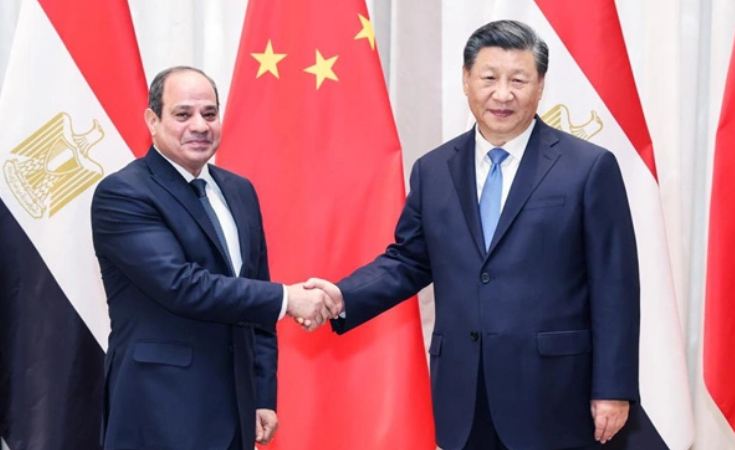
Chinese President calls on Middle Eastern nations to oppose external interference, strengthen regional ownership, development and dialogue, and ensure the people of the region remain masters of their own affairs.
Web Desk
CAIRO: Chinese President Xi Jinping on Wednesday proposed a four-point framework for building a new security architecture in the Middle East, calling on Middle Eastern nations to oppose external interference and consider reshaping the region’s security order while stressing that the people of the region should remain masters of their own affairs.
Xi made the proposal during talks with Egyptian President Abdel Fattah El-Sisi in Cairo. Xi is on his first trip to the Middle East in four years comes as US partners in the region reassess their strategic relationships after months of conflict that have disrupted trade, shaken economies and raised questions about Washington's long-term role.
Beijing has stepped up its diplomatic engagement on Middle East security and conflict-resolution efforts. Egypt, itself a major US defence partner that receives around $1.3 billion annually in military aid from Washington, has been steadily increasing economic and military cooperation with China in recent years.
The Chinese president said the region needed a security framework driven primarily by its own countries rather than imposed from outside. China, he added, supported Middle Eastern states in developing good-neighbourly and friendly relations and strengthening dialogue on peace and security.
Xi outlined four priorities for advancing common security in the region: unleashing internal drivers, adopting an integrated approach, strengthening the foundation of security through development, and enhancing international coordination.
He said the first priority was to enable countries in the region to take greater responsibility for their own security and future. “People in the Middle East should remain masters of their own affairs,” Xi said, stressing that external interference should be rejected.
China supports regional countries in strengthening dialogue on peace and security, exploring the establishment of a new security architecture and taking their future into their own hands, he said.
The proposal comes against the backdrop of continuing conflicts and tensions across the Middle East, where multiple crises have become increasingly interconnected. Xi argued that these challenges could not be addressed in isolation and required an integrated approach. He called for comprehensive solutions to regional disputes, noting that the various hotspots in the Middle East were closely linked.
Palestinian Issue Remains at the core
Xi emphasised that the Palestinian issue remained at the core of the Middle East question and should never be overlooked or marginalised. The Chinese president has repeatedly called for a political settlement of the Palestinian issue and support for the establishment of an independent Palestinian state. His latest remarks again placed the Palestinian question within the broader framework of regional security rather than treating it as a separate issue. He said sustainable peace in the Middle East could not be achieved without addressing the underlying political and security problems confronting the region.
Development directly Linked to Regional Security
Xi also linked regional security directly to economic and social development, arguing that lasting peace and stability ultimately depended on development. “The foundation for common security should be strengthened through development,” he said.
China, he added, was prepared to work with Middle Eastern countries to promote development cooperation, align the interests of regional states and gradually build mutual trust. Beijing also stands ready to cooperate with countries in the region to safeguard the security of international shipping lanes, Xi said.
The reference to maritime security carries particular significance as instability in the Middle East has repeatedly disrupted international shipping and commercial routes. Xi suggested that protecting maritime trade should form part of broader regional cooperation rather than being addressed solely through military measures.
He also stressed the need to eliminate the root causes of conflict, arguing that security could not be sustained without addressing the political, economic and developmental factors that contribute to instability.
Xi Call for Stronger UN Role
The Chinese president’s fourth priority focused on strengthening international coordination. Xi said the UN Charter and international law should remain the fundamental principles governing international affairs in the Middle East.
He called on the international community, particularly external powers, to abandon double standards, respect the sovereignty and territorial integrity of regional states and contribute to regional peace and stability. Xi also urged stronger support for the United Nations to play an effective role in addressing Middle East affairs.
His emphasis on the UN and international law reflected Beijing’s broader position that regional security arrangements should be based on multilateralism and respect for national sovereignty.
Rather than relying exclusively on military alliances or external security guarantees, Xi’s proposal envisages a regional system in which Middle Eastern countries themselves play the central role, supported by international institutions and development partnerships.
Sisi Welcomed China’s Approach
President Sisi welcomed China’s approach, saying Egypt highly appreciated Beijing’s consistent, objective and impartial position on the Middle East. He reaffirmed Egypt’s commitment to reducing tensions, resolving conflicts and differences through political means and advancing regional security and development.
Egypt, he said, was ready to continue strengthening coordination with China to ease tensions, safeguard regional stability and explore the creation of a regional security architecture.
Economic ties expand
Home to the Suez Canal and a population of more than 110 million, Egypt is an important market for China, importing some $10 billion of Chinese goods in the first half of this year alone.
Chinese investment has risen rapidly since Sisi visited China and signed a strategic partnership agreement in 2014, with Chinese companies pouring billions into container ports, green hydrogen projects and facilities to make iron pipes, car tyres, and satellites.
Egypt's cabinet says the Suez Canal Economic Zone has attracted about $4 billion in Chinese investment. On Wednesday, Egyptian authorities announced plans to expand a Chinese-developed industrial area in the zone, while ZC Rubber Group signed a preliminary agreement to study a $500 million tyre making complex.
Egypt occupies a strategically important position in Middle East diplomacy, given its longstanding role in efforts to mediate regional conflicts and its geographical position linking the Mediterranean, Red Sea and wider Middle Eastern region.
The convergence between the Chinese and Egyptian positions reflects a shared emphasis on political dialogue, regional ownership and development as components of long-term security.
Xi’s proposal goes beyond calls for temporary ceasefires or crisis management by presenting a broader vision for restructuring the way regional security is approached. Its four elements — regional ownership, comprehensive solutions, development and international coordination — are closely interconnected.
Under the approach outlined by Xi, regional countries would take the lead in resolving disputes and establishing mechanisms for collective security, while outside powers would be expected to respect sovereignty and support rather than dictate regional arrangements.
Development would serve as the economic foundation for stability, while international organisations, particularly the United Nations, would provide a broader legal and diplomatic framework.
Xi’s comments also underline China’s growing diplomatic engagement in the Middle East. Beijing has increasingly presented itself as a supporter of dialogue and negotiated settlements, while seeking to expand economic and political cooperation with countries across the region.
The Chinese president’s emphasis on safeguarding international shipping lanes also highlights the link between regional security and the global economy. Disruptions to major maritime routes in the Middle East can have consequences far beyond the region, affecting energy supplies, trade flows and global markets.
Xi, Sisi Stress Diplomacy over Confrontation
Both Xi and Sisi stressed the importance of diplomacy over confrontation. For Beijing, the establishment of a sustainable regional security architecture would require Middle Eastern countries to strengthen trust, expand dialogue and address disputes through political and diplomatic channels. For Cairo, closer coordination with China could help support de-escalation efforts and strengthen international backing for regional stability.
Xi’s proposal therefore places the Middle East’s security challenges within a wider framework encompassing political settlements, economic development, maritime security, international law and multilateral cooperation.
Chinese President said the ultimate objective should be a Middle East in which security is sustainable, development is shared and regional countries have greater control over their own future. Sisi’s endorsement of exploring a regional security architecture suggested that Egypt sees scope for greater cooperation with Beijing on these objectives.

More from World News


Comments
No comments yet. Be the first to comment!
Leave a Comment