

Under Falling Roofs, Childhood Is Buried
Tuesday, 20 October 2026
Asem Mustafa Awan
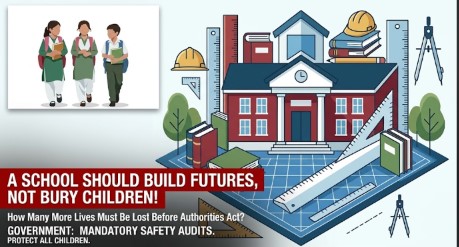
Children leave home for school carrying books, unfinished homework and dreams they are too young to explain. Parents send them away believing that, for a few hours, their children are safe. In Peshawar, that ordinary act of faith ended beneath a collapsing school roof. In Kahna, Lahore, an earlier roof collapse at a tuition centre had already buried children beneath rubble. Two tragedies now confront Pakistan with one unbearable question. Why are children dying in places meant to prepare them for life?
The Peshawar tragedy at Al-Khair Education Centre on October 15 claimed dozens of young lives and injured many others. Parents rushed to the scene, desperate for news, while rescuers searched through debris. A school day became a nightmare from which some families would never awaken. Their children had gone to learn, not to become names on a casualty list.
In Kahna, 14 children died when a tuition-centre roof collapsed on June 30. An inquiry report later found that the centre was operating in a residential house and was not registered with a government authority. The circumstances differ, and each incident requires its own investigation. But together they expose a disturbing gap between the promise of education and the protection children receive.
A classroom should be among the safest places in society. A child’s safety cannot depend on whether a building looks respectable, its owner offers reassurances or a family can afford expensive schooling. The state has a basic duty to ensure educational facilities meet safety standards. Charitable trusts, private organisations and individual teachers may help provide education, but public authorities cannot outsource their responsibility to protect the children inside those buildings.
Who approved these premises for educational use? Were structural inspections conducted? Were defects reported and ignored? Did anyone check whether the buildings could safely accommodate the children inside? If regulations existed, why did they fail to prevent disaster? These questions demand independent answers, not a quick announcement followed by silence.
Arresting an owner may be necessary, but it cannot end accountability. Investigators must establish the roles of owners, contractors, building-control authorities and officials responsible for inspections. If evidence shows negligence or violations, legal action must follow. Responsibility should neither be assigned without proof nor allowed to disappear behind a chain of offices. An inquiry is not meant merely to produce a file; it must establish what happened and help prevent a repeat.
Every school, academy and tuition centre, whether public, private or trust-run, needs a documented safety audit. Inspections must examine roofs, foundations, walls, electrical installations, emergency exits and unauthorised extensions. Buildings found unsafe must stop operating while children are inside. Authorities should publish inspection results, set repair deadlines and verify that corrective work is complete. A certificate must reflect a genuine assessment, not a formality. Inspectors themselves must answer for failures in their duties.
Poverty must never mean accepting danger as the price of affordable education. Families unable to pay high fees often have fewer choices and less influence. Their children deserve the same protection as those in well-funded institutions. If a building cannot safely accommodate students, low fees, charitable intentions or a shortage of classrooms cannot justify keeping it open. A child’s life is not a discount society can offer to the poor.
The Kahna tragedy also raises a separate question about dependence on private tuition. Why must children spend hours at school and then attend another class to understand their lessons? Tuition can help when a student needs extra support. But when it becomes automatic, parents can reasonably ask whether classroom teaching is delivering the understanding it should.
Teachers need manageable class sizes, training, resources and time to give individual attention. Their responsibility is not merely to finish a syllabus but to help children learn. Parents also have a role in encouraging reading, revision and independent study at home. Children need rest, recreation and family time, not an endless procession of classrooms. Yet this debate must remain separate from the cause of any collapse. Private tuition did not, by itself, bring down a roof; building safety and possible negligence must be established through evidence.
The immediate task is protection. Authorities should inspect premises before approving educational use, monitor them regularly and close unsafe facilities without fear or favour. Parents need a simple way to check registration and safety status. Complaints must trigger action, not disappear into paperwork. Every tragedy should lead to reforms that can be measured, monitored and enforced.
Public grief will fade from headlines. The empty places in classrooms and the pain inside bereaved homes will not. No condolence speech can explain to a parent why a child who left home with a schoolbag never returned. No inquiry report can restore a life. Its value lies in establishing the truth and changing what happens next.
A government must not merely investigate the deaths of children. It must build a system that protects them while they are alive. No child should have to gamble with life to receive an education. Until every school and tuition centre offers a genuinely safe place to learn, the nation’s promises to its children remain written on fragile ground, beneath roofs that may not hold.


More from Opinion News



Comments
No comments yet. Be the first to comment!
Leave a Comment