

Iraq PM declares October 1 ‘Sovereignty Day’ after US-led coalition exit
Wednesday, 30 September 2026
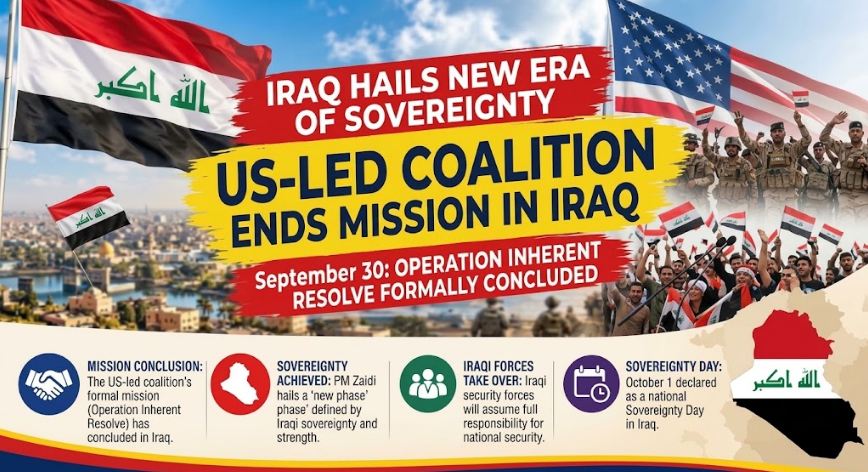
US and UK troops complete withdrawal as 12-year Operation Inherent Resolve mission ends, with Washington pledging continued training and intelligence support
Web Desk
BAGHDAD: In a historic moment, the US-led coalition, which was deployed in Iraq more than a decade ago to fight militants, formally concluded its Operation Inherent Resolve mission in Iraq on Wednesday, a move widely celebrated by the country’s leaders.
The Iraqi government declared October 1 as Sovereignty Day, describing the end of the British and American military mission as the beginning of a new chapter for the country.
The conclusion of Operation Inherent Resolve came after more than a decade of coalition operations against the Islamic State (IS), which seized large parts of Iraq and Syria in 2014. The Iraqi government has designated October 1 as Sovereignty Day to mark what it describes as a major step in completing the country’s transition towards full control over its security and territory.
At a ceremony marking the end of the mission, Iraqi Prime Minister Ali al-Zaidi on Wednesday said Iraq was entering a new phase defined by sovereignty, stronger institutions, capable security forces, unified decision-making and balanced relations with friendly countries.
The withdrawal follows a 2024 agreement between Baghdad and Washington to wind down the coalition’s military mission in Iraq. The final US forces and equipment left Erbil Air Base on Wednesday, bringing the coalition’s Iraq mission to a formal close.
The US military said the departure represented a planned transition towards a bilateral defence relationship between Washington and Baghdad. The Combined Joint Task Force responsible for Operation Inherent Resolve will continue operating from Jordan, while US forces and coalition partners remain engaged in the fight against IS in Syria.
The Pentagon has also said the United States will continue providing targeted training and intelligence support to Iraqi security partners, meaning the end of the coalition’s military mission does not amount to the complete end of US-Iraq security cooperation.
The exit of the remaining UK military personnel, around 100, from Irbil, in the northern Kurdistan region, was co-ordinated over recent weeks with US forces, who also departed on Wednesday.
The British government similarly said the coalition’s military mission had concluded and that UK personnel involved in the operation had departed Iraq. The British Ministry of Defence said Iraqi Security Forces and the Kurdish Peshmerga had achieved the enduring territorial defeat of IS in Iraq and were positioned to assume primary responsibility for the country’s security.
IS defeated but threat remains
The international coalition was established in 2014 after IS captured extensive territory in Iraq and Syria and carried out mass killings, persecution and other abuses. Iraqi forces, Kurdish Peshmerga fighters and other local groups played major roles alongside coalition members in reversing the group’s territorial gains.
Iraq declared the military defeat of IS in 2017, while the group lost its last significant territorial strongholds in Syria in 2019. Coalition forces nevertheless remained in Iraq to help Iraqi security forces prevent an IS resurgence and to provide training, advice and intelligence support.
The end of the coalition mission now shifts primary responsibility for Iraq’s security to the country’s own forces. US officials have stressed that the transition is based on the progress made by Iraqi security institutions while maintaining a framework for continued bilateral cooperation.
Focus turns to armed factions
For Baghdad, the withdrawal also carries a domestic political dimension. The government has sought to strengthen the state’s control over weapons and address the presence of armed groups operating outside direct state authority.
Iraqi leaders have linked the post-coalition phase to efforts to ensure that weapons are held under state control. The government had initially set September 30 as a deadline for armed factions to disarm, but the timetable was subsequently withdrawn as negotiations continued over how weapons held by powerful groups should be regulated.
The issue remains politically sensitive because several influential factions have resisted giving up their weapons. Their demands have included not only the departure of foreign forces but also an end to what they describe as American political and economic influence in Iraq.
Zaidi has nevertheless pledged to strengthen the state’s monopoly over arms and place national security decisions under government authority. The Iraqi leadership has described this as an important component of its broader effort to consolidate sovereignty.
In a statement ahead of Sovereignty Day, Iraq’s executive, legislative and judicial leaders said the occasion would underline the importance of strengthening state institutions and addressing weapons held outside government control.
End of a 23-year US military presence
The withdrawal also marks the end of a US military presence in Iraq that dates back to the 2003 invasion that toppled Saddam Hussein. The United States had previously deployed forces to the region during the 1991 Gulf War following Iraq’s invasion of Kuwait. American and British forces returned on a much larger scale in 2003, when US President George W Bush launched Operation Iraqi Freedom.
The invasion was justified by the US administration in part on claims that Saddam Hussein’s government possessed weapons of mass destruction. No such stockpiles were subsequently found, and the invasion was followed by years of insurgency, sectarian violence and political instability.
US forces formally withdrew from Iraq in 2011, but returned in 2014 after the rapid expansion of IS prompted Baghdad to seek international military assistance. The new coalition mission became known as Operation Inherent Resolve.
The latest withdrawal therefore closes another chapter in a US military involvement that has spanned more than two decades, although Washington’s security relationship with Baghdad will continue in a different form.
The departure has been welcomed by Iraq’s political leadership and by groups that have long demanded the removal of foreign troops. At the same time, concerns remain over the country’s ability to contain IS remnants and manage powerful armed factions without a permanent foreign military presence.
For the Iraqi government, however, the immediate message is one of state authority and sovereignty. With the coalition’s military mission formally concluded, Baghdad is seeking to place greater responsibility for the country’s security, political decisions and control of weapons firmly in Iraqi hands.



More from World News





Comments
No comments yet. Be the first to comment!
Leave a Comment