

New York Puts Brakes on Classroom AI to Protect Children’s Thinking Skills
Thursday, 03 September 2026
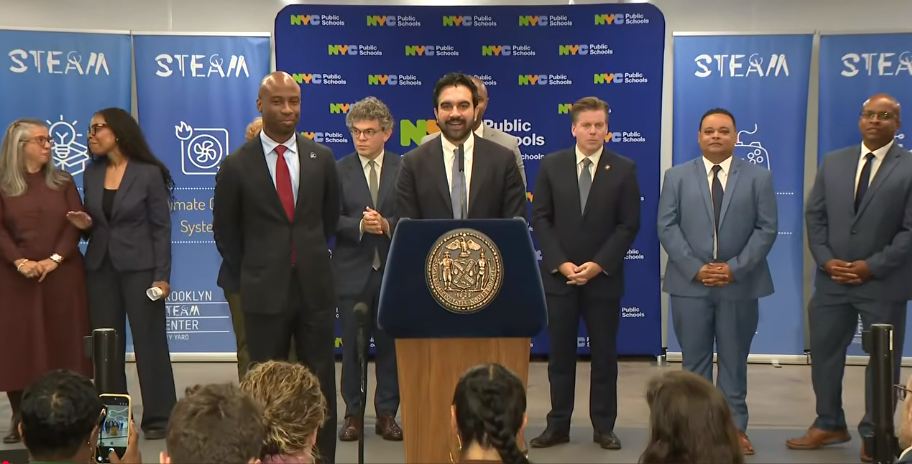
One-year moratorium bars student-facing generative AI from 2-K through eighth grade as city seeks to balance technological progress with human learning
Web Desk
NEW YORK: In an era when artificial intelligence can write essays, solve complex problems and provide instant answers, New York City has taken an urgent and unusual step, asking its youngest students to put the technology aside and learn to think through problems for themselves.
Mayor Zohran Mamdani and Schools Chancellor Kamar H. Samuels have introduced a one-year moratorium on student-facing generative artificial intelligence in public schools from 2-K through eighth grade, affecting nearly 600,000 students, or about two-thirds of the city’s public-school enrollment. The policy will apply during the 2026-27 school year and represents one of the strongest efforts yet by a major US school system to limit children’s direct reliance on generative AI.
The decision is significant not because New York City is rejecting artificial intelligence as a technology, but because it is drawing a line between learning about AI and allowing children to depend on it while they are still developing basic intellectual and social skills.
Mamdani has argued that children need teachers, classmates and the experience of struggling with difficult questions rather than routinely turning to a machine for an immediate solution. The policy therefore seeks to preserve the traditional foundations of education: discussion, creativity, curiosity, writing, reading, problem-solving and direct relationships between students and teachers.
The move comes as schools around the world grapple with a difficult question: how can children benefit from one of the most powerful technologies ever developed without allowing it to replace the mental effort through which learning actually takes place?
Artificial intelligence has enormous potential in education. It can provide personalised assistance, help teachers prepare lessons, support students with disabilities and offer new ways of explaining difficult subjects. UNESCO has also recognised AI’s potential while warning that education systems need safeguards, age-appropriate approaches and attention to the possible effects of over-reliance on the technology. UNESCO specifically identifies critical thinking and creativity as skills that remain central in the AI era.
That tension is at the heart of New York’s new policy
Under the moratorium, student-facing generative AI will not be permitted for students from 2-K through eighth grade. Companion chatbots will be prohibited across all grades, while nearly 40 existing educational technology tools with AI functions are being reviewed, disabled or removed where their AI features cannot be separated from the rest of the programme. The city is not, however, imposing an absolute rejection of AI in education.
High school students will receive formal AI literacy instruction twice a year, with two 45-minute modules designed to teach them what AI is, how it works, and how bias, misinformation, ethical questions and over-reliance can affect users. A limited number of high school classrooms will also participate in carefully supervised pilots involving five approved educational AI programmes.
The distinction is deliberate. Rather than allowing students to use AI simply as an answer-producing machine, the city says the older students will be taught to question AI-generated information and understand its limitations.
The five pilot programmes will be used under direct teacher supervision and within defined limits. English classes may use Quill for close reading and evidence-based analysis, while Edia will be used in mathematics to encourage students to explain their reasoning. Brisk Teaching, Playlab and Intel AI-Ready Schools will also be tested in controlled classroom settings. The city says the pilots are designed to keep students as the primary thinkers rather than allowing technology to take over the learning process.
Teachers will still be permitted to use AI for lesson planning and certain operational tasks, provided the tools meet city safety requirements. Exceptions will also be available for assistive technology used by students with disabilities, multilingual learners and students taking career-readiness programmes where AI skills are directly relevant.
The city is simultaneously reducing students’ exposure to screens. Children in 2-K through second grade will not have one-to-one screen time under the new policy. For students in grades three through five, the city recommends no more than 30 minutes of daily one-to-one screen time, while students in grades six through eight will have a recommended limit of 45 minutes.
New York’s decision is particularly notable because of the size and influence of its school system. With roughly 600,000 students affected by the AI moratorium, the policy could become an important test case for other education systems considering how much technology is appropriate in classrooms.
It is not the first major US school district to move against student use of generative AI. Los Angeles Unified, the nation’s second-largest public school district, has also imposed a moratorium on student use of generative AI on district-issued devices for the current school year. Los Angeles officials say the restriction is part of a broader reconsideration of technology and screen use in schools.
That means New York cannot accurately be described as the first major US city to restrict AI in schools. What makes its initiative distinctive is its breadth and its combination of restrictions with a structured plan for teaching older students about AI. City officials call it the nation’s broadest student-facing AI moratorium.
The debate reflects a wider concern about what happens when technology becomes so efficient that students no longer need to perform the intellectual work themselves.
If a student uses AI to generate an essay, solve every difficult mathematical problem or immediately provide an explanation, the answer may be correct, but the learning process can become weaker. Education is not simply about obtaining information. It is also about developing the ability to ask questions, make mistakes, evaluate evidence, construct arguments and reach conclusions independently.
UNESCO has similarly warned that excessive reliance on generative AI could have long-term implications for human capacities such as critical thinking and creativity. Its guidance calls for human-centred and age-appropriate approaches to AI in education rather than treating technological adoption as an end in itself.
That does not mean children should be kept permanently away from AI. Quite the opposite: New York’s policy acknowledges that young people will enter a world in which artificial intelligence is increasingly embedded in workplaces, universities and everyday life.
The city therefore intends to use high school as a bridge between traditional learning and technological fluency. Students will be taught both the possibilities and the risks of AI, including bias, misinformation and the dangers of relying on a machine to do the thinking for them.
Mamdani has compared the approach to other forms of age-appropriate learning. His argument is that just because a technology is powerful does not mean a young child is automatically ready to use it independently. The objective, he says, is to give children time to develop foundational skills before introducing them to increasingly sophisticated tools.
The policy also reflects a growing recognition that technological progress in education needs to be judged by educational outcomes rather than by the amount of technology placed in classrooms.
For years, the arrival of new digital tools was frequently presented as an unquestionable improvement to education. Artificial intelligence has intensified that expectation because of its extraordinary ability to generate text, analyse information, explain concepts and respond to individual prompts.
But the central question is no longer whether AI can perform useful educational tasks. It is whether every useful task should be handed to AI, particularly when students are still developing the ability to perform those tasks themselves.
New York’s one-year pause is therefore less a rejection of AI than an attempt to establish boundaries before dependence becomes normalised. During the 2026-27 school year, a Technology in Schools Coalition involving students, teachers, parents, experts, advocates and other stakeholders will examine the effects of the moratorium and the limited high school pilots before making recommendations for future policy.
The experiment will be closely watched beyond New York. If students maintain or improve learning outcomes while spending less time with AI, the policy could strengthen arguments for greater restrictions on younger learners. If carefully controlled AI use demonstrates clear educational benefits, it could provide evidence for a more targeted model of technology adoption.
Either way, New York has placed an important principle at the centre of the debate: technology should serve education, not replace the human process through which children learn to think.
Artificial intelligence may be among the most valuable technologies of the modern era, but its greatest contribution to education may ultimately depend on knowing when not to use it. For New York, the immediate priority is to ensure that before children learn how to command powerful machines, they first learn how to reason, question, create and think for themselves.

More from Technology News



Comments
No comments yet. Be the first to comment!
Leave a Comment