

Tears, Tributes and One Final Goal: Messi Bids Emotional Farewell to Argentina
Wednesday, 07 October 2026
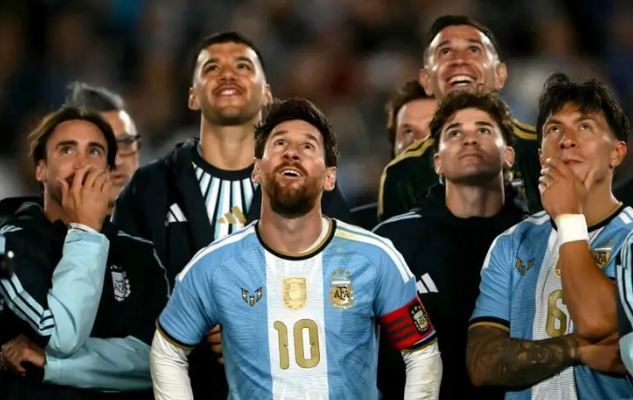
After 21 years, 208 appearances and 126 goals, Argentina’s greatest football hero walks away from international football with a World Cup, two Copa América titles and the love of generations
Sports Desk
BUENOS AIRES: The legendary footballer Lionel Messi’s extraordinary journey in the blue and white of Argentina ended not with silence, but with tears, thunderous applause and one final goal, as a packed Monumental Stadium said goodbye to the man who transformed the nation’s football dreams into reality.
At 39, Messi walked onto the field for the last time as an Argentina international surrounded by his three sons, while his wife Antonela Roccuzzo and mother Celia Cuccittini watched proudly from the stands. Before thousands inside the stadium and millions watching around the world, the player who had carried Argentina through triumph, heartbreak and years of expectation finally brought the curtain down on a 21-year international career.
It was an ending worthy of a career that has few parallels in football history. The farewell, billed in Argentina as Messi’s “Last Tango”, was filled with emotion from the moment his team bus approached the stadium. Thousands of supporters lined the streets hoping for one final glimpse of their hero, while footage showed Messi wiping away tears as he absorbed the extraordinary reception.
Inside the Monumental, an enormous Argentina shirt bearing his famous No. 10 was placed on the pitch. Instead of his name, it carried a simple word: “Gracias”.
The message said what millions of Argentines were feeling.
Thank you.
Thank you for the goals, the trophies, the impossible dribbles, the painful defeats and, above all, for finally delivering the World Cup that an entire country had waited decades to see.
Messi’s international career began in August 2005, long before the modern social-media era, and stretched across generations of Argentine supporters. Children who watched him make his debut grew up watching him become captain, record-breaker and eventually world champion. For Argentina, he became more than a footballer. He became a symbol of perseverance.
For years, Messi carried the burden of comparison with Diego Maradona and the expectations of a football-mad nation. His early years with the national team were marked by disappointment, including painful defeats in major finals. Yet he continued returning, continued trying and continued wearing the shirt that he regarded as the greatest honour of his career. That persistence eventually changed everything.
Messi led Argentina to Copa América glory in 2021, ending a long wait for a major senior international trophy. Three years later, Argentina successfully defended the continental title, with Messi again at the heart of the team. But his defining achievement came in Qatar in 2022.
At the World Cup, Messi captained Argentina to the title, ending the country’s 36-year wait for football’s biggest prize. He had reached the World Cup final in 2014 and endured the disappointment of losing on that stage, but in Qatar he finally lifted the trophy.
The victory cemented his place alongside the greatest figures in Argentine football and gave him the one achievement that had eluded him for much of his career.
By the time he retired, Messi had represented Argentina at six World Cups, reached three finals and won one. Argentina also finished runners-up at the 2014 and 2026 World Cups and won the Copa América in 2021 and 2024. His individual numbers were equally extraordinary.
Messi finished his international career as Argentina’s record appearance holder with 208 caps and its leading scorer with 126 goals. He also accumulated 69 assists for the national team, while winning the Ballon d’Or eight times during his career. But statistics only tell part of the story.
The emotional connection between Messi and Argentina was visible throughout his farewell. Before kick-off, he became visibly emotional during the national anthem, while head coach Lionel Scaloni also struggled to contain his feelings. Messi’s sons Thiago, Mateo and Ciro joined him on the field, creating one of the most personal moments of the night. His father, Jorge, who died two months earlier, was also on Messi’s mind.
After the game, Messi spoke openly about what Argentina meant to him and admitted that leaving the national team would hurt deeply.
He told supporters that he would have wanted to continue playing for Argentina for the rest of his life because representing the country was the most beautiful thing that could happen to him. Yet he said he knew the time had come.
His decision followed Argentina’s defeat to Spain in the 2026 World Cup final in New Jersey, a match in which Messi left the field in tears after Argentina lost 1-0.
Reflecting on that campaign, Messi said he had given everything and believed younger players deserved their opportunity. His retirement therefore marked not simply the end of an era for Argentina, but the passing of a torch to a new generation. The tributes began even before his final match.
The University of Buenos Aires awarded Messi an honorary doctorate, recognising his extraordinary contribution and influence. Adidas also changed its social-media profile image to mirror the “No. 10 Gracias” tribute displayed at the stadium.
Former Barcelona team-mate Ronaldinho, who shared the field with Messi during the early years of his legendary club career, paid tribute to him as a player who had brought joy to millions and written his name into the history of Argentina and the world.
Another former team-mate, Brazilian superstar Neymar, expressed gratitude for the way Messi had made him love football even more.
“It’s not just Argentina that thanks you, the world thanks you for everything you did for football,” Neymar said in his tribute.
The respect extended beyond Argentina’s borders and even beyond Messi’s former team-mates.
Benin’s players, who faced Argentina in Messi’s farewell match, embraced him and sought photographs with him after the final whistle, underlining the extraordinary status he has achieved across the football world. For Argentine supporters, however, the occasion was deeply personal.
Thousands travelled to Buenos Aires to witness Messi’s final appearance. Inside the stadium, chants of his name repeatedly filled the air.
One supporter pleaded simply: “Messi, please don’t go.”
Another message described him as an eternal source of gratitude for his football and praised him as an example for children and adults to pursue their dreams while remaining grounded.
Another fan said it was difficult to imagine another footballer receiving such a farewell, describing Messi as “one of one”.
Outside the Argentina Football Association headquarters, supporters unfurled a huge Argentine flag carrying Messi’s image alongside the words “The joy of my life”. The final match itself almost seemed secondary to the farewell.
Argentina faced Benin in a friendly in front of around 85,000 spectators at the Monumental. The stadium paused in the 10th minute, a tribute to Messi’s iconic shirt number, as supporters gave him a prolonged standing ovation.
For much of the first half, Argentina appeared determined to create opportunities for their captain. Messi came close to scoring several times, while Benin also threatened. The breakthrough finally came in the second half.
Veteran defender Nicolás Otamendi turned in a corner delivered by Messi to give Argentina the lead. Nico Paz then doubled the advantage with a curling effort. And then came the moment everyone inside the stadium had been waiting for. In the 71st minute, Messi stepped up to take a penalty. He converted it into the top corner.
Argentina’s players immediately surrounded their captain, celebrating one final international goal with the man who had given them so many unforgettable moments. It was Messi’s 126th goal for Argentina and his final one in the blue and white.
He completed the night with a goal and two assists as Argentina won 3-0, bringing his international career to a fitting close.
At the final whistle, Messi stood before the supporters as a drone display illuminated the sky with his image and messages of gratitude. The emotion returned.
Messi raised his arms towards the crowd as the Monumental continued singing his name. Benin players approached to embrace him. His team-mates gathered around him. His family watched from the stands.
After 21 years, the story had reached its final chapter. Yet Messi’s football journey is not necessarily over.
He remains under contract with Inter Miami until the end of the 2028 season, meaning supporters may still have opportunities to watch him play at club level. But Argentina will never be the same without its No. 10.
For generations, the national team had Maradona. Then came Messi, a small boy who left Rosario, grew into one of football’s greatest players and eventually returned to give his country the trophy it had dreamed of for decades.
His final statistics will remain in record books: 208 appearances, 126 goals, 69 assists, six World Cups, three World Cup finals, two Copa América titles and one unforgettable World Cup triumph. But his greatest legacy may be less measurable.
He taught a generation that failure does not have to be the end of a dream. He endured criticism, lost finals, walked away and returned. He carried the expectations of an entire country and ultimately fulfilled the dream that once seemed beyond his reach.
As the lights faded at the Monumental and the final images of Messi appeared above the stadium, Argentina said goodbye not simply to its captain, but to an era.
The tears were real. The gratitude was overwhelming. And the final goal was almost symbolic: Messi left international football exactly as he had spent much of his career, with the ball at his feet, the crowd on its feet and his name forever written into Argentina’s football history.


More from Sports News




Comments
No comments yet. Be the first to comment!
Leave a Comment