

Waziristan’s Chilgoza at Risk as Union Urges End to Premature Harvesting
Friday, 18 September 2026
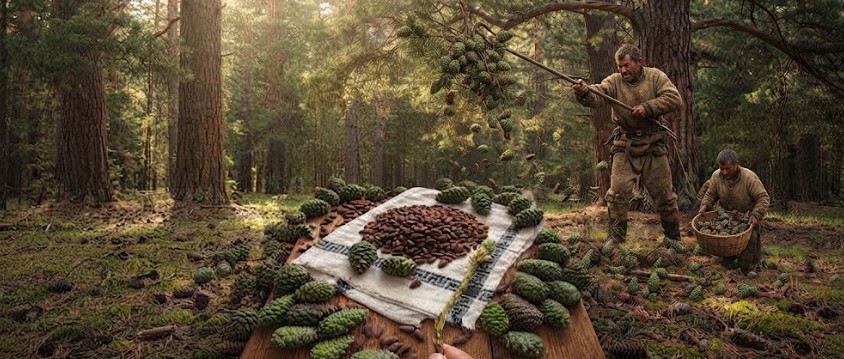
Union warns hammer-breaking of immature cones could damage quality, depress prices and threaten livelihoods; locals urge government to modernise harvesting, provide training and strengthen value chains in long-neglected South Waziristan
Hamid Khan Wazir
WANA: The Chilgoza harvest is far more than a seasonal economic activity for the people of South Waziristan. For thousands of families across the mountainous region, the prized pine nut is a vital source of income, supporting forest owners, seasonal labourers, collectors, transporters, processors, traders and many others connected with the local economy. But the future value of this precious natural resource is facing a serious challenge.
The Chilgoza Union Wana has appealed to forest owners, workers, collectors, traders and residents of South Waziristan to immediately discourage the premature harvesting of Chilgoza cones, particularly the practice of breaking immature green cones with hammers or other crude methods to extract the nuts before they have naturally matured.
The union warned that short-term attempts to obtain nuts early could ultimately damage the quality, reputation and market value of Waziristan’s Chilgoza, while also undermining the livelihoods of communities that depend on the crop.
It urged all those associated with the sector to allow cones sufficient time to mature naturally and called for collective action to protect the quality of Chilgoza from the forest to the final market. It urged forest owners and workers not to sacrifice the long-term quality and reputation of Waziristan’s Chilgoza for short-term financial returns.
Premature harvesting threatens quality and income
According to the union, immature nuts do not develop their full colour, taste, weight and texture. When prematurely harvested produce reaches the market, it may be perceived by buyers and traders as inferior, potentially resulting in lower prices and weaker demand.
The consequences can extend well beyond individual forest owners. A decline in the quality and reputation of Chilgoza can affect the entire value chain, including seasonal workers, transporters, local traders, processors and communities whose incomes depend on the annual harvest.
The union therefore stressed that protecting the quality of the crop is not merely a matter for individual collectors but a collective responsibility of the entire Chilgoza-producing community.
“Chilgoza is a precious natural product and preserving its quality is our collective responsibility,” the union said in its appeal, urging all stakeholders to discourage the use of hammers and other old methods for extracting nuts from immature cones.
Waziristan’s precious natural and economic asset
Chilgoza, scientifically known as Pinus gerardiana, is a high-value non-timber forest product native to the northwestern Himalayas and the Suleman Mountain Range of Pakistan and Afghanistan.
The tree generally grows in dry, cold mountainous areas at elevations of approximately 2,000 to 3,350 metres above sea level.
South Waziristan is among Pakistan’s important Chilgoza-producing regions. According to the Food and Agriculture Organization (FAO), Chilgoza forests in South Waziristan and adjoining former Frontier Region areas cover approximately 95,647 hectares. Major forest areas include Shawal, Tare Jawara, Shawange, Badar, Pheerghar, Anghur Adda, Birmal, Razghe, Shakai and Sholam.
These forests represent an extraordinary natural asset for a region that has long faced economic and development challenges. They provide an opportunity not only for household income but also for sustainable rural employment, local enterprise and export growth.
For communities in Waziristan, therefore, protecting Chilgoza means protecting both the forest and an important economic lifeline.
From a traditional crop to a potential economic powerhouse
Pakistan’s pine nuts have increasingly attracted attention in domestic and international markets because of their rich flavour, nutritional value and natural cultivation.
Growing international demand has created significant opportunities for Chilgoza-producing areas. Pakistan is reported to be among the world’s major pine-nut producers, while China has emerged as a particularly important destination for Pakistani exports.
According to data from the General Administration of Customs of the People’s Republic of China (GACC), Pakistan’s pine-nut exports to China increased substantially between 2023 and 2025.
Export volumes rose from approximately 579.8 tonnes in 2023 to 1,147 tonnes in 2025, while export earnings increased from about $8.2 million in 2023 to $18.8 million in 2024, before easing slightly to approximately $17.9 million in 2025.
Traders have also revealed that a large majority of Pakistan’s pine-nut exports are destined for China, where Pakistani Chilgoza is valued for characteristics including its relatively thin shell, texture and flavour.
The figures demonstrate the potential of Chilgoza as an export-oriented sector. But for Waziristan to benefit fully from this opportunity, the sector requires far greater attention, investment, technical support and modernisation.
Government support urgently needed in Waziristan
The locals said that the sector should no longer be treated merely as a traditional seasonal activity. They called upon the federal and provincial governments to develop a comprehensive programme for the modernisation of Chilgoza harvesting and processing in South Waziristan, with particular attention to training, safety, forest conservation, value addition and market access.
They stressed that communities should be provided with modern harvesting equipment and technical training so that collectors can remove mature cones without damaging trees, branches or themselves.
Modern harvesting kits can include equipment such as cone pruners, safety belts, helmets, gloves, protective boots, climbing equipment and specialised cone-picking tools.
Such equipment can reduce damage to trees and branches while also making harvesting safer for workers. Proper training can further improve harvesting practices, reduce wastage and help ensure that only mature and high-quality produce enters the market.
For a region like South Waziristan, investment in the Chilgoza sector could have an impact far beyond the forests themselves.
A game-changing opportunity for South Waziristan
The government, the union said, should view Chilgoza as a potential game-changing economic sector for South Waziristan and Pakistan as a whole.
A properly developed Chilgoza value chain could create employment opportunities, strengthen rural incomes, encourage local processing and packaging, improve export earnings and provide communities with a stronger economic incentive to protect their forests.
Rather than allowing the region’s valuable natural resources to leave the area as a largely raw commodity, greater emphasis could be placed on local processing, grading, packaging, branding and value addition.
Better roads, storage facilities, market information, technical assistance and direct access to domestic and international buyers could further strengthen the sector.
The union also called for stronger institutional support to help local communities overcome longstanding difficulties related to transportation, marketing, technical knowledge and unreliable markets.
Traditional harvesting practices need to change
The quality issue is closely connected with the way Chilgoza is harvested.
In the past, crude harvesting practices have included stripping trees of entire branches and, in more damaging cases, cutting down trees to collect cones.
Such practices can injure trees, make natural regeneration more difficult and threaten the long-term productivity of Chilgoza forests.
Modern harvesting techniques provide an opportunity to change this pattern. With appropriate tools and training, mature cones can be detached more carefully, reducing damage to trees while improving worker safety.
Chilgoza supports an entire local economy
The importance of the crop extends throughout the local economy. The Chilgoza value chain includes forest owners, seasonal collectors, labourers, transporters, processors, middlemen and traders. Major markets for Chilgoza include Bannu, Dera Ismail Khan, Peshawar, Rawalpindi and Lahore, from where the product moves to national and international markets.
A value-chain study of pine nuts in South Waziristan has identified Chilgoza as one of the principal sources of income in the area.
The FAO has likewise described Chilgoza as an important economic incentive for forest conservation, noting that the nuts contribute to incomes, livelihoods, food security and nutrition. This means that protecting the quality of Chilgoza can have a multiplier effect across the region.
Forest protection and economic development must go together
The challenge facing Waziristan’s Chilgoza forests is not limited to harvesting practices. Climate variability, changing rainfall patterns, forest degradation, overexploitation, inadequate market access and limited value-addition facilities are among the broader pressures facing the sector.
Research has also highlighted difficulties involving transportation, market access, production and unequal distribution of value along the supply chain. For this reason, the future of Chilgoza requires an approach that combines forest conservation with economic development.
International recognition for Pakistan’s Chilgoza conservation efforts
Pakistan’s efforts to restore and conserve Chilgoza forests have also received international recognition.
The country’s “Reversing Deforestation and Degradation in High Conservation Value Chilgoza Pine Forests” project has received the UN Decade on Ecosystem Restoration World Restoration Flagship Award.
The initiative involves Pakistan’s Ministry of Climate Change, provincial forest departments and the FAO and reflects the growing international recognition of the ecological and economic importance of Chilgoza forests.
For South Waziristan, this recognition presents an opportunity to build stronger programmes on the ground and ensure that local communities become central beneficiaries of conservation and development efforts.
With responsible harvesting by local communities and meaningful investment and technical support from the government, Waziristan’s Chilgoza sector could move from a traditional seasonal livelihood to a modern, sustainable and internationally competitive economic sector.
Better harvesting, better quality, better markets and better livelihoods can give Waziristan’s Chilgoza a stronger future, benefiting both the people of the region and Pakistan’s wider economy.

More from Pakistan News




Comments
No comments yet. Be the first to comment!
Leave a Comment