

Tarar Accuses Bilawal of ‘Double Standards’, Sanaullah Warns 27th Amendment Remarks Could Invite Disqualification
Tuesday, 17 November 2026
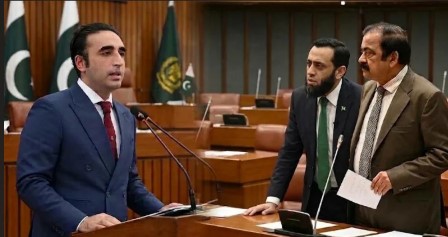
Information minister defends debate on new provinces, says PPP cannot distance itself from system; PM’s adviser questions Bilawal’s claim that constitutional amendment was passed under pressure
Staff Report
ISLAMABAD: Federal Information Minister Attaullah Tarar and Adviser to the Prime Minister on Political Affairs Rana Sanaullah on Tuesday strongly criticised Pakistan Peoples Party (PPP) Chairman Bilawal Bhutto-Zardari over his remarks about the country's political system and the passage of the 27th Constitutional Amendment, accusing him of political contradictions and warning that his statements could have serious consequences.
While Tarar accused Bilawal of adopting double standards by benefiting from government privileges while criticising the system, Sanaullah questioned his remarks about the amendment's passage under pressure, saying they could potentially expose him to disqualification.
The government leaders' responses came after Bilawal called for a "political reset", declaring that the country's system had not collapsed on its own but had been deliberately dismantled. He also criticised the passage of the 27th Amendment, saying it had been imposed without political consensus and that the judiciary had consequently lost the confidence of significant sections of society.
Tarar calls out PPP's 'double standards'
Responding to Bilawal's criticism, Information Minister Attaullah Tarar said it was contradictory for the PPP to enjoy the privileges of being part of the ruling coalition while simultaneously portraying itself as an opposition party. "It is a contradiction in principle to benefit from government privileges and then to act as the opposition, to secure protocol and ministries and also to take the high moral ground; these are all double standards," Tarar said.
He maintained that the debate on good governance, accountability and the creation of new provinces could not be suppressed, arguing that these were legitimate democratic and constitutional issues that deserved discussion both inside and outside parliament. The minister said people wanted better governance, improved public services and an accountable government, adding that political parties should work together to address these demands rather than turn the debate into a controversy.
Referring to proposals for creating new provinces, Tarar said no one should be prevented from discussing administrative reforms or seeking public opinion on the issue. "The people of the whole of Pakistan, including Sindh, will decide whether they want new provinces or not. The people's representatives come from the people, not the other way around," he said.
He argued that a referendum was a constitutional mechanism rather than a backdoor arrangement, maintaining that the people's will should ultimately be respected. Tarar said the creation of smaller administrative units should be viewed constructively, adding that past misuse of referendums could not be used as an excuse to deny people their democratic rights or access to better governance.
He also questioned the criticism directed at the National Accountability Bureau (NAB), pointing out that reforms to the accountability institution had been introduced by political forces that were now questioning its performance.
The information minister further reminded political parties that they had been part of the country's existing political system for decades and could not suddenly disassociate themselves from its shortcomings.
"We have been part of this system for decades, and now we cannot divorce ourselves from the weakness of this system," he said, adding that using politics to seek exemption from accountability was unacceptable to both the public and the law.
Sanaullah says Bilawal's remarks could invite disqualification
Separately, Rana Sanaullah questioned Bilawal's remarks about the passage of the 27th Constitutional Amendment, arguing that his suggestion that the legislation had been passed under pressure could potentially create legal and constitutional complications for him.
Speaking on Geo News' programme Capital Talk, Sanaullah said the PPP had been fully involved in the legislative process and had played an active role in securing the passage of both the 26th and 27th constitutional amendments.
"They were fully involved in the 26th Amendment. For the 27th Amendment, they ensured that every single vote was accounted for, and now they are calling it brute force," he said. Sanaullah questioned whether Bilawal's remarks about the amendment being passed through force implied that he had cast his own vote under someone else's influence or pressure.
"If a political party makes such a claim about itself, even a year later--- or on the very same day--- saying that it cast its vote to amend the Constitution under someone's influence or pressure, I believe that amounts to disqualification," he said.
The PM's adviser urged Bilawal to review his speech, arguing that his remarks could ultimately go against him if interpreted as an admission that he had not exercised his free will while voting on a constitutional amendment.
He added that a lawmaker's claim of having voted under pressure rather than independently raised serious questions about the validity of the legislative process and the consequences of such an assertion. Sanaullah also attributed Bilawal's criticism to the PPP's reservations about proposals to divide Sindh or create new provinces, saying the party had consistently opposed such moves.
"He is upset or apprehensive about the division of Sindh. This is indeed an issue for them, and we have known from the outset that the PPP has reservations whenever there is talk of creating new provinces or dividing Sindh," he said.
The PML-N leader expressed surprise over Bilawal's latest remarks, recalling that the PPP chairman had recently visited the Prime Minister's House, where both sides had held what he described as a mature discussion and agreed to move forward with mutual understanding. He said there had been no indication of resentment during the meeting, despite earlier tensions between the PPP and PML-N over the Gilgit-Baltistan and Azad Jammu and Kashmir elections.
Sanaullah also rejected the suggestion that Bilawal's remarks amounted to an admission of wrongdoing during the passage of the 27th Amendment, saying the PPP chairman had made a political statement out of anger and had not considered its possible implications.
"There was no admission. He made a political statement out of anger, although he did not realise its implications at the time," he said. He further highlighted the PPP's involvement in the judicial commission constituted to deliberate on the 27th Amendment, noting that Bilawal himself had been nominated as one of the government's representatives, alongside him.
According to Sanaullah, the government had been required to nominate two members to the commission. The PPP and PML-N initially submitted their respective nominees, but the arrangements were subsequently revised to include Bilawal and Sanaullah.
He said Bilawal had insisted on joining the commission, following which the PML-N withdrew its National Assembly nominee and nominated the PPP chairman from the government's side. The PPP, in turn, withdrew Farooq H. Naek's name from the Senate, while the PML-N nominated Sanaullah.
He added that both had attended a recent meeting of the judicial commission, further questioning Bilawal's criticism of the amendment and the process surrounding it.


More from Pakistan News

Comments
No comments yet. Be the first to comment!
Leave a Comment