

Pakistan Jumps 17 Places to 119th in UN E-Government Index 2026, Enters High Digital Governance Category
Friday, 20 November 2026
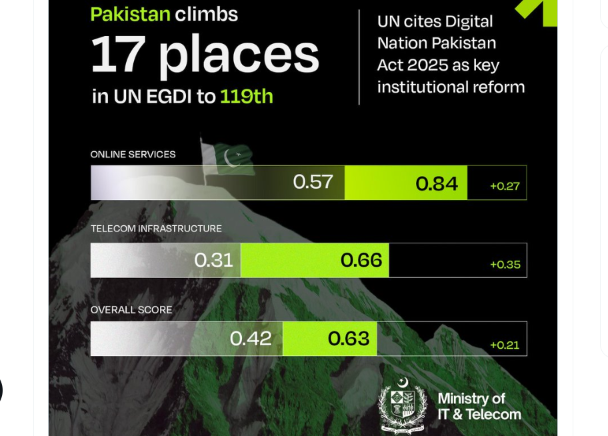
UN recognises Pakistan among Southern Asia’s largest gainers as its score surges 23pc to 0.6264; online services and telecom infrastructure improve, while Digital Nation Pakistan Act 2025 provides institutional framework for transformation
Hamid Khan Wazir
ISLAMABAD: Pakistan has advanced 17 places to secure the 119th position in the United Nations E-Government Development Index (EGDI) 2026, marking its second consecutive improvement in the global rankings and moving the country into the High EGDI category for the first time, as its digital governance score registered a 23 per cent increase over the 2024 assessment.
The latest United Nations E-Government Survey 2026 places Pakistan among the largest gainers in Southern Asia, recognising improvements in online public services, telecommunications infrastructure and digital participation. The country has climbed 31 positions over the past four years, rising from 150th in 2022 to 136th in 2024 and now 119th in 2026.
According to the survey, Pakistan’s overall EGDI score increased from 0.5096 in 2024 to 0.6264 in 2026, reflecting progress in the government's efforts to expand digital infrastructure, improve online service delivery and strengthen public access to government platforms.
The Ministry of Information Technology and Telecommunication said the latest improvement reflected sustained efforts across federal and provincial institutions to accelerate the country's digital transformation.
Federal Minister for Information Technology and Telecommunication Shaza Fatima Khawaja attributed the progress to coordinated institutional efforts and the government's Digital Nation vision under Prime Minister Shehbaz Sharif. "Pakistan has risen 31 places in two editions of the UN's benchmark for digital government," she said, adding that the progress reflected sustained work to bring public services online and expand connectivity across the country.
She said the improvement demonstrated that Pakistan's digital transformation initiatives were gaining international recognition, while emphasising the importance of continuing efforts to make technology-driven public services accessible to citizens.
Digital services and connectivity record significant gains
The UN assessment highlights improvements across several key components of Pakistan's digital governance performance, particularly online public services and telecommunications infrastructure.
Pakistan's Online Services Index (OSI) score increased by 20 per cent to 0.8422, giving the country the second-highest score in Southern Asia under this component. The improvement reflects the growing availability of government services through digital platforms, enabling citizens to access public information and services online.
The country's Telecommunications Infrastructure Index (TII) score also recorded substantial progress, increasing by 39 per cent to 0.6590. This followed a 52 per cent improvement in the previous edition, indicating continued expansion of the country's digital connectivity infrastructure.
Pakistan also achieved the highest score in Southern Asia for Online Participation and Engagement, recording 0.9655. This indicator measures the extent to which governments facilitate public participation through online consultations, feedback mechanisms and access to official information.
The regional comparison is based on the United Nations' Southern Asia subregional assessment. Pakistan's second-highest position in online services and highest score in online participation refer specifically to these respective indicators, rather than its overall e-government ranking in the region.
UN recognises Digital Nation Pakistan Act 2025
The United Nations survey has also highlighted the Digital Nation Pakistan Act, 2025, as an important institutional development accompanying the country's progress in digital governance.
The legislation established a formal framework for coordinating Pakistan's digital transformation and provided for the creation of the Pakistan Digital Authority (PDA), tasked with facilitating and coordinating digital initiatives across federal and provincial governments.
The authority is expected to help strengthen institutional coordination, promote integrated digital systems and support the development of shared digital infrastructure to improve the delivery of public services.
Chairperson of the Pakistan Digital Authority Dr Sohail Munir said the UN's recognition of the legislation highlighted the importance of establishing an institutional foundation for coordinated digital transformation.
He said the next phase would focus on developing shared digital public infrastructure, ensuring interoperability between government systems and making public services function more consistently for citizens across different provinces. Munir added that the National Digital Masterplan would provide a unified direction for these initiatives, while the latest international assessment offered fresh momentum for advancing the country's digital transformation agenda.
Digital literacy identified as next major priority
Despite the improvement in international rankings, the government faces the challenge of ensuring that the benefits of digitalisation reach all segments of society, particularly communities with limited internet access, digital resources and technological skills.
The next phase of the Digital Nation agenda will focus on expanding digital public services, strengthening telecommunications connectivity and improving digital skills and literacy across the country.
Greater digital literacy will be essential to enabling citizens to use online government platforms effectively, while improved connectivity and interoperable systems will be necessary to ensure that digital services remain accessible across urban and rural areas.
Published every two years by the United Nations Department of Economic and Social Affairs (UN DESA), the E-Government Survey assesses 193 UN member states through three principal dimensions: the Online Services Index, Telecommunications Infrastructure Index and Human Capital Index.
The assessment examines governments' capacity to use information and communication technologies to deliver public services, strengthen institutional efficiency and facilitate citizen participation. It also classifies countries into four broad EGDI categories, ranging from Low to Very High.
Pakistan's movement from the Middle EGDI category in 2022 to the High category in 2026 marks a significant change in its classification under the UN framework. However, sustaining this progress will depend on translating improvements in digital infrastructure and online government platforms into accessible, reliable and inclusive services for citizens nationwide.


More from Technology News




Comments
No comments yet. Be the first to comment!
Leave a Comment