

Petrol Drops by Re1, Diesel Rises by Rs2 Amid JI Hopes of Public Relief Through Talks with Govt
Friday, 20 November 2026
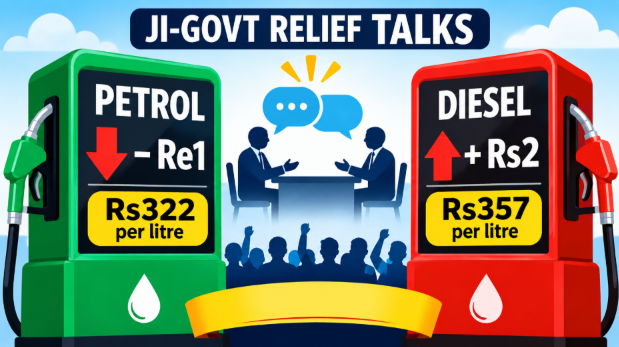
Technical-level negotiations conclude with draft relief proposals, including a proposed petroleum levy cut; PM Shehbaz and JI Emir Hafiz Naeem expected to decide final package on November 24 or 25.
Hamid Khan Wazir
ISLAMABAD: The federal government has reduced the price of petrol by Re1 per litre while increasing the rate of high-speed diesel (HSD) by Rs2, setting petrol at Rs 322 and diesel at Rs 357 per litre from Saturday, November 21, amid Jamaat-i-Islami’s (JI) claims of progress in negotiations with the government over much-needed relief for the public.
The latest revision, announced by the Oil and Gas Regulatory Authority (OGRA) on Friday, comes as the government faces mounting pressure to ease the financial burden on households struggling with high fuel prices and the rising cost of living.
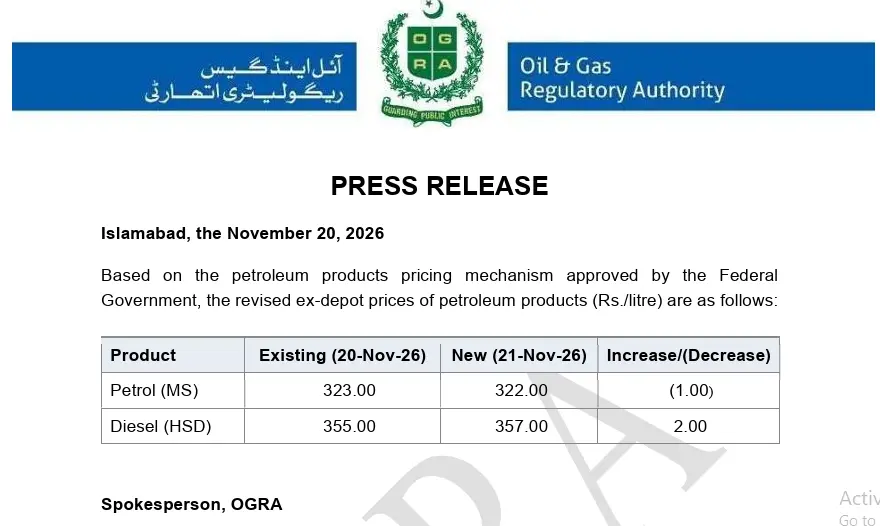
Under the revised petroleum prices, petrol will be available at Rs322 per litre, down from Rs323, while high-speed diesel will cost Rs357, up from Rs355 per litre. The new rates will take effect on November 21. The marginal reduction in petrol prices, accompanied by an increase in diesel rates, comes at a critical time as Jamaat-i-Islami says negotiations with the federal government have made progress towards securing further relief for the public.
JI Naib Emir Liaqat Baloch announced on Thursday that negotiations between the party and the government had been completed at the technical committee level, with both sides finalising draft proposals on public relief measures. Baloch, who heads JI's negotiating committee, said the government had also prepared a proposal for a further reduction in the petroleum levy, a move that could provide additional relief to consumers if approved.
He said the final relief package would be announced following a meeting between Prime Minister Shehbaz Sharif and JI Emir Hafiz Naeemur Rehman, expected to take place on November 24 or 25.
The upcoming meeting is expected to be crucial in determining whether the proposals agreed upon during technical-level discussions translate into concrete relief measures for the public. On Thursday, the government increased the price of petrol by Re1 to Rs323 per litre and kept the diesel rate unchanged at Rs355 per litre.
Globally, oil prices fell on Friday, and were set for a weekly decline on strong exports from the Middle East despite Houthi attacks on Saudi Arabia’s capital Riyadh and reports of tanker disruptions in the Strait of Hormuz. Brent crude futures were down 84 cents, or 0.9%, at $91.14 a barrel at 1310 GMT. US West Texas Intermediate futures for December were down $1.11, or 1.3%, at $82.10 a barrel, while the more active January contract CLc2 was down 58 cents, or 0.7%, at $81.86.
Brent is on track for a 5% decline for the week and the December WTI contract for a 7% weekly drop as expectations of a supply surplus grew because crude shipments through the Strait of Hormuz have returned to roughly pre-war levels. This would be the benchmarks’ third straight week of decline. Meanwhile, the government has maintained that it is taking steps to protect consumers from the impact of international market fluctuations and broader economic challenges.
Deputy Prime Minister and Foreign Minister Ishaq Dar had previously highlighted what he described as proactive government measures, including policy changes and structural reforms in petroleum pricing, to bring fuel prices down from their April 3 peak during the Iran–US conflict on 3 April 2026, reached Rs. 458 per litre for Petrol and Rs. 520 per litre for Diesel and provide relief through a fuel subsidy scheme.
In a separate move aimed at improving transparency in petroleum pricing, OGRA has begun publishing daily fuel prices on its official website. The initiative is intended to provide consumers with timely information and facilitate the quicker transmission of fluctuations in international oil prices to the domestic market.
The reduction is expected to provide some relief to daily commuters, public transport operators, farmers and businesses that rely heavily on petroleum products. However, the impact on consumers is likely to remain limited, as any meaningful reduction in transportation fares and commodity prices will depend on whether transport operators and businesses pass on the benefit of lower fuel costs to the public.
Fuel Relief Scheme Continues for Small Vehicle Owners
Meanwhile, the government had launched the Prime Minister's Fuel Relief Scheme nationwide on September 17 to ease the financial burden on lower-income segments following rising petroleum prices amid the evolving Middle East situation. The subsidy programme covers owners of motorcycles, rickshaws and vehicles with engine capacities of up to 800cc, targeting segments considered particularly vulnerable to increases in transportation and fuel expenses.
The initiative is aimed at providing targeted assistance to individuals who depend heavily on motorcycles and small vehicles for daily commuting and livelihoods. For Pakistani consumers, the latest consecutive reduction offers some respite, although the substantial tax component in domestic fuel prices and uncertainty surrounding international oil markets remain key factors shaping future petroleum price adjustments.
Government Introduces Daily Fuel Price Review
In a significant change to the petroleum pricing system, the government has shifted towards daily fuel price reviews in response to unpredictable movements in international oil prices. The petroleum levy remains a major source of federal revenue. The government has budgeted approximately Rs1.677 trillion in receipts from the levy during the current fiscal year against a revised estimate of Rs1.498tr for 2025-26.
OGRA has also started publishing daily petroleum price information on its official website to improve transparency and enable consumers to track changes in fuel costs. Previously, petroleum prices were generally revised on a fortnightly basis. Following the outbreak of the US-Iran conflict on February 28, the government initially moved to weekly adjustments before introducing the latest daily review mechanism amid continuing uncertainty in global energy markets. The revised approach is intended to ensure that changes in international oil prices are reflected more promptly in domestic petroleum rates.
Government Maintains Heavy Petroleum Taxes
Despite the latest reduction, petroleum products continue to carry substantial taxes and duties, adding to the financial burden on consumers. The government is currently collecting approximately Rs114 per litre in taxes and duties on petrol and Rs100 per litre on high-speed diesel.
Meanwhile, under an arrangement announced on November 2 for a period of 30 days, oil refineries will contribute towards the petroleum levy by absorbing a cumulative financial impact of Rs15 billion. According to the government, this arrangement has enabled a reduction of Rs14.71 per litre in the consumer price of petrol through adjustments involving refinery pricing and petroleum levy calculations.
Revised Pricing Formula to Pass on International Oil Changes
The federal cabinet approved changes to the petroleum pricing mechanism on October 30 to address volatility in international markets following the US-Iran conflict. Under the revised formula, the import price of petrol is determined using the actual import cost of the relevant Pakistan State Oil (PSO) cargo. Where the actual cost of a cargo is unavailable for daily price calculations, the premium, incidental expenses and customs duty applicable to the last available cargo are used instead.
For domestic refineries, the government has temporarily maintained the premium, incidental expenses and customs duty used in calculating ex-refinery petrol prices at their March 7, 2026, pre-war levels for 30 days. The difference between the import price and the resulting ex-refinery price is to be surrendered by refineries under the petroleum levy account, with the financial benefit passed on to consumers through corresponding reductions in petrol prices.
The government has also introduced a temporary adjustment mechanism to smooth fluctuations in petrol prices by incorporating the benefit arising from the premium differential at a rate of $2.950 per barrel per day.
Fuel Prices Fall From April's Record Highs
The latest reduction comes after petrol and diesel prices witnessed unprecedented increases following the outbreak of hostilities involving the United States, Israel and Iran on February 28. High-speed diesel had surged to a record Rs520.35 per litre on April 3 after rising from approximately Rs281 per litre before the conflict.
Petrol prices also reached an all-time high of Rs458.41 per litre on April 3, having climbed from around Rs266 during the first week of March. Although subsequent reductions have brought prices down considerably from their April peaks, fuel remains an expensive commodity for households and businesses.
Middle East Tensions Keep Global Oil Markets Under Pressure
International oil markets remain sensitive to developments in the Middle East, particularly uncertainty surrounding Iran, Washington and the security of regional energy supplies. The conflict that began on February 28 disrupted energy shipments after Tehran moved to close the Strait of Hormuz, a critical global shipping route that previously handled approximately one-fifth of the world's energy supplies. Tensions have intensified following the collapse of a fragile ceasefire between Tehran and Washington in June, raising concerns about renewed military confrontation and further disruptions to international oil shipments.
Fuel Costs Remain Critical for Households and Businesses
Petrol and high-speed diesel are among Pakistan's most important petroleum products, and their prices have a direct impact on transportation costs, inflation and the overall cost of living. Petrol is predominantly consumed by private vehicles, motorcycles, small cars and rickshaws, making price changes particularly significant for middle- and lower-middle-income households.
Diesel, meanwhile, plays a central role in the country's transport and logistics networks, agricultural machinery, power generation and large industrial generators. Any substantial change in its price can affect freight charges, food transportation and the cost of essential commodities. Petrol and high-speed diesel are also the country's major petroleum revenue-generating products, with monthly sales estimated at 700,000 to 800,000 tonnes each, compared with approximately 10,000 tonnes of monthly kerosene demand.
Fuel Relief Scheme for Motorcyclists and Small Vehicles
Separately, the government launched the Prime Minister's Fuel Relief Scheme nationwide on September 17 to reduce the impact of rising petroleum costs on financially vulnerable segments of society. The scheme covers owners of motorcycles, rickshaws and vehicles with engine capacities of up to 800cc.
The latest petroleum price reduction, alongside the revised pricing mechanism and targeted relief measures, forms part of the government's efforts to manage the economic consequences of international energy market volatility.



More from Business News



Comments
No comments yet. Be the first to comment!
Leave a Comment