

Soaring Power, Gas Prices, Tough Business Climate Top Pakistanis’ Concerns: Survey
Monday, 14 September 2026
National Citizen Survey exposes widening gap between public priorities and state spending as inflation, unemployment, corruption, debt and weak institutional trust dominate citizens’ concerns
Hamid Khan Wazir
ISLAMABAD: Pakistan’s citizens are increasingly burdened by soaring electricity and gas prices, rising living costs, unemployment and a difficult business environment, while growing concerns over corruption, national debt, education and weak public trust in state institutions point to a widening disconnect between public priorities and the state’s policy and spending choices, according to the National Citizen Survey 2026.
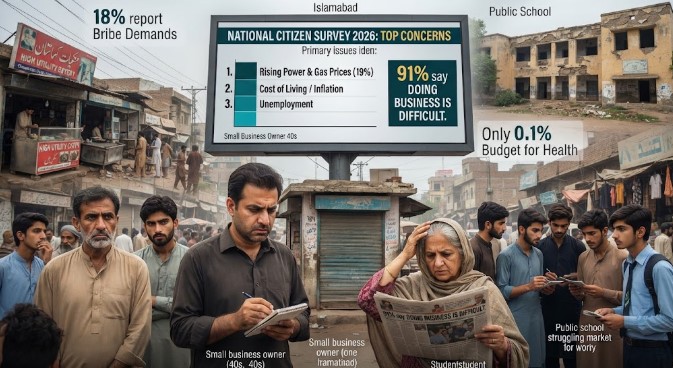
Pakistan’s first dedicated national citizen survey, conducted by the Institute for Public Opinion Research (IPOR), found that 19 percent of respondents identified rising electricity and gas prices as the country’s biggest problem, making it the single most pressing concern among citizens. The survey also revealed that 91 percent consider starting or running a business in Pakistan difficult, with taxation emerging as the biggest obstacle to business activity.
The findings were unveiled on September 14, 2026, at a Citizens’ Roundtable in Islamabad organised by PILDAT Consulting, where experts from academia, think tanks, the judiciary, legal fraternity and media reviewed the survey’s findings. PILDAT Consulting Executive Director Mamoon Bilal delivered the opening remarks, while IPOR Executive Director Tariq Junaid briefed participants on the methodology and major findings.
The National Citizen Survey 2026 was conducted by IPOR between August 23 and September 5, through face-to-face interviews with 5,155 voting-age citizens at their homes. The survey employed a four-stage stratified sampling methodology covering all four provinces, with representation from 60 percent rural and 40 percent urban populations, as well as major age, gender and income groups.
Rising costs top public concerns
The survey paints a stark picture of economic pressure on ordinary Pakistanis. Following electricity and gas prices, rising prices of everyday consumer goods emerged as another major concern, while unemployment ranked as the third most pressing problem facing the country.
The findings also highlighted a substantial mismatch between citizens’ priorities and the allocation of public resources. According to the report, health receives just 0.1 percent of the Rs18.771 trillion federal budget, while 42.9 percent is allocated to debt servicing.
The report noted that debt-servicing expenditure is greater than the combined spending on defence, health, education, pensions and subsidies, raising questions about the fiscal space available for sectors directly affecting citizens’ quality of life.
Business climate remains deeply challenging
The country’s business environment also emerged as a major source of public concern. An overwhelming 91 percent of respondents said starting or operating a business in Pakistan was difficult, while taxes were identified as the biggest barrier to business activity.
The findings suggest that citizens continue to face significant hurdles in generating livelihoods and expanding economic activity at a time when unemployment and inflation remain among the country’s leading concerns.
Direct encounters with corruption
The survey also examined citizens’ direct experiences with corruption. Eighteen percent of respondents said a government official had personally demanded a bribe from them during the previous year.
According to the researchers, the finding provides an important measure of citizens’ direct encounters with corruption rather than merely their perceptions of the problem.
Weak trust in public institutions
Public confidence in state institutions was similarly found to be weak. None of the institutions covered in the survey including Parliament, the Election Commission of Pakistan and the Federal Board of Revenue secured the complete confidence of a majority of respondents.
The Federal Investigation Agency (FIA) recorded the highest level of complete public confidence among the institutions surveyed, at 33 percent, followed by the National Accountability Bureau (NAB) at 23 percent.
Complete confidence in Parliament stood at 15 percent, while the corresponding figure for the Revenue Department was 13 percent.
Education system fails to meet modern economic needs
The country’s education system also came under significant public scrutiny, with 60 percent of citizens saying that the existing education system does not meet the requirements of a modern economy.
The finding highlights concerns over whether the education system is adequately preparing young people for employment, entrepreneurship and the skills demanded by a rapidly changing economy.
Debt and IMF programme fuel public concern
Pakistan’s mounting national debt remains another major source of anxiety. Sixty-six percent of respondents expressed serious concern over the country’s rising debt, including 49 percent who described the situation as “extremely concerning.”
Public sentiment toward the International Monetary Fund (IMF) programme was also largely negative. According to the survey, 68 percent of respondents believed the IMF programme was either harmful or provided no benefit to ordinary citizens.
Drugs and changing information landscape
The growing use of drugs was described as “extremely dangerous” by 79 percent of respondents, underscoring widespread concern over the social consequences of substance abuse.
The survey also examined public perceptions of reports about Pakistan produced by foreign-funded NGOs and think tanks. Forty-three percent of respondents said such reports were contrary to facts, exaggerated or driven by a foreign agenda, while 25 percent considered the reporting fact-based.
Meanwhile, the country’s information landscape appears to be undergoing a significant transformation. Forty-two percent of respondents said they now place greater trust in social media than television for news, although 56 percent believed the internet was contributing to a decline in social values.
Call for policies aligned with citizens’ priorities
Researchers said the consistency of the findings across Pakistan’s four provinces, urban and rural populations, income groups and age categories made the results difficult to ignore.
The survey, they said, points to a persistent disconnect between what citizens identify as their most urgent problems and how public resources are allocated.
Overall, the findings place economic hardship, rising prices, unemployment, taxation, corruption, education, healthcare, debt and governance among the key issues demanding policymakers’ attention.
The researchers emphasised the need for policymakers to take citizens’ priorities more effectively into account when designing public policy and allocating state resources, arguing that a stronger alignment between public expectations and government priorities is essential to addressing the country’s growing economic and governance challenges.
More from Pakistan News



Comments
No comments yet. Be the first to comment!
Leave a Comment