

PTI Warns Budget FY2026-27 Will Trigger ‘Tsunami of Taxes’
Sunday, 14 June 2026
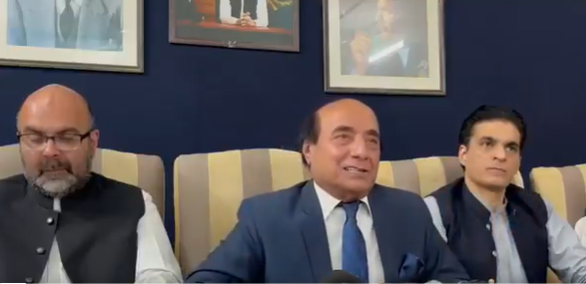
PM Should Not Expect PPP-PML-N Style CoD From PTI, Says Latif Khosa
Jhagra Calls Soaring Cost of State ‘Elephant in the Room’, Urges Spending Cuts
Claims of Saving Pakistan From Default Ring Hollow Amid Mounting Public Hardship: Arif Jutt
Exports Fell by $2b Under Current Regime, Rose by $8b Under PTI: Rana Atif
ISLAMABAD: Pakistan Tehreek-e-Insaf (PTI) on Sunday warned that the federal budget for FY2026-27 would unleash a “tsunami of taxes” and push millions of “inflation-hit and poverty-stricken citizens” further below the poverty line.
The party also ruled out any possibility of entering into a Charter of Democracy with the government similar to the one signed between PPP and PML-N.
Addressing a press conference alongside PTI leaders Taimur Khan Jhagra, MNA Mobeen Arif Jutt and MNA Rana Atif, senior PTI leader and MNA Sardar Latif Khosa described the budget as IMF-driven and elite-centric, arguing that it offered no meaningful relief to ordinary citizens and had been presented by what, he said, an unelected “Form-47 government.”
Khosa warned that the budget would further deepen public hardship and negatively affect the economy. Referring to the FBR’s Rs15.264 trillion tax collection target for FY2026-27, a 17.6 percent increase over the revised target of Rs12.983 trillion for the previous year, he questioned how the government planned to achieve the goal after repeatedly missing earlier targets. He cautioned that additional taxation would place a heavier burden on existing taxpayers and push more lower- and middle-income families into poverty.
Responding to Prime Minister Shehbaz Sharif’s offer of a Charter of Democracy with the opposition, Khosa questioned the fate of the 2006 agreement between martyred Benazir Bhutto and Nawaz Sharif, claiming that none of its commitments had been fulfilled. He alleged that both these two parties i.e., PPP and PML-N undermined constitutional supremacy, judicial independence, electoral transparency and political freedoms.
Khosa maintained that despite winning more than 180 seats in the February 8 elections, PTI was denied power, while PML-N formed the government with only 17 seats. He also accused the government of political victimization, citing hundreds of cases against PTI founder Imran Khan, his wife and party leaders, including cancer survivor Dr Yasmin Rashid.
Speaking on the occasion, Taimur Jhagra criticized the government for raising the petroleum levy to as much as Rs100 per litre, saying the move would have a cascading impact across the economy. He termed the ever-rising cost of running the state the “elephant in the room” and argued that meaningful relief would remain impossible without curbing extravagant expenditures.
He noted that federal salaries and administrative expenses had risen to around Rs100 billion, while combined expenditures of the federation and provinces had exceeded Rs1 trillion. Pension liabilities, he added, had also climbed to nearly Rs1 trillion. Jhagra argued that taking almost Rs3 trillion from provinces while offering minimal relief could not be considered sound fiscal management.
He stated Pakistan’s economy had endured one of its worst periods since April 2022, adding that despite regional economies posting growth rates of around six percent, Pakistan had failed to achieve even four percent GDP growth. He said soaring inflation had eroded purchasing power and pushed millions into economic distress.
Jhagra stated that the official poverty rate had risen to 28.9 percent in FY2024-25 from 21.9 percent in 2019, leaving around 70 million Pakistanis below the national poverty line. Rejecting claims of economic recovery, he said exports had declined by six percent and investment by 26.5 percent, while most economic targets had been missed.
Calling the budget a complete failure, he said the finance minister had offered only limited relief to salaried individuals without presenting any roadmap for economic revival. He questioned how provinces would fund education and healthcare if their fiscal share continued to shrink.
Mobeen Arif Jutt said the government had failed to broaden the tax base despite presenting its fifth budget.
While supporting faceless tax assessments to reduce corruption and discretionary powers, Jutt warned that the proposed legislation lacked safeguards for taxpayer privacy and accountability. He argued that the government appeared more interested in protecting officials than reforming the taxation system.
“The claims of saving Pakistan from default ring hollow when the people themselves are already overwhelmed by economic distress,” he added.
Rana Atif questioned the government’s claims of economic stabilization, saying unprecedented taxes had been imposed without meaningful structural reforms. He said progress on privatization and power sector reforms had remained negligible, while circular debt had again surged after temporary reductions achieved through heavy bank borrowing.
He further claimed that exports had declined by nearly $2 billion under the current dispensation, whereas they had increased by $8 billion during PTI’s tenure. He stressed that sustainable economic stability could only be achieved through political stability and free, fair elections.
More from Pakistan News
Comments
No comments yet. Be the first to comment!
Leave a Comment