

One in Seven Punjab Women Married Before 18, Survey Reveals Stark District Divide
Tuesday, 29 September 2026
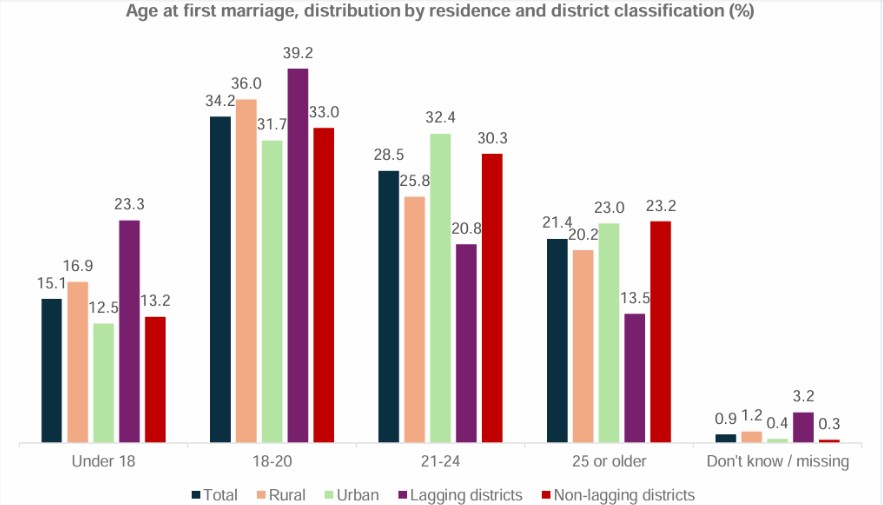
Half of ever-married women were married by 20; early marriage rises to nearly one in four in seven lagging districts, while median age ranges from 18 in Dera Ghazi Khan to 22 in seven districts
Hamid Khan Wazir
ISLAMABAD: Nearly one in seven ever-married women in Punjab was married before reaching the age of 18, while almost half entered marriage by the age of 20, exposing a sharp divide in marriage patterns across the province, particularly between its most disadvantaged and better-performing districts.
According to an analysis by Gallup Pakistan of the Punjab Health and Population Survey (PHPS) 2024–25, 15.1% of ever-married women aged 15–49 reported marrying before 18, while another 34.2% married between 18 and 20. Together, the figures mean that 49.3%, almost one in every two women surveyed, were married by age 20.
The findings are based on interviews with 19,536 ever-married women across all 36 districts of Punjab, conducted between November 2024 and February 2025.
The data also reveals that the province's marriage patterns are far from uniform. In the seven districts classified as lagging on health and development indicators, 23.3% of women married before 18, compared with 13.2% in the remaining 29 districts. That represents a 10.1 percentage-point gap, more than twice the 4.4-point difference between rural and urban Punjab.
Nearly Two-Thirds Married by 20 in Lagging Districts
The divide becomes even more pronounced when marriage before 21 is considered. In the seven lagging districts, 62.5% of ever-married women had married by the age of 20, compared with 46.2% in non-lagging districts, a difference of 16.3 percentage points.
By contrast, only 13.5% of women in lagging districts married at 25 or older, compared with 23.2% in non-lagging districts. The pattern suggests that the issue extends beyond child marriage alone. In the most disadvantaged parts of Punjab, marriage is substantially more concentrated in the early years of adulthood, while marriage at 25 or later is considerably less common.
The seven lagging districts identified in the survey are Rahim Yar Khan, Bhakkar, Dera Ghazi Khan, Muzaffargarh, Pakpattan, Rajanpur and Bahawalpur.
Dera Ghazi Khan Records Lowest Median Marriage Age
District-level figures from the PHPS dashboard show an even wider picture. The median age at first marriage ranges from 18 years in Dera Ghazi Khan to 22 years in seven districts, Faisalabad, Gujranwala, Jhelum, Rawalpindi, Sialkot, Toba Tek Singh and Vehari.
Muzaffargarh and Rajanpur record a median age of 19, making them, along with Dera Ghazi Khan, the only districts with a median below 20. Overall, the province is almost evenly divided: 18 of Punjab's 36 districts have a median age of 21 or above, while 18 record a median of 20 or below.
The four-year difference between the highest and lowest district medians, however, does not tell the entire story. A median only identifies the point at which half of women have married. It does not reveal how many women married at particularly young ages.
The age-band data therefore provides an important second dimension to the picture, showing substantially higher concentrations of early marriage in disadvantaged districts.
Rural-Urban Divide Exists but District Disadvantage Is Sharper
The survey found that early marriage is more prevalent in rural Punjab than in urban areas. 16.9% of rural women married before 18, compared with 12.5% of urban women, producing a 4.4 percentage-point difference.
But the district-level divide is considerably larger. In lagging districts, 23.3% married before 18, compared with 13.2% in non-lagging districts.
The difference also narrows considerably at the other end of the age distribution. 20.2% of rural women and 23.0% of urban women married at 25 or older, a gap of only 2.8 percentage points.
This indicates that residence alone does not explain the full variation in marriage timing. The broader socioeconomic and development conditions associated with district-level disadvantage correspond with substantially different marriage patterns.
Education Appears to Shift Marriage Timing But Mainly After Secondary School
The survey also shows a relationship between educational attainment and age at marriage. Women with no education, primary education and middle education all recorded a median age at first marriage of 20 years.
The median rises to 21 years among women with secondary education and reaches 23 years among those with higher education. This produces a three-year difference between women with no education and those with higher education.
The pattern is therefore not linear across every level of schooling. The median remains at 20 years through middle education and begins rising after the secondary level.
The findings are particularly significant in the context of Punjab's lagging districts, where educational disadvantage and early marriage are concentrated together.
Early Marriage and Adolescent Fertility Move Together
The survey's findings on marriage age coincide with significant differences in adolescent fertility. Punjab's adolescent fertility rate stands at 52 births per 1,000 women aged 15–19.
But the rate rises to 76 in lagging districts, compared with 48 in non-lagging districts. The rural-urban divide is also substantial: adolescent fertility stands at 63 births per 1,000 women in rural areas, compared with 37 in urban areas.
The district-type difference of 28 points is slightly wider than the 26-point rural-urban difference. The data does not establish that early marriage directly causes higher adolescent fertility, or that one indicator alone explains the other. However, the concentration of early marriage, adolescent fertility and educational disadvantage in the same districts highlights a cluster of interconnected social and development challenges.
Seven Districts Carry Multiple Disadvantages
The seven lagging districts stand out across several indicators examined by the PHPS and related Gallup Pakistan analyses. In these districts, 59.7% of ever-married women have no formal education, compared with 29.6% in non-lagging districts. At the same time, 23.3% married before 18, compared with 13.2% elsewhere.
The same seven districts also record higher adolescent fertility and, according to the broader analysis, higher levels of consanguinity. The overlap is particularly pronounced in Dera Ghazi Khan, Rajanpur and Muzaffargarh, where some of the lowest marriage-age medians coincide with severe educational and social disadvantages.
However, the survey cannot establish a simple cause-and-effect relationship between these indicators. Early marriage, limited education, adolescent fertility and socioeconomic disadvantage may influence one another in multiple directions.
A Data Gap Also Raises Questions
The analysis highlights another important issue: the quality of reporting on age at marriage differs significantly between district types. Don't-know or missing responses for age at first marriage were reported for 3.2% of women in lagging districts, compared with only 0.3% in non-lagging districts.
That is more than a tenfold difference.
The disparity is important when interpreting the figures because missing or uncertain reporting may affect estimates of marriage timing, particularly in areas where civil documentation and record-keeping may be weaker.
Gallup Pakistan notes that the published PHPS report itself does not provide age-at-first-marriage figures for individual districts; the district-level median figures cited in the analysis are drawn from the PHPS dashboard based on the underlying survey dataset.
Punjab's Marriage Pattern Is Almost Split in Half
At the provincial level, the numbers produce a striking divide. Of the women surveyed, 15.1% married before 18, 34.2% between 18 and 20, 28.5% between 21 and 24, and 21.4% at 25 or older.
In other words, 49.3% were married by 20, while 49.9% married at 21 or later. The remaining 0.9% either did not know or did not report their age at marriage.
The largest single category is the 18–20 age group, accounting for more than one-third of all ever-married women. This means that while marriage before 18 remains a significant minority practice, the broader issue revealed by the survey is the concentration of marriage around the late teenage and very early adult years.
The figures should also be interpreted historically. Because the survey covers women aged 15–49, the results represent marriages contracted over roughly the past three decades rather than the marriage behavior of girls today. They therefore cannot be interpreted as a current annual rate of child marriage.
The Broader Development Challenge
The findings place marriage age within a wider set of disparities affecting women across Punjab. The survey covers 24,540 households across all 36 districts and was conducted under the World Bank-supported National Health Support Program and Punjab Family Planning Program. It examines health, fertility, contraception, maternal and child health, nutrition, education-related characteristics and other household indicators.
What emerges from the marriage data is a province divided not simply between rural and urban communities, but also—and in some indicators more sharply—between districts facing different levels of development.
For policymakers, the figures point to the importance of examining early marriage alongside girls' education, adolescent fertility, family planning, documentation and broader socioeconomic conditions rather than treating it as an isolated demographic statistic.
The most striking figure may therefore not be the 15.1% who married before 18, but the much broader finding that nearly half of Punjab's ever-married women were married by the age of 20—and that this proportion climbed to nearly two-thirds in the province's seven lagging districts.
That divide places the timing of marriage firmly within Punjab's larger debate over girls' education, reproductive health, development inequality and the opportunities available to women across different parts of the province.

More from Pakistan News


Comments
No comments yet. Be the first to comment!
Leave a Comment