
Economy, Politics Dominate Pakistan’s Media Debate as Focus on Law and Order Plummets: Gallup Report
Wednesday, 18 November 2026
Economy Emerges as the Most Discussed Subject in October with 16% Share, Followed by Politics at 15%; Analysis of 1,528 Opinion Pieces Reveals Shifting Media Priorities
Hamid Khan Wazir
ISLAMABAD: Economic challenges and political developments dominated Pakistan’s media discourse in October 2026, with the economy emerging as the most discussed subject in newspaper opinion pages and television commentary, while attention to law and order and terrorism-related issues witnessed a dramatic decline, according to a new media analysis by Gallup & Gilani Pakistan.
The monthly Newspaper Content Analysis Research Study, conducted under the supervision of Executive Director Bilal I. Gilani, examined 1,528 opinion columns and editorials published across 12 national newspapers and one television news channel, identifying Economy, Politics and Governance as the leading themes shaping public debate during the month.
According to the 78th edition of the research series, economic issues accounted for 16 per cent of the total media discussion, followed closely by Politics at 15 per cent. Governance, Social Issues and International Affairs each secured a 7 per cent share, while Foreign Relations accounted for 6 per cent.
The findings indicate that economic management, political leadership and the performance of state institutions remained at the centre of discussions among Pakistan’s opinion writers and editorial commentators.
Economic pressures dominate editorial attention
Within the economy category, discussions concerning the International Monetary Fund (IMF), debt and fiscal policy emerged as the largest area of focus, accounting for 21 per cent of economic coverage.
Inflation and the cost of living followed closely at 20 per cent, reflecting continued media attention to rising prices and household financial pressures. Growth and economic reforms accounted for 19 per cent, while investment and business attracted 14 per cent of the discussion.
Trade and exports represented 9 per cent, while agriculture and industry and budget and taxation each accounted for 8 per cent. The findings highlight the prominence of IMF engagement, debt management, inflation and economic reforms in the national economic debate, with relatively less attention devoted to productive sectors, exports and taxation.
Sharp decline in coverage of law and order
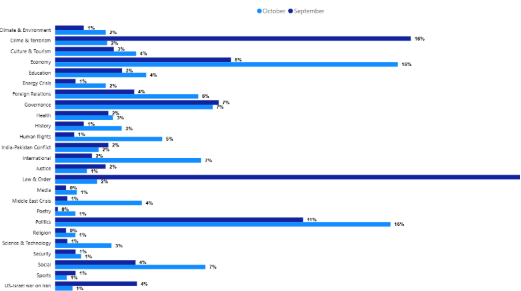
One of the most striking findings was the significant shift in media attention away from law and order and terrorism-related issues compared with September. Law and Order, which had dominated the September discussion with a 24 per cent share, fell sharply to just 2 per cent in October. Similarly, Crime and Terrorism coverage dropped from 16 per cent to 2 per cent during the same period.
In contrast, the economy's share doubled from 8 per cent in September to 16 per cent in October, making it the leading subject of media commentary. Political coverage also increased from 11 per cent to 15 per cent.
Social issues rose from 4 per cent to 7 per cent, while International Affairs registered a notable increase from 2 per cent to 7 per cent. Foreign Relations also gained attention, rising from 4 per cent to 6 per cent. Governance, meanwhile, remained unchanged at 7 per cent.
Human rights and international developments gain attention
The report also identified increased attention to several other national and international issues. Human Rights coverage increased from 1 per cent in September to 5 per cent in October, while discussions surrounding the Middle East crisis rose from 1 per cent to 4 per cent.
Education and Culture and Tourism each recorded a 4 per cent share, compared with 3 per cent in the previous month. History and Science and Technology also increased from 1 per cent to 3 per cent each, while Health-related discussions rose from 2 per cent to 3 per cent.
Climate and Environment and the Energy Crisis each accounted for 2 per cent, up from 1 per cent in September. Coverage of the India-Pakistan conflict remained unchanged at 2 per cent.
Meanwhile, attention to the US-Israel war on Iran declined from 4 per cent to 1 per cent, while Justice-related coverage slipped from 2 per cent to 1 per cent.
English and Urdu newspapers show different priorities
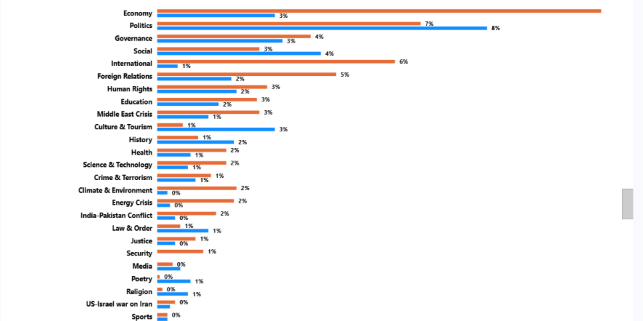
The study also highlighted notable differences between English- and Urdu-language media in their selection of subjects. Economic issues received considerably greater attention in English-language publications, accounting for 13 per cent of coverage, compared with 3 per cent in Urdu newspapers. International Affairs followed a similar pattern, representing 6 per cent of English-language coverage against just 1 per cent in Urdu publications.
Foreign Relations also attracted greater attention in English newspapers, with a 5 per cent share compared with 2 per cent in Urdu newspapers. Politics, however, received slightly more attention in Urdu publications, accounting for 8 per cent compared with 7 per cent in English newspapers. Social issues also featured more prominently in Urdu newspapers at 4 per cent, against 3 per cent in English publications.
Culture and Tourism and History received relatively greater attention in Urdu newspapers, while Climate and Environment, Energy Crisis and the India-Pakistan conflict were more prominent in English-language coverage.
Study covers 13 national media outlets
The analysis covered opinion columns and editorials published in four Urdu newspapers--- Jang, Express, Nawa-i-Waqt and Daily Pakistan--- and eight English newspapers, including The News, The Nation, Dawn, The Express Tribune, Business Recorder, Daily Times, Pakistan Today and Pakistan Observer. GEO TV was also included in the research.
The report's word-cloud analysis further identified Pakistan, Government, Economic, Political and Country as the most frequently appearing terms across the leading categories. Explaining the purpose of the research series, Bilal Ijaz Gilani said the initiative seeks to understand how mainstream media sets the national agenda and how Urdu and English opinion pages respond to changing national and international developments.
He said the monthly analysis also examines how issues move between television talk shows and newspaper editorials, helping researchers understand the perspectives and influence of media opinion leaders. The study was released by Gilani Research Foundation and conducted by Gallup & Gilani Pakistan as part of its ongoing effort to generate evidence-based insights into Pakistan's media landscape.
The October 2026 report is the 78th edition of the monthly content analysis series, which has been tracking trends in newspaper opinion and editorial coverage since 2015.
More from Pakistan News
Comments
No comments yet. Be the first to comment!
Leave a Comment