

Ahsan Iqbal calls for integrated, evidence-based strategies to boost climate resilience in Balochistan
Friday, 17 April 2026
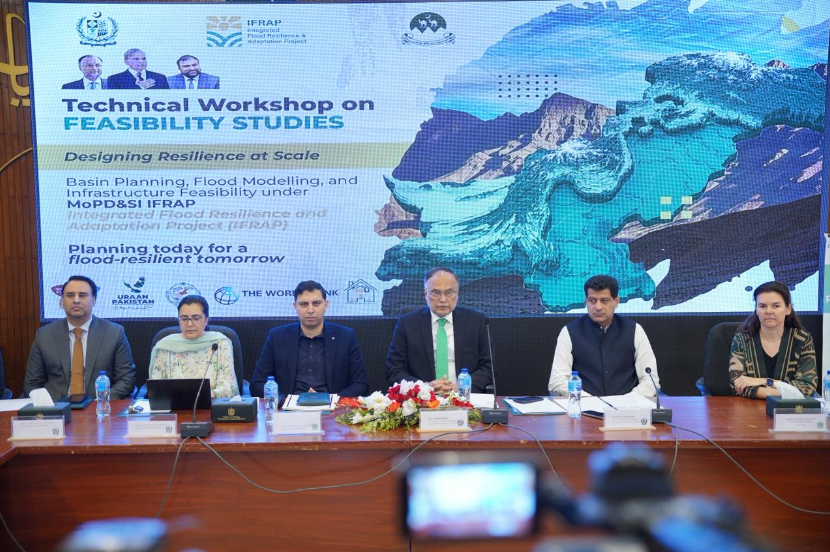
ISLAMABAD: Federal Minister for Planning, Development and Special Initiatives, Ahsan Iqbal on Friday underscored the urgent need for integrated and evidence-based strategies to enhance climate resilience in Balochistan, noting that the devastating 2022 floods in Pakistan had disproportionately affected already vulnerable regions such as Sindh and Balochistan, further widening socio-economic disparities.
He made these remarks while delivering the keynote address at the Integrated Flood Resilience and Adaptation Project (IFRAP) technical workshop on “Designing Resilience at Scale, Basin Planning, Flood Modeling, and Infrastructure Feasibility,” held here on Friday.
The IFRAP program aims to strengthen climate resilience in Balochistan through integrated infrastructure development, advanced flood modeling, basin planning, and sustainable water resource management strategies.
Addressing distinguished participants including government representatives, development partners, and technical experts, the Minister highlighted that climate change has become the “new normal,” necessitating a shift from reactive recovery efforts to proactive resilience-building. The Minister outlined the origins of the IFRAP initiative, explaining that the federal government secured a $400 million financing package from the World Bank to support Balochistan after the province was unable to independently undertake such financial commitments. The program encompasses infrastructure rehabilitation, livelihood restoration, and a strong resilience component aimed at mitigating future climate risks.
Ahsan Iqbal stressed that Pakistan is among the most water-stressed countries globally, ranking 14th among the 17 most water-scarce nations. He highlighted critical challenges, including declining reservoir capacity due to silting and the absence of new major water storage infrastructure over the past five decades. He emphasized that Pakistan’s current water storage capacityapproximately 30 days, falls significantly short of the global benchmark of 120 days and called for urgent investments in water reservoirs and storage systems, particularly as 80% of water inflows occur during the monsoon season.
The workshop focused on advancing technical capabilities in basin-level planning, flood modeling, and infrastructure feasibility. The Minister underscored the importance of these approaches in enabling scientific and data-driven decision-making, climate-resilient infrastructure design, efficient allocation of limited financial resources, and long-term water resource sustainability. He stressed that feasibility studies developed under IFRAP must guide policy through rigorous, evidence-based methodologies rather than traditional input-driven planning.
Highlighting reforms in public sector development practices, Ahsan Iqbal emphasized a transition from input-based budgeting to outcome-based frameworks. He noted that utilization of funds alone is not a meaningful indicator of success; instead, measurable development outcomes and impact must define project effectiveness.
Recognizing Balochistan’s developmental challenges, the Minister reiterated the government’s commitment to accelerated investment in the province, including a development budget exceeding Rs. 200 billion. He stressed that equitable regional development is essential for national cohesion and sustainable economic growth and drew attention to alarming groundwater depletion in Quetta, where water levels are declining by up to four meters annually, calling for urgent implementation of integrated water resource management systems.
The Minister highlighted the establishment of a National Water Security Task Force and emphasized the importance of coordination among federal and provincial governments, technical institutions, and international partners. The workshop also featured addresses by Mir Zahoor Buledi, Minister for Planning and Development Balochistan, Asad Allah Nasar, Project Director IFRAP, and representatives from the World Bank and other international organizations. The event brought together hundreds of participants, including experts from around the globe, policymakers and practitioners from across Pakistan and Balochistan, as well as dozens of students from universities in Balochistan.
He concluded by urging participants to leverage the workshop to enhance technical expertise and develop actionable solutions that will enable Balochistan to transition from vulnerability to resilience. “By investing in water storage, scientific planning, and climate-resilient infrastructure, we can transform future floods from disasters into opportunities for sustainable water management,” he stated.


More from Pakistan News




Comments
No comments yet. Be the first to comment!
Leave a Comment