

Why Good Manners Matter More Than Ever in the Digital Age
Thursday, 20 August 2026
Fozia Zahoor
Every social media platform begins with a simple formality.
Before creating an account, users are presented with pages of terms and conditions, community guidelines and privacy policies. Although these documents contain important rules governing behaviour on the platform, very few people actually read them. Most simply scroll to the bottom, click "I Agree", and continue.
Ironically, we readily accept the rules of a digital platform while gradually forgetting the moral values that families, teachers and religion have spent generations trying to instil.
Technology has transformed the way we communicate, but it has not changed the principles that make communication meaningful. Respect, patience, honesty, humility and kindness were considered virtues long before smartphones were invented. They remain equally relevant today.
Social media has given every individual a public voice. This is one of the greatest achievements of the digital age. A student, a teacher, a journalist, a doctor or an ordinary citizen can now express opinions before a global audience within seconds. Yet every freedom carries a corresponding responsibility.
Unfortunately, many people misunderstand freedom of expression as freedom from responsibility.
A difference of opinion that could have ended with respectful disagreement often develops into an exchange of insults. A thoughtful discussion quickly turns into personal attacks. Harsh words are followed by abusive language, offensive emojis and mocking stickers. The original issue is forgotten while anger becomes the centre of attention.
One cannot help asking a simple question.
Is every opinion an invitation to an argument?
Must every disagreement be answered with a comment?
Modern social media already provides a remarkably simple solution.
If a page repeatedly spreads ideas we dislike, we can un-follow it.
If an individual constantly disturbs our peace, we can block the account.
If a discussion becomes toxic, we can simply leave the group.
These options require only a few seconds, yet they often save hours of unnecessary conflict and emotional exhaustion.
The greater challenge, therefore, is not learning how to use social media. It is learning how to use ourselves.
The Prophet Muhammad (peace be upon him) taught that a believer should speak good or remain silent. This timeless guidance is perhaps even more relevant today than it was fourteen centuries ago. Every comment posted online becomes part of our character. Every respectful response reflects our upbringing. Every abusive remark reveals something far more about the writer than the reader.
Our words leave a digital footprint, but they also leave a moral footprint.
Another worrying trend is our increasing dependence on digital approval. A photograph receives fewer likes than expected, and disappointment follows. An unfamiliar person posts a negative comment, and our mood is ruined for the entire day. We become emotionally influenced by people whose names, faces and intentions we do not even know.
Have we allowed strangers to determine our happiness?
No number of likes can measure a person's worth.
No anonymous comment can diminish genuine character.
Real confidence is built through values, not virtual approval.
Families remain the first schools of character. Parents teach courtesy before children learn grammar. Teachers reinforce discipline before they teach literature, mathematics or science. Religious teachings cultivate humility, patience, forgiveness and compassion because societies cannot survive on laws alone. They survive on values willingly practised by their citizens.
Technology will continue to evolve. New platforms will emerge. Artificial intelligence will reshape communication in ways we can scarcely imagine. Yet no technological advancement can replace good manners, self-restraint or moral integrity.
Perhaps the question is not whether social media is making society worse.
Perhaps the real question is whether we are carrying our values with us when we enter the digital world.
The screen may separate faces, but it should never separate us from our humanity.
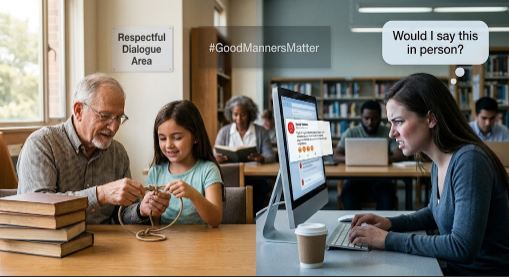
If every user paused before posting a comment and asked a simple question—"Would I say these words if this person were standing before me?"—the internet would become a kinder, wiser and more respectful place.
Technology has given us the freedom to speak.
Wisdom teaches us when, how and even whether we should.



More from Opinion News



Comments
No comments yet. Be the first to comment!
Leave a Comment