

They Built the Years We Inherited, Who Will Stand Beside Them Now
Thursday, 01 October 2026
Asem Mustafa Awan
The world moves quickly. Cities grow, markets expand, technology changes lives and younger generations race towards futures that their elders helped make possible. Yet somewhere in the middle of that rush are millions of older people whose own lives have not slowed down.
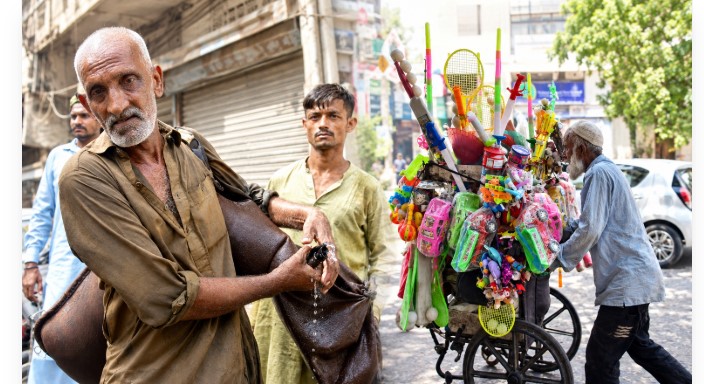
These two photographs from Karachi capture that contradiction with painful simplicity.
One elderly man pushes a wheelchair loaded with toys. Bright colours, plastic balls, bats, dolls and children's games surround him, creating an almost cheerful picture. But behind those colours is a much harder reality. The man is still working at an age when many would expect a person to be resting after decades of labour. His wheelchair serves two purposes, carrying his merchandise and offering him somewhere to sit when his ageing body needs a break.
A few streets away, another elderly man carries a traditional leather water bag. His hair and beard are almost entirely white. His face bears the marks of age, while his work demands that he continue walking through a crowded city selling water to survive.
There is something deeply symbolic in the contrast. One man sells toys associated with childhood. The other carries water, one of humanity's most basic necessities. Both are engaged in work that requires physical effort. Both are old. Both appear to have little choice but to continue.
The United Nations established October 1 as the International Day of Older Persons to draw attention to the rights, contributions and wellbeing of older people. In 2026, the theme is “The Age of Longevity: Rethinking Systems for Longer Lives.” The UN says longer lives create both opportunities and challenges, requiring societies to rethink healthcare, employment, pensions, housing and social support.
Pakistan faces a particularly important challenge as its elderly population grows. A UNFPA assessment estimated that around 15 million Pakistanis were aged 60 or above and projected that this number could reach 44 million, or 16 per cent of the population, by 2050. The same assessment found that only a small proportion of people above statutory pension age received an old-age pension and warned that economic pressures could make traditional family support increasingly difficult to sustain.
That is where these photographs become more than pictures of two elderly workers.
They become questions.
What happens to a man who spends his entire life working when his body can no longer keep pace? What happens when there is no pension, no savings, no secure employment and no dependable social protection? Who provides healthcare when age brings illness? Who provides dignity when earning a daily wage becomes the only safety net?
Pakistan has traditionally relied heavily on families to care for older people. That cultural bond remains valuable. But families themselves face rising costs, unemployment and economic pressures. Depending entirely on relatives cannot be the only answer to the needs of an ageing population.
The old men in these photographs are not merely poor elderly workers.
They are part of a generation that carried families, raised children, learned trades, built communities and survived difficult times.
They should not become invisible simply because their productive years are considered over.
A society's progress is not measured only by the height of its buildings or the speed of its roads. It is also measured by what happens to the person who can no longer work as fast as before.
The toys on the cart belong to tomorrow's children.
The water in the leather bag sustains today's people.
But the men carrying them belong to yesterday's generation.
They helped build the years we inherited. The least a society can offer them is the dignity of growing old without having to beg their bodies for one more day's labour.
Photo Online
More from Opinion News


Comments
No comments yet. Be the first to comment!
Leave a Comment