

The Cockroach Who Refused To Crawl
Wednesday, 21 October 2026
Asem Mustafa Awan
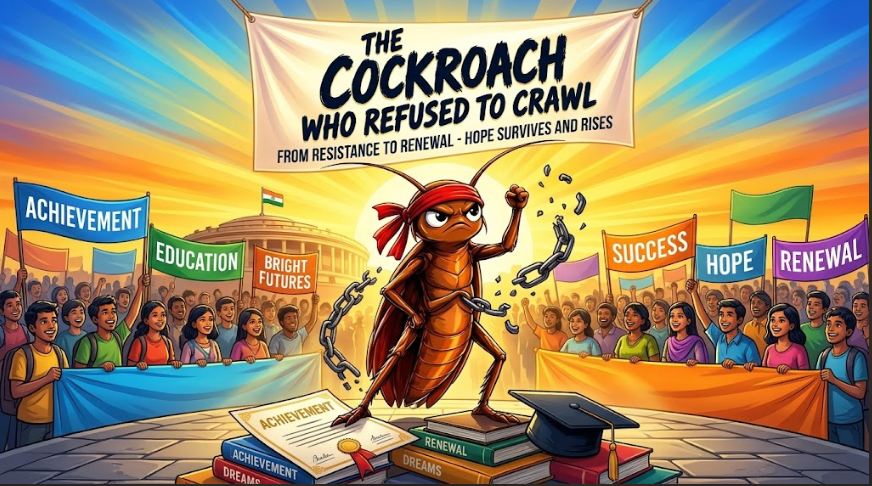
Sometimes a political movement begins not with a grand manifesto, but with a word that wounds. In India, “cockroach” became such a word after Chief Justice Surya Kant made remarks comparing some unemployed young people to cockroaches and parasites during a court hearing. Abhijeet Dipke, a young communications professional, turned the insult into the Cockroach Janta Party, a satirical movement for people who felt dismissed by the system.
The idea was simple. If society considered young people unwanted, invisible or disposable, they would reclaim the name and make themselves impossible to ignore. A cockroach survives hostile surroundings. In political satire, it became a symbol for citizens confronting unemployment, examination scandals and institutions seemingly more responsive to power than ordinary lives.
The movement’s rise showed how ridicule can turn into recognition. Behind the online humour were graduates waiting for jobs, families investing their savings in education and students questioning whether hard work still offered a fair route forward. The label caught attention; the frustration beneath it gave the movement its weight.
Dipke was detained and arrested in October ahead of protests in Delhi, then granted bail subject to an undertaking to maintain peace. Two fellow leaders, Ashutosh Ranka and Saurav Das, remained in judicial custody as of October 19, with a court extending their custody. The movement has also challenged electoral-list revisions that it says disadvantage voters, allegations denied by the Election Commission. The legal issues must be judged through due process. But the episode raises a democratic question: how should a state respond when young citizens use satire and protest to challenge power?
A movement’s popularity does not make every claim true, nor does a provocative name guarantee lasting change. Its significance lies in the discontent it reveals. When so many people recognise themselves in a joke about being unwanted, the joke has become a report from lives shaped by insecurity and exclusion.
That feeling extends across South Asia. In Nepal, anger over corruption, privilege and limited prospects fuelled youth-led protests against the political establishment. In Bangladesh, grievances over jobs, unequal opportunity and concentrated power contributed to the mass uprising that forced a change of government in 2024. Their circumstances differ, but both demonstrate the danger of treating public patience as inexhaustible.
Elite capture occurs when institutions and opportunities increasingly serve connected groups while ordinary citizens face closed doors. A graduate may possess a degree but lack access to a job. A family may save for years only to discover that merit is not enough. A small business owner may follow every rule while watching influence bend them for someone else. Each experience appears private until enough people recognise the same pattern.
Pakistan offers a warning of its own, written not in satire but in stark economic figures. The World Bank’s October 2026 poverty brief says the national poverty rate rose from 22 per cent in 2018-19 to 29 per cent in 2024-25. Around 70 million Pakistanis are now living in poverty. Growth has remained too weak to generate enough jobs, while real wages have fallen and many new jobs are informal, poorly paid or insecure.
These numbers are not merely economic indicators. They represent families deciding which bill can wait, parents sacrificing their needs for their children and young graduates wondering whether education will provide a way out. Poverty does not automatically produce political revolt, and economic hardship alone cannot explain every regional upheaval. But when sacrifice becomes routine while opportunity appears reserved for the connected, resentment gathers beneath the surface.
Elite capture is especially corrosive when people believe that the rules are strict for them but negotiable for the powerful. Public trust weakens when access to jobs, influence and justice seems determined by connections rather than competence. Pakistan’s challenge is not a shortage of ambition among its people. It is ensuring that ambition has a fair chance to become achievement.
Across the region, the metaphor changes, but the human injury remains familiar. In India, young people have reclaimed the cockroach as a symbol of survival. Elsewhere, people may be too exhausted, economically dependent or fearful to protest openly. Their silence should not be mistaken for contentment. Sometimes people are pushed so far down that survival consumes the energy required to demand change.
Governments often measure stability by the absence of demonstrations. A wiser measure is whether citizens can seek redress before frustration becomes rupture. Fair recruitment, credible examinations, independent institutions, accessible justice and meaningful accountability are not concessions to restless youth. They are foundations of public trust. Protest movements, for their part, need clear demands and peaceful organisation if they are to turn anger into lasting reform.
The cockroach may be an unlikely emblem for political hope, but its message is unmistakable. Those treated as disposable are refusing to disappear quietly. South Asia’s leaders should pay attention, not merely to the creature chosen for the protest, but to the conditions that made the symbol resonate.
A democracy is tested not by how gracefully it welcomes praise, but by how fairly it responds to criticism. When citizens must call themselves cockroaches to be noticed, the failure belongs to a system that has stopped seeing them as people. And when people are reduced to feeling smaller than the smallest creatures, silence may look like order - until the day it breaks.
More from Opinion News

Comments
No comments yet. Be the first to comment!
Leave a Comment