

Raising Children In The Digital Jungle
Wednesday, 22 July 2026
Fozia Zahoor
Every generation faces challenges unknown to the one before it. Today, one of the greatest challenges is not simply raising children, but raising them in a digital jungle where opportunities and dangers exist side by side. A smartphone is no longer just a device for making calls or sending messages. It has become a gateway to an unlimited world of knowledge, creativity, entertainment, relationships and information. Yet, the same gateway can also lead to deception, exploitation and emotional harm.
Technology itself is not the enemy. In fact, digital platforms have revolutionised education, communication and learning. Children can explore virtual classrooms, learn new languages, develop creative skills and connect with educational resources from across the globe. Rejecting modern technology is neither practical nor desirable. The real challenge lies elsewhere. Children do not need protection from technology; they need protection within technology.
Unfortunately, the digital world is not designed exclusively for children. Hidden behind attractive screens are fake identities, online predators, cyberbullying, blackmail, financial scams, addictive games, deepfakes, misinformation and psychological manipulation. A single careless click or an innocent conversation with a stranger can expose a young mind to risks that may leave lasting emotional and psychological scars. Unlike dangers in the physical world, digital threats often remain invisible until significant damage has already been done.
Many parents carefully supervise where children go, whom they meet and what time they return home. Ironically, far less attention is sometimes given to the places children visit every day through a screen. The online world has become the new playground, yet many adults remain unfamiliar with its hidden pathways. Understanding concepts such as phishing, privacy settings, digital footprints, AI-generated content and online grooming has become an essential part of modern parenting. Children cannot be protected from dangers that parents and caregivers themselves fail to recognise.
Protection, however, should never mean fear or excessive control. A child who fears punishment is less likely to report online harassment, bullying or blackmail. Families must create an atmosphere where uncomfortable digital experiences can be discussed without hesitation or shame. Children should feel confident that seeking help will bring guidance rather than blame. Trust remains the strongest form of digital protection.
Digital safety deserves the same importance as road safety. Children are taught not to trust strangers in public places; the same lesson must apply behind a screen. Personal information, photographs, passwords, school details and locations should never be shared carelessly. Equally important is understanding that every post, photograph, comment and search contributes to a permanent digital footprint that may continue to exist long after the delete button has been pressed.
Parents also have responsibilities within the digital space. Sharing children's photographs, school details or personal milestones on social media without careful thought may unintentionally compromise privacy. Respecting a child's digital identity is becoming as important as protecting physical safety.
Another silent concern is mental well-being. Endless scrolling, comparison with carefully edited online lives, fear of missing out, sleep deprivation and constant notifications can gradually affect confidence, concentration and emotional health. Artificial intelligence has added another dimension. While AI can be an extraordinary learning companion, it can also create convincing fake images, voices and misinformation, making critical thinking more important than ever.
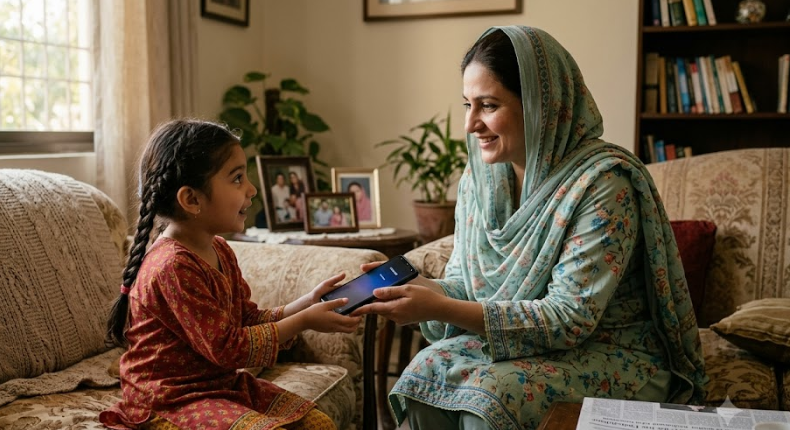
The future does not belong to children who merely know how to operate technology. It belongs to those who understand how to use it wisely, ethically and safely. Raising children in the digital jungle requires more than providing devices; it requires providing values, awareness, open communication and guidance. The strongest parental investment is not in the latest technology but in nurturing a relationship where every online question, fear and experience can be shared openly. In such an environment, technology becomes a bridge to learning rather than a pathway to danger.
The question is no longer whether children should enter the digital world; they already have. The real question is whether they enter it alone or with the wisdom and guidance of those who love them most. Every child deserves not only a smartphone, but also a trusted conversation; not only internet access, but also digital values; and not only the freedom to explore, but also the confidence to seek help without fear.
The issue is no longer merely a family concern; it is a societal responsibility. Schools must teach digital citizenship, governments must strengthen cyber safety measures, technology companies must design safer platforms, and parents must remain the first line of defence. Protecting children in the digital world requires a partnership, not isolated efforts. In the end, the greatest firewall is not an application installed on a device; it is the trust installed in a child's heart. The greatest parental investment is not the smartphone placed in a child's hand, but the values placed in a child's mind. Screens will continue to illuminate children's faces; only values can illuminate their future.



More from Opinion News






Comments
No comments yet. Be the first to comment!
Leave a Comment