

Not Just A Burden, But A Generation At Risk
Sunday, 27 September 2026
Asem Mustafa Awan
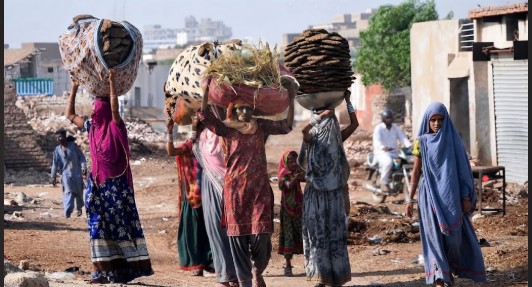
The women carrying dried crop roots, firewood and cow dung are carrying more than fuel. They are carrying a burden passed from one generation to another.
For families living close to the edge, the search for fuel is not a choice. It is part of survival. When affordable and reliable household energy remains beyond reach, women walk, gather what they can find and return home with heavy loads balanced on their heads. The fuel will be burned, a meal will be prepared and another day will begin.
But the real cost of this poverty is not measured only by the weight these women carry.
It is measured in the opportunities their children lose.
Time spent collecting fuel is time that could have been spent on education, rest or productive work. In households struggling to meet basic needs, children can also become part of the daily survival effort, helping with household chores, collecting fuel or contributing to family income. Poverty can therefore become a cycle in which one generation inherits the unfinished struggle of another.
The scale of that struggle is enormous. The World Bank estimated Pakistan's poverty rate at 45 per cent in FY2025 under its lower-middle-income international poverty line of $4.20 a day, compared with 47.1 per cent the previous year.
The consequences are visible in the country's classrooms as well. UNICEF estimates that 25.1 million children aged five to 16 are out of school, representing about 35 per cent of the children in that age group.
Behind every number is a child whose future can be shaped by circumstances far beyond his or her control.
The women in these images have learned to survive without many things others consider ordinary. Their endurance is remarkable. But endurance should never become a substitute for opportunity.
A country cannot claim progress merely because its cities are expanding, roads are being built or economic figures are improving.
Progress should also be visible in the lives of women who no longer have to walk for hours searching for something to burn, and children who can spend their days carrying books instead of burdens.
The question is no longer how long these women can continue carrying the load.
The question is why their children should have to inherit it.
Photo APP
More from Opinion News


Comments
No comments yet. Be the first to comment!
Leave a Comment