

Kitchen, family and the disappearing dining table
Monday, 28 September 2026
Fozia Zahoor
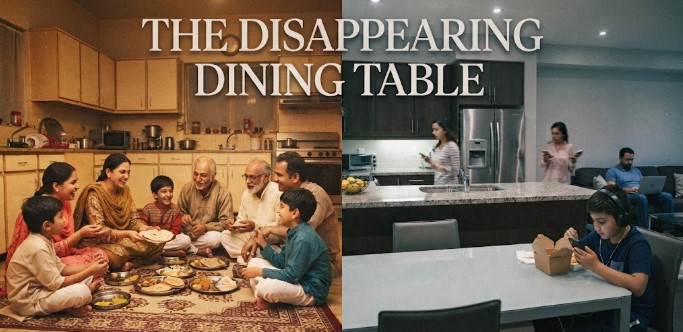
A kitchen is not merely a place where food is prepared. In the traditional South Asian home, it was a centre of love, care, conversation and connection.
Food was slowly cooked, often according to the preferences of every member of the family. Fresh, hot roti reached the table. Everyone was expected to be there. Those who arrived late were waited for, and sometimes scolded. Children sat together, sometimes sharing plates and glasses. The meal was nourishment, but it was also belonging.
The floor mat spread for a family meal was more than a place to eat. It was an informal family forum. Breakfast, lunch and dinner provided opportunities to discuss the day's routine, personal difficulties, children's concerns and family matters. Tensions were released through conversation. Problems were often settled amicably. When the mat was folded away, it seemed that some of the day's tensions were folded away with it.
Then modern life began changing the kitchen.
In the name of convenience and modernity, cooking has increasingly been handed over to domestic help, whose relationship with the family is naturally different from that of a mother caring for her own household. For her, cooking is employment; for a mother, food has traditionally been an expression of care.
When home-cooked food loses its familiar taste and warmth, family members may turn more readily to fast food and home delivery. The cost is not only financial. Frequent dependence on restaurant and processed food can also carry health consequences.
Something else is disappearing: shared time.
Family members may live under one roof yet spend much of their day in separate rooms, protected by the language of privacy and surrounded by individual screens. A sibling may not know what another sibling is facing. A child may carry anxiety without anyone at the dinner table noticing. Emotional distance can grow quietly.
The kitchen, therefore, is not simply about food. It is about the relationships built around food.
Modern life need not mean abandoning the kitchen. Convenience has its place. Domestic help has its place. Eating outside has its place. But a family also needs a place where everyone sits together, speaks freely and listens.
A warm meal cannot solve every problem. Yet a shared meal can create the space in which problems are noticed before they become burdens.
When the kitchen falls silent, the house does not immediately become empty.
But when the family stops gathering around food, something important begins to disappear.

More from Opinion News




Comments
No comments yet. Be the first to comment!
Leave a Comment