

Centuries Apart on the Same Soil
Monday, 20 April 2026
Asem Mustafa Awan
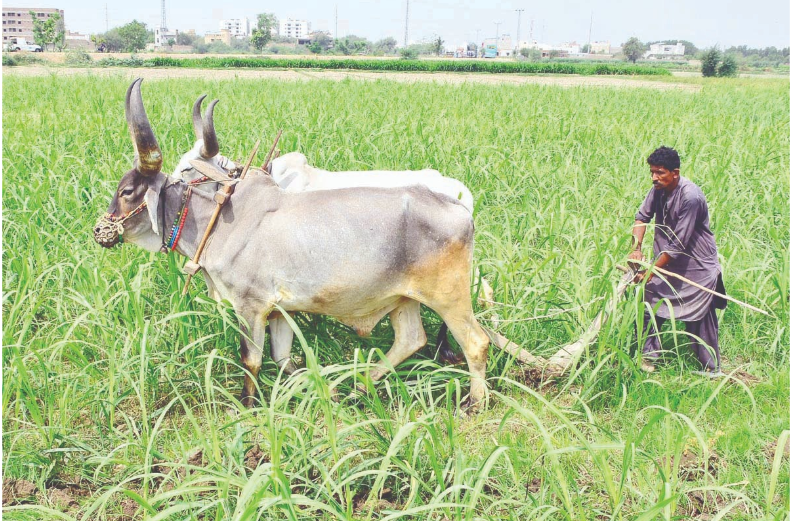
In a green field under an open sky, a young farmer guides a wooden plough, pulled by two bulls cutting through soft earth. It is a scene that feels timeless — almost poetic at first glance. But look closer, and the poetry gives way to a harder truth. This is not tradition by choice. This is survival shaped by limitation.
The plough is as old as civilization itself. From ancient river valleys to early agrarian societies, it marked the beginning of settled life. Thousands of years later, it still marks the limits of it. In a world racing toward automation and precision agriculture, this young man tills his land with tools his ancestors would recognize instantly. Not because he rejects progress, but because progress has not reached him.
The contrast is no longer subtle. It is structural. According to the World Bank, nearly half of the population lives below the poverty line. The United Nations adds a deeper layer — around 40 percent of children face stunted growth, while access to clean drinking water remains out of reach for a vast majority. These are not distant statistics; they live within this frame, in the soil beneath his feet and the effort in his hands.
And yet, elsewhere, comparisons are drawn with cities of the developed world. Skylines are measured against Paris, ambitions aligned with global capitals. But those parallels often stop at the surface. For a narrow slice, the 21st century is real — connected, mobile, and expanding. For the rest, time moves differently. Here, development is not delayed; it feels displaced.
There is no anger in his expression, only focus. The bulls move steadily, the plough follows, and the land responds as it always has. Life goes on — not because it is easy, but because it must. But beneath this persistence lies a quiet question: how long can effort alone compensate for absence?
For many, the answer is already unfolding beyond these fields. It is seen in the journeys taken out of desperation — dangerous crossings, uncertain destinations, and, too often, tragic endings. The search is not just for opportunity, but for escape from a cycle that offers little room to rise.
This image does not reject the past. It exposes the present. It shows a country living in parallel timelines — where advancement and deprivation exist side by side, rarely intersecting.
And as the plough carves its line through the soil, it also draws an invisible divide — not just between land and seed, but between those who move forward with the world, and those still waiting to be carried along.
PHOTO CREDIT APP
More from Opinion News


Comments
No comments yet. Be the first to comment!
Leave a Comment