

Beyond the Police Clearance Certificate
Wednesday, 07 October 2026
Fozia Zahoor
When institutions recruit employees, a police clearance certificate is often considered an essential requirement. It tells us whether a person has a recorded criminal history. But can it tell us whether that person is trustworthy, respectful and safe to work with children and women?
Not necessarily.
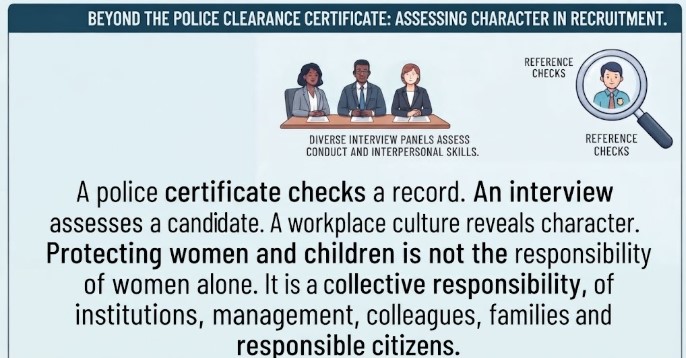
A clean record cannot reveal a person's attitude towards women, respect for personal boundaries, temperament or patterns of inappropriate behaviour. This is particularly important in schools, colleges and workplaces where employees interact closely with women and children. Recruitment, therefore, must go beyond certificates. Interview panels should be sufficiently diverse and professionally equipped to assess not only qualifications and experience but also professional conduct, interpersonal behaviour and respect for boundaries. Behavioural questions, reference checks and careful observation can provide information that a certificate never can.
This does not mean that a person should be labelled on the basis of a single uncomfortable gesture or impression. But repeated boundary violations or behaviour that consistently makes others uncomfortable should not be casually dismissed either. Prevention begins where criminal law may not yet have a role to play. Institutions should be willing to address inappropriate conduct before it develops into something more serious.
Male colleagues also have an important role in creating a safe workplace. Men often recognise inappropriate behaviour in other men. If a colleague repeatedly makes inappropriate remarks, invades personal boundaries, behaves disrespectfully towards women or creates discomfort, responsible coworkers should not simply laugh it off as “just the way he is.” They can remain alert and, where there is a genuine concern, report it confidentially to the appropriate authority. Silence should never become a shield for misconduct.
At the same time, women should not be made responsible for preventing men's misconduct. Awareness is important, but vigilance must never become a substitute for accountability. Institutions must provide confidential complaint mechanisms, protection against retaliation and impartial investigations so that no woman fears becoming “the difficult employee” for speaking up.
Management should also pay attention to patterns. A single concern may require investigation; repeated concerns should never be ignored merely because no criminal offence has yet been established.
And the responsibility begins at home. Children need a trusted adult, often a mother, with whom they can speak without fear or embarrassment. They should be able to say, “Someone made me uncomfortable today,” and know that they will be heard rather than blamed.
A police certificate checks a record. An interview assesses a candidate. A workplace culture reveals character. And a trusting family gives a child the courage to speak.
Protecting women and children is not the responsibility of women alone. It is a collective responsibility, of institutions, management, colleagues, families and responsible citizens.



More from Opinion News






Comments
No comments yet. Be the first to comment!
Leave a Comment