

Pakistan Faces Over 200,000 Annual AMR-Related Deaths as NIH, WHO Urge Responsible Antibiotic Use
Wednesday, 18 November 2026
Health Authorities Warn That Misuse of Antibiotics Could Make Common Infections Life-Threatening Again; One Health Approach Urged to Protect Human, Animal and Environmental Health
Hamid Khan Wazir
ISLAMABAD: Pakistan faces more than 200,000 deaths annually associated with antimicrobial resistance (AMR), including nearly 40,000 deaths directly attributable to resistant infections, prompting the National Institute of Health (NIH) and the World Health Organization (WHO) to call for urgent nationwide action to curb the misuse and overuse of antibiotics.
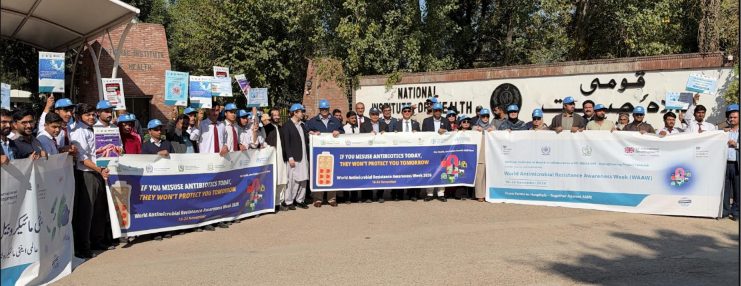
Marking World Antimicrobial Resistance Awareness Week, the NIH and WHO, in collaboration with the UK Health Security Agency (UKHSA), the Food and Agriculture Organization (FAO), students and civil society representatives, organized an awareness walk in Islamabad to highlight the growing threat posed by antimicrobial resistance.
Under this year's global theme, "One Health, One Action: Prevent AMR Now," participants emphasized that combating the crisis requires coordinated efforts across human healthcare, veterinary services, agriculture and environmental protection.
The awareness campaign carried a powerful message for families, healthcare professionals, farmers and other stakeholders: **"If we misuse or overuse antibiotics today, they won't protect us tomorrow."**
Antimicrobial resistance occurs when bacteria, viruses, fungi and parasites develop the ability to withstand medicines designed to eliminate them, making infections increasingly difficult or sometimes impossible to treat. Health experts warn that AMR is undermining decades of medical progress and threatening to turn once-treatable infections into life-threatening conditions.
The growing crisis is being accelerated by the inappropriate prescription and excessive use of antibiotics in healthcare, agriculture and livestock production. Poor infection prevention and control, inadequate access to quality diagnosis and treatment, weak healthcare and veterinary systems, and environmental contamination through wastewater and improper waste disposal are also contributing to the emergence and spread of drug-resistant microorganisms.
According to projections highlighted during the awareness campaign, annual deaths in Pakistan could rise to approximately 63,000 directly attributable deaths and 262,000 associated deaths by 2050 if urgent interventions are not introduced.
NIH Chief Executive Officer Dr. Muhammad Salman stressed that addressing antimicrobial resistance requires a comprehensive One Health strategy that recognizes the close links between human, animal and environmental health.
He identified irrational prescribing practices, the over-the-counter sale of antibiotics without appropriate medical supervision, inadequate infection prevention and control in hospitals and communities, and the misuse of antimicrobials in agriculture and livestock as major factors driving resistance in Pakistan.
WHO Representative in Pakistan Dr. Luo Dapeng described AMR-related deaths as preventable and called for collective action to protect lives. "As we speak, before I finish my five-minute remarks, two people will have died due to antimicrobial resistance or associated reasons in Pakistan," he said.
Dr. Luo emphasized that WHO would continue working alongside Pakistan's NIH and other partners to address the challenge across human, animal and environmental health sectors.
"The science is clear: the misuse and overuse of antibiotics pose a major public health threat, but the good news is that we can all do our part to preserve a healthier future for every family, starting with the choices that we make every day as individuals, by using antibiotics only when they are really needed," he added.
Dr. Zeeshan Iqbal Baig, National Lead at UKHSA, described antimicrobial resistance as one of the most pressing public health threats of the present time.
He warned that the excessive and inappropriate use of antimicrobials in humans, animals and agriculture was contributing to treatment failures, preventable deaths and rising healthcare costs. He called for a coordinated One Health response, stressing the need to move beyond awareness campaigns towards responsible antimicrobial use.
Dr. Pawin Padungtod, One Health Team Lead at FAO Pakistan, said the strong participation in the awareness walk reflected a shared commitment among the government and its partners to address antimicrobial resistance through collective action and stronger cooperation.
"AMR is a growing One Health challenge that requires coordinated action across human, animal and environmental health sectors," he said, adding that everyone could contribute to reducing the risks associated with antimicrobial resistance.
The awareness walk also aimed to promote the key priorities of Pakistan's National Action Plan (NAP) 2.0 on Antimicrobial Resistance. The plan focuses on strengthening surveillance systems across human and animal health sectors, improving public and professional awareness, and enforcing effective infection prevention and control measures in healthcare facilities.
The NIH, WHO and UKHSA urged policymakers, healthcare providers, veterinarians, farmers and the general public to translate commitments into practical, life-saving measures.
They stressed that antibiotics should only be used when medically necessary and under appropriate professional guidance, while calling for stronger monitoring, responsible prescribing, improved hygiene and better infection prevention practices.
Health authorities emphasized that tackling antimicrobial resistance is not solely the responsibility of doctors or hospitals but requires action from every sector and household to safeguard the effectiveness of life-saving medicines for future generations.
About WHO
Founded in 1948, WHO is the United Nations agency that connects nations, partners and people to promote health, keep the world safe and serve the vulnerable. We work with 194 Member States in 150+ locations – so everyone, everywhere, can attain the highest level of health. WHO has been present in Pakistan – a founding member of the Organization – since 1960.


More from Health News




Comments
No comments yet. Be the first to comment!
Leave a Comment