

Cigarette Prices Soar, Yet Smokers Spend More: Gallup
Wednesday, 09 September 2026
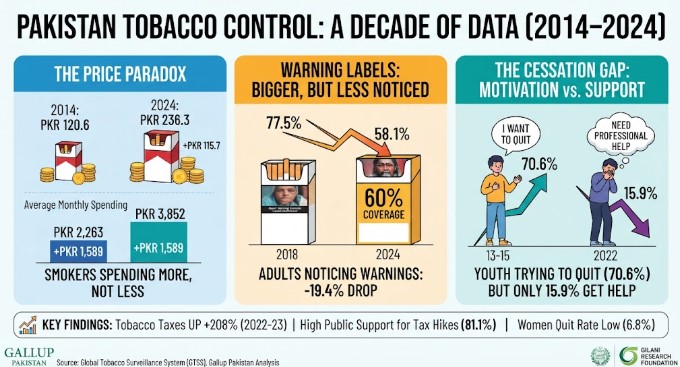
Cost of 20 cigarettes rises by PKR 115.7 in a decade; monthly spending jumps by PKR 1,589, 81.1% of adults favor higher tobacco taxes, while fewer smokers receive help to quit
Hamid Khan Wazir
ISLAMABAD: A decade of higher tobacco taxes, rising cigarette prices and strengthened tobacco-control measures has produced a mixed picture in Pakistan, with new analysis by Gallup Pakistan revealing that while cigarettes have become substantially more expensive, smokers who continue the habit are spending considerably more, while access to professional support for quitting has declined.
The analysis is based on Pakistan’s Global Adult Tobacco Survey (GATS) 2014 and 2024 and Global Youth Tobacco Survey (GYTS) 2013 and 2022, conducted as part of the Global Tobacco Surveillance System.
According to the survey, the inflation-adjusted cost of 20 manufactured cigarettes increased from PKR 120.6 in 2014 to PKR 236.3 in 2024, representing a real increase of PKR 115.7 over the decade. However, the increase in cigarette prices has not translated into lower spending among those who continue to smoke. Average monthly cigarette expenditure among smokers rose from PKR 2,263.7 in 2014 to PKR 3,852.9 in 2024, an increase of PKR 1,589.2 in real terms.
The findings point to a critical challenge for Pakistan’s tobacco-control efforts: raising prices and taxes alone may not be sufficient to help existing smokers quit. The data indicates that while fiscal measures have made tobacco more expensive, the support systems needed to help smokers overcome nicotine dependence have not kept pace.
More Pakistanis Support Higher Tobacco Taxes
Gallup Pakistan’s analysis found strong public support for further tobacco taxation. As many as 81.1% of adults in 2024 favored increasing taxes on tobacco products, indicating substantial public backing for stronger fiscal measures.
At the same time, the cost of 100 packs of cigarettes was equivalent to 5.0% of per-capita GDP, underscoring the significant economic burden associated with tobacco consumption.
The analysis noted that part of the increase in spending among remaining smokers may reflect a selection effect, whereby more price-sensitive smokers are more likely to quit, leaving behind smokers who are more willing or able to absorb higher prices.
Health Warnings Are Larger, but Their Impact Is Declining
Despite strengthened health-warning requirements, fewer smokers reported noticing warnings on cigarette packages in 2024 than in 2014.
The proportion of current smokers who noticed health warnings fell from 77.5% in 2014 to 58.1% in 2024, a decline of 19.4 percentage points.
This decline occurred despite the expansion of warning coverage on cigarette packs from 40% to 60% during the period.
The behavioral impact of the warnings also weakened. The proportion of smokers who thought about quitting because of health warnings fell from 29.7% in 2014 to 20.2% in 2024.
Among women smokers, the figure was particularly low, with only 9.1% reporting that health warnings made them think about quitting in 2024.
The findings suggest that simply increasing the physical size of warnings may not be enough to maintain their effectiveness over time, particularly where smokers become accustomed to repeatedly seeing the same warnings.
Tobacco Advertising Exposure Declines, But Youth Remain Exposed
The analysis found that exposure to tobacco advertising, promotions and sponsorships among adults declined over the decade.
The proportion of adults who noticed any tobacco advertising, promotion or sponsorship fell from 38.6% in 2014 to 30.5% in 2024, while tobacco advertising noticed in stores declined from 20.4% to 17.8%.
However, tobacco users themselves remained significantly more exposed. In 2024, 32.1% of current tobacco users noticed tobacco advertising in stores, compared with 17.8% of adults overall.
The situation among young people remains particularly concerning. In 2022, 64.3% of students aged 13–15 reported seeing tobacco use on television, in videos or in movies, virtually unchanged from 63.3% in 2013.
Meanwhile, exposure to anti-tobacco messages among students declined slightly, from 52.7% in 2013 to 50.7% in 2022.
The Biggest Gap: Smokers Want to Quit, But Support Is Falling
The most significant concern highlighted by the analysis is the widening gap between smokers’ desire to quit and the support available to help them do so.
Among adults in 2024, 39.0% of current smokers planned to quit or were thinking about quitting. Nearly half—49.9%—of smokers who had visited a healthcare provider during the previous 12 months had been advised to quit.
Yet only 24.1% of current smokers had made a quit attempt during the previous 12 months, statistically unchanged from 24.7% in 2014.
The number of successful quitters also remained low. Among adults who had ever smoked daily, only 13.8% had successfully quit by 2024, including 14.9% of men and just 6.8% of women.
Young Smokers Are Trying to Quit With Less Support
The findings are even more striking among young smokers. In 2022, 70.6% of current smokers aged 13–15 had tried to stop smoking during the previous 12 months, up from 58.4% in 2013.
Yet despite this stronger desire to quit, access to professional assistance declined sharply. Only 15.9% of young smokers had ever received help from a cessation programme or professional, compared with 27.0% in 2013.
In other words, more young smokers are attempting to quit, while fewer are receiving professional assistance to do so.
The analysis further found that 57.2% of current young smokers showed signs of nicotine dependence, highlighting the urgent need for accessible and age-appropriate cessation support.
Taxation Must Be Accompanied by Stronger Cessation Support
Gallup Pakistan’s findings suggest that Pakistan’s tobacco-control strategy faces a critical implementation gap. While taxation, advertising restrictions and health-warning requirements have produced measurable changes, these measures have not been matched by sufficient progress in helping existing smokers quit.
The data indicates that tobacco-control policy needs to move beyond price increases alone and place greater emphasis on accessible cessation services, professional counselling, stronger healthcare-based quit support and targeted interventions for young smokers and women.
The analysis concludes that the desire to quit is widespread, but desire alone is not enough. Without accessible and effective support, many smokers—particularly young people experiencing nicotine dependence—may continue to struggle to translate their intention to quit into successful cessation.



More from Health News






Comments
No comments yet. Be the first to comment!
Leave a Comment