

Ustad Amanat Ali Khan Remembered as Timeless Voice of Patiala Gharana
Friday, 18 September 2026
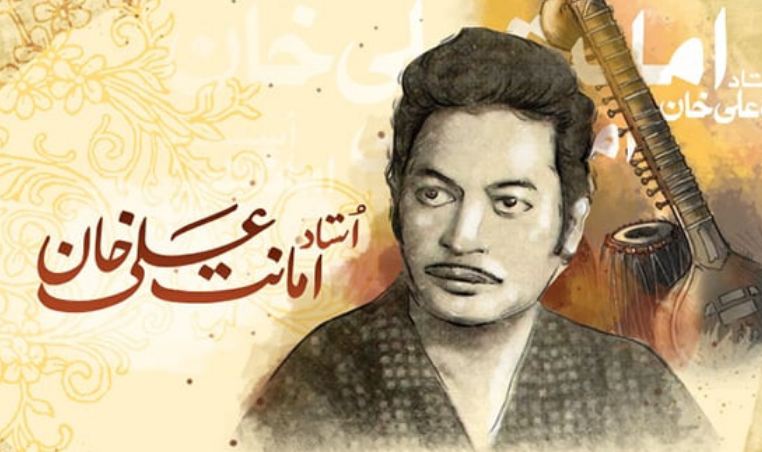
Legendary vocalist’s enduring contribution to classical music and ghazal continues to resonate with generations of listeners
Entertainment Desk
ISLAMABAD: More than five decades after his passing, the distinctive voice and musical legacy of Ustad Amanat Ali Khan continue to live on, with admirers on Friday remembering the legendary vocalist on his 52nd death anniversary.
Widely recognised as one of the prominent exponents of the Patiala Gharana, Amanat Ali Khan left an enduring mark on Pakistan’s classical and ghazal music through his command of raag, thumri and ghazal singing. His artistry enabled him to connect the traditions of classical music with a wider audience, making his work influential well beyond the formal circles of classical music.
Born in 1922 in Hoshiarpur, British India, Amanat Ali Khan belonged to a distinguished musical family. He was the son of Ustad Akhtar Hussain Khan and grandson of Ali Baksh Jarnail, one of the founding figures of the Patiala Gharana. Raised in an environment steeped in music, he received training within the family tradition and developed into a vocalist known for his expressive voice and mastery of sur.
Following the Partition, Amanat Ali Khan migrated to Pakistan in 1948 and settled in Lahore, where he went on to establish himself as one of the country's leading classical vocalists.
His musical journey was closely linked with his younger brother, Ustad Bade Fateh Ali Khan. The brothers formed a celebrated vocal duo and became prominent representatives of the Patiala Gharana across the subcontinent. Their performances helped introduce the richness of the tradition to audiences in both Pakistan and India.
The brothers began performing publicly in the 1940s and gained wider recognition after appearing at the prestigious All Bengal Music Conference in Kolkata in 1949. They subsequently toured extensively across South Asia, strengthening the reputation of the Patiala Gharana and establishing themselves as leading performers of their generation.
Amanat Ali Khan also became a familiar voice on Radio Pakistan and Pakistan Television. During the 1960s and 1970s, he was among the vocalists who successfully earned appreciation in both classical and ghazal formats, demonstrating an ability to preserve classical discipline while reaching a broad listening audience.
His repertoire included numerous memorable ghazals and semi-classical compositions that remain part of Pakistan's musical heritage. Songs such as “Insha Ji Utho,” “Honton Pe Kabhi Unke,” “Yeh Na Thi Hamari Qismat” and “Aa Mere Pyar Ki Khushboo” continue to be associated with his distinctive vocal style.
Amanat Ali Khan's strength was not limited to his voice. He was particularly admired for his command of sur and his ability to render complex classical compositions in an expressive and accessible manner. His singing was known for its powerful upper-register delivery, while his brother Fateh Ali's command of the lower register complemented their performances.
The two brothers' contrasting yet complementary vocal styles became a defining feature of their celebrated performances and helped establish their place among the leading representatives of the Patiala tradition.
In recognition of his contribution to Pakistan's musical heritage, Amanat Ali Khan was honoured with the Pride of Performance by the Government of Pakistan in 1969.
His influence also extended beyond individual performances. Through his recordings, radio broadcasts and television appearances, he helped carry the Patiala Gharana's musical traditions to successive generations at a time when Pakistan's cultural landscape was rapidly evolving.
Ustad Amanat Ali Khan died in Lahore in September 1974 at the age of 52. He was laid to rest at Mominpura graveyard in Lahore. His death marked the loss of one of the country's most distinctive classical voices, but his recordings and musical traditions continued to inspire singers and listeners long after his passing.
More than half a century later, his name remains closely associated with the golden era of Pakistani classical and ghazal music, while his contribution to the Patiala Gharana continues to form an important chapter in the country's cultural history.


More from Entertainment News




Comments
No comments yet. Be the first to comment!
Leave a Comment