

Women Outnumber Men Among Pakistan’s University Graduates for Second Consecutive Year: Gallup Pakistan
Wednesday, 23 September 2026
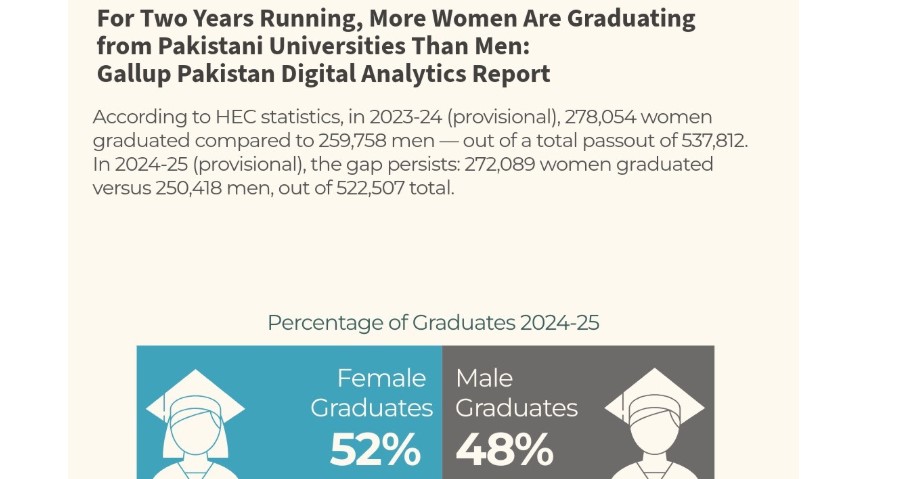
HEC data shows female graduates crossed 50pc in 2023-24 and reached 52.1pc in 2024-25, marking a notable shift in the gender composition of higher education
Hamid Khan Wazir
ISLAMABAD: Women have outnumbered men among university graduates in Pakistan for a second consecutive year, signalling a notable shift in the gender balance of the country’s higher education system, according to a Gallup Pakistan Digital Analytics report based on Higher Education Commission (HEC) statistics.
The report found that 278,054 women graduated from Pakistani universities and higher education institutions in 2023-24, compared with 259,758 men, bringing the total number of graduates that year to 537,812. The trend continued in 2024-25, when 272,089 women graduated compared with 250,418 men, out of a total of 522,507 graduates.
According to the analysis, women accounted for 52.1 per cent of all graduates in 2024-25, confirming that the gender balance in university graduation has shifted in favour of women in recent years. The crossover first occurred in 2023-24, when women moved ahead of men in annual graduate numbers for the first time in the period covered by the analysis.
The development represents a reversal of the pattern seen during the earlier years of the period under review. In 2016-17, male graduates slightly outnumbered female graduates, with 176,837 men compared with 175,566 women. Men continued to account for a larger share of annual graduates through 2022-23, before women moved ahead in 2023-24 and maintained their lead the following year.
Despite the recent shift, the report noted that the overall gender distribution across the full nine-year period remains almost evenly balanced. From 2016-17 to 2024-25, approximately 4.06 million students graduated from Pakistan’s higher education institutions, including around 2,028,544 women and 2,033,426 men. The cumulative figures therefore remain close to a 50-50 gender split, even as the balance has tilted toward women in the most recent years.
The report also highlighted a substantial expansion in Pakistan’s annual higher education graduate output. The number of graduates increased by 48 per cent, rising from 352,403 in 2016-17 to 522,507 in 2024-25, with the highest annual total recorded in 2023-24 at 537,812 graduates.
Another major change identified by the analysis is the growing dominance of bachelor’s degree graduates within the annual output. Their share increased from 61.5 per cent in 2016-17 to 74.9 per cent in 2024-25, indicating a significant change in the composition of higher education qualifications being completed.
At the same time, the share of master’s graduates declined considerably over the period. The number of students completing master’s degrees fell from 91,159 in 2016-17 to 79,207 in 2024-25, while their proportion of the annual graduate total dropped from 25.9 per cent to 15.2 per cent.
The report also pointed to a notable rise in advanced research qualifications. The number of PhDs awarded annually more than tripled, increasing from 1,416 in 2016-17 to 4,276 in 2024-25. The increase highlights the expansion of doctoral-level output even as the overall structure of university graduation has shifted increasingly toward bachelor’s degrees.
Gallup Pakistan said the findings offer a more nuanced picture of gender and higher education in the country. While Pakistan continues to face significant challenges in broader gender-related indicators, the higher education data shows areas where participation and educational attainment among women have been improving.
The report was prepared by the Gallup Pakistan Digital Analytics team to examine higher education statistics and gender composition among graduates. The data has also been converted into a dashboard by the HEC to facilitate access and analysis.
The findings provide an important snapshot of changing educational patterns in Pakistan, particularly the sustained rise in the proportion of women among university graduates. However, the report's figures relate specifically to higher education graduates and should not, by themselves, be taken as a measure of overall gender equality or women's participation across all levels of education, employment and society.

More from Education News



Comments
No comments yet. Be the first to comment!
Leave a Comment