

WAWA Education Survey: A Potential Game Changer for Long-Neglected South Waziristan
Thursday, 08 October 2026
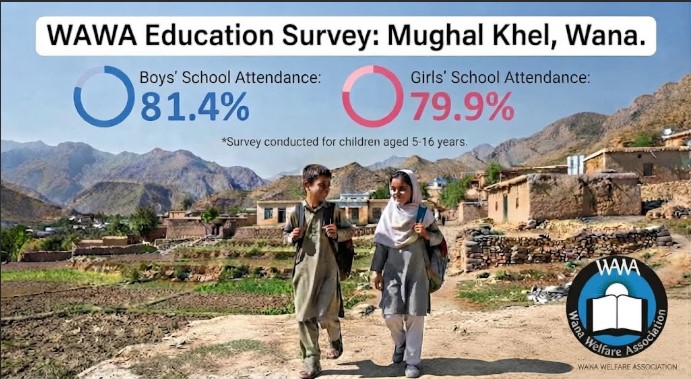
Comprehensive survey highlights boys’ school attendance at 81.4% and girls’ at 79.9% in Mughalkhel, Wana, alongside 20 doctors, 37 engineers and 253 ulema; 189 teams and 839 volunteers drive a landmark initiative to map educational gaps and guide social development across Lower South Waziristan.
Hamid Khan Wazir
WANA: In a potentially transformative initiative for one of Pakistan’s long-neglected regions, the Wana Welfare Association (WAWA), a non-governmental, non-profit organisation, has released the findings of its education and literacy survey for Village Mughal Khel in Wana, offering a powerful evidence-based picture of the community’s educational progress, persistent challenges and future opportunities.
In an encouraging sign, the survey reports that 81.4 per cent of boys and 79.9 per cent of girls in the surveyed age groups are attending school, reflecting a promising commitment to education among families in the locality. However, the children still out of school, the number of students discontinuing education after matriculation and intermediate, and widespread youth unemployment underline the urgent need to turn this valuable data into concrete action.
Backed by 189 survey teams and 839 volunteers across Lower South Waziristan, WAWA’s initiative could prove a game changer by helping identify educational gaps, bring out-of-school children into classrooms and build a practical roadmap for lasting educational and social development.
The findings are significant not only for Mughal Khel but also for the wider Lower South Waziristan region, where reliable, village-level information can help communities, educators, policymakers and public representatives identify priorities and design targeted interventions.
WAWA deserves strong recognition for undertaking this extensive exercise. By collecting information at the grassroots level, the association is creating an evidence base that could help transform education planning, strengthen public accountability and guide efforts to ensure that children are not left behind simply because their educational needs remain undocumented.
189 Teams and 839 Volunteers Join the District-Wide Initiative
According to the details, the broader survey covering educational, religious and social matters began across Lower South Waziristan on August 25, 2026. A total of 189 teams were formed, with 839 individuals volunteering their services for the initiative.
The survey has now entered its final stages, with the association releasing findings from individual localities in sequence. The Mughal Khel report is among the important village-level assessments emerging from this exercise.
WAWA has announced that reports on other major villages will be presented in the coming days. These will be followed by surveys from Tehsil Barmal, Shakai, Toi Khullah and Wana. After the locality-wise reports have been presented, the association plans to formally release a consolidated picture of the entire surveyed area.
This phased approach can help communities understand their circumstances village by village before the findings are brought together into a wider assessment of educational and social needs across Lower South Waziristan.
The initiative is particularly valuable because effective planning begins with knowing the scale and location of a problem. Without reliable information, it is difficult to determine how many children need school placements, where educational facilities are inadequate, which students are at risk of dropping out, or what support unemployed young people require.
School Attendance: Encouraging Progress, but Hundreds Still Left Behind
The Mughal Khel survey recorded information about children aged five to 16, revealing encouraging school-attendance figures alongside a significant challenge that demands immediate attention.
According to the released findings, 856 of the 1,115 boys covered by the survey were attending school, while 195 were reported to be out of school. Among 1,072 girls, 800 were attending school and 201 were out of school.
The reported attendance rates were 81.4 per cent for boys and 79.9 per cent for girls, indicating a relatively narrow gender gap in school attendance.
These figures offer grounds for encouragement. They suggest that a substantial proportion of children in the locality are connected to formal education, while the comparatively small difference between the reported attendance rates of boys and girls provides a useful starting point for promoting equal educational opportunities.
However, the number of children reported to be out of school remains deeply concerning because every child excluded from education represents a lost opportunity to develop knowledge, skills and the capacity to contribute to society.
The findings also demonstrate why a detailed survey matters. Once out-of-school children are identified at the village level, local authorities and community organisations can work towards determining their individual circumstances and developing appropriate responses.
These may include helping families secure school admissions, identifying financial barriers, improving access to nearby schools, supporting children who have fallen behind and raising awareness among parents about the long-term value of education.
The Education Gap Beyond Matriculation and Intermediate
The survey also highlights a critical challenge beyond school enrollment, enabling students to continue their education after completing secondary and higher-secondary schooling.
According to the reported findings, 270 individuals completed matriculation, or Grade 10, without pursuing further education. Another 224 completed intermediate, or Grade 12, but did not continue their studies.
The locality has produced 229 college graduates and 166 university-degree holders, while 198 students are currently pursuing higher education in colleges and universities.
These figures demonstrate that educational achievement exists in Mughal Khel, but progression through the education system remains an important concern.
The presence of 198 students pursuing higher education is also an encouraging foundation. With appropriate support, these students could become future professionals, educators and community leaders who contribute to the development of their area.
Religious Education Remains an Important Part of Community Life
The Mughal Khel survey also documents participation in religious education. According to the findings, 135 students--- 64 boys and 71 girls --- are enrolled in madrasas, while 253 individuals are reported as madrasa graduates, or ulema.
These figures provide a useful picture of the community’s religious educational landscape alongside its formal schooling and higher-education indicators.
The survey separately identifies 25 individuals in the Tablighi Jamaat category, including those who have spent four months in the path of Allah as part of their religious preaching activities.
Doctors, Engineers and Graduates: A Foundation for Future Progress
Despite the challenges, Mughal Khel has produced people with professional qualifications and experience that could become an important resource for local development.
The survey records 37 engineers and 20 doctors, alongside college and university graduates and students pursuing higher education.
277 Unemployed Youth Highlight Urgent Need for Skills and Jobs
One of the most pressing findings concerns employment. The survey reports 277 unemployed young people aged 18 to 50, highlighting the need to examine the relationship between education, skills development and access to work.
Local stakeholders could use the findings to assess demand for vocational and technical training, digital skills, apprenticeships, entrepreneurship support and links with employers.
The 277 reported cases should therefore be treated not merely as a statistic but as a call to investigate the barriers preventing residents from accessing meaningful work.
Why WAWA’s Survey Could Prove a Game Changer
The most important contribution of WAWA’s initiative may ultimately be the practical use of its findings.
For years, communities with limited access to development resources have often faced difficulties demonstrating the precise scale of their needs. A comprehensive local survey can help close that information gap by identifying educational participation, gaps in progression, professional resources and employment challenges.
For Mughal Khel, the findings could support a coordinated action plan built around several priorities
Identify every out-of-school child: Verify the records and work with families, schools and relevant authorities to facilitate enrollment and continued attendance.
Reduce school dropouts: Investigate why students leave after matriculation or intermediate and develop targeted financial, academic and counselling support.
Support girls’ education: Build on the reported attendance rate while identifying barriers that may prevent girls from enrolling or completing their education.
Expand access to higher education: Connect eligible students with scholarships, colleges, universities and career-guidance services.
Strengthen technical and vocational training: Assess the needs of unemployed youth and connect training programmes with realistic employment opportunities.
Mobilise local professionals: Encourage doctors, engineers, graduates and other skilled residents to contribute through mentoring and community education initiatives.
Use evidence to guide public investment: Share verified findings with education authorities and policymakers to help direct resources towards documented needs.
Education: The Most Powerful Tool for Lasting Change
Education is far more than a route to academic qualifications. It provides individuals with the knowledge, skills and confidence to make informed decisions, pursue livelihoods and contribute to their communities.
For a region seeking wider social and economic progress, improving educational access and completion can help create opportunities across generations. But enrollment must be accompanied by quality teaching, sustained attendance, progression to higher levels and pathways into employment.
The Mughal Khel findings underline both the promise and the challenge. The locality has children attending school, students pursuing higher education, qualified professionals and religious scholars. It also has children reported to be out of school, students who have discontinued their studies and hundreds of unemployed residents.
The task now is to connect these realities through practical interventions that ensure educational opportunities translate into real outcomes. As the association proceeds with reports from other major villages and then Tehsils Barmal, Shakai, Toi Khullah and Wana, the eventual consolidated assessment is expected to provide a broader picture of the area's educational and social needs. That final report could help establish a stronger basis for prioritising interventions across Lower South Waziristan.
WAWA’s 189 teams and 839 volunteers have contributed to an initiative that deserves recognition for bringing grassroots information into the development discussion. The next challenge is to ensure that their work leads to action: more children in classrooms, fewer students abandoning education, wider access to professional and technical training, and better opportunities for young people to earn a dignified livelihood.

More from Education News


Comments
No comments yet. Be the first to comment!
Leave a Comment