

WAWA Education Survey Exposes Girls’ Education Crisis, Mass Unemployment in South Waziristan
Sunday, 11 October 2026
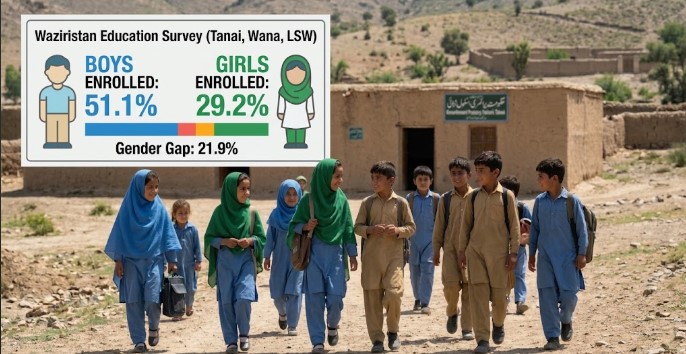
Survey in Tanai, Tehsil Wana, Lower South Waziristan, reveals that 70.8pc of school-age girls are out of school, 696 people aged 18–50 are unemployed, while madrassa enrolment reflects the community’s strong commitment to religious education.
Hamid Khan Wazir
WANA: An important village-level education and literacy survey in Tanai, Tehsil Wana, Lower South Waziristan District, Khyber Pakhtunkhwa, has exposed deep-rooted challenges in the long-neglected region, revealing a stark gender gap in school enrolment, with only 29.2 per cent of school-age girls attending school compared with 51.1 per cent of boys, alongside a high number of out-of-school children and widespread unemployment.
Conducted by the Wana Welfare Association (WAWA), a non-governmental, non-profit organisation, the grassroots assessment provides a valuable snapshot of the area’s educational and socio-economic challenges. Its findings highlight an urgent need for targeted interventions while offering government departments and policymakers locally gathered data to help shape more effective education, skills-development and employment policies.
The survey also reveals an encouraging picture of religious education, with 437 children enrolled in madrassas, including 234 girls and 203 boys. However, the figures on formal schooling raise serious questions about equal educational opportunities for girls and boys and the future prospects of the region’s younger generation.
Girls left far behind in formal education
The most striking finding concerns the disparity between boys’ and girls’ participation in formal schooling. According to WAWA’s survey, 70.8 per cent of girls aged 5-16 in Tanai are out of school, compared with 44.9 per cent of boys in the same age group.
Of the 1,162 girls counted in the survey, 657 were reported to be out of school, while 271 were attending formal educational institutions. Among 1,621 boys, 637 were out of school and 781 were enrolled.
The reported figures show that girls face a substantially greater barrier to accessing formal education than boys. The situation calls for focused efforts to identify the reasons behind girls’ exclusion, improve access to schools, address shortages of educational facilities and engage parents and community representatives in promoting girls’ education.
Madrassa education shows encouraging participation
Alongside the challenges facing formal education, the survey records substantial participation in religious education. A total of 437 children---203 boys and 234 girls--- are enrolled in madrassas in the surveyed area. The fact that girls account for more than half of the reported madrassa enrolment highlights the important role religious institutions play in the educational lives of local families.
WAWA’s findings also identify 161 madrassa graduates who have qualified as religious scholars, while 79 community members are associated with the Tableeghi Jamaat.
These figures provide a broader picture of the community’s educational and religious landscape. The challenge is to ensure that religious education and formal schooling are not treated as competing priorities, while expanding opportunities for children to acquire the literacy, scientific knowledge, technical skills and qualifications needed to navigate a changing economy.
Education beyond matriculation remains a major challenge
The survey also raises concerns about the limited progression of students into higher education and the number of people whose formal education appears to have ended after secondary or higher-secondary qualifications.
According to the reported figures, 127 individuals had passed Grade 10 without pursuing further education, while 135 had passed Grade 12 but had not continued their studies. The survey additionally identified 100 college graduates and 84 university graduates, while 89 students were currently enrolled in colleges or universities.
These figures highlight the need for further investigation into the barriers preventing students from continuing their education, including financial hardship, limited access to higher educational institutions, transportation difficulties and a lack of local opportunities.
Improving access to intermediate and degree colleges, scholarships, career counselling and vocational training could help students overcome barriers to further education and develop skills aligned with employment opportunities.
696 people reported unemployed as job opportunities remain scarce
The survey’s employment findings underline another major challenge confronting Tanai. WAWA recorded 696 unemployed people aged between 18 and 50, a figure that points to significant employment pressures in the surveyed community.
Unemployment among educated residents is particularly important to examine because it can mean that years of schooling and professional training do not translate into productive work. At the same time, residents without formal qualifications may face even greater difficulties securing stable livelihoods.
The survey identified only 16 practising medical doctors and 13 qualified engineers in the area. These figures offer a glimpse of the professional workforce but do not, by themselves, establish the full extent of local shortages or the employment status of every qualified person.
The findings strengthen the case for better access to technical and vocational education, entrepreneurship support, job-oriented training and investment that can create sustainable employment opportunities within the region.
WAWA survey offers policymakers a local evidence base
Beyond highlighting individual challenges, the survey demonstrates the value of collecting reliable information at the village level.
WAWA deserves recognition for undertaking a grassroots education and literacy assessment that documents out-of-school children, educational attainment, further-study participation, religious education, unemployment and the presence of qualified professionals.
For areas where comprehensive and regularly updated local data may be limited, such assessments can help identify gaps that broad district or provincial statistics might not fully capture. Properly documented village-level information can assist government departments, educational authorities, development organisations and donors in directing resources towards communities and groups with the greatest needs.
The findings could help authorities identify where additional girls’ schools are needed, which children require support to enter or return to education, where students are dropping out, and what barriers prevent matriculates and intermediate graduates from pursuing higher studies. Employment data could also support the planning of vocational programmes and initiatives tailored to local economic conditions.
A wider village-by-village picture to emerge
WAWA plans to release further findings from its phased, village-wise surveys covering other parts of Lower South Waziristan. As additional assessments become available, they could provide a more detailed picture of educational access, literacy, school participation, unemployment and professional capacity across the region.
Such evidence could form the basis of a practical development agenda built around measurable needs rather than assumptions. It could also help authorities track progress by comparing future findings with the initial village-level data.
The Tanai survey delivers a clear message that girls’ exclusion from formal schooling, interruptions in education after matriculation and Grade 12, and unemployment require sustained attention. At the same time, participation in religious education and the community’s existing pool of educated residents provide foundations on which further progress can be built.
By continuing its village-level assessments, WAWA is helping bring local realities into sharper focus. The next step is for government institutions, civil society organisations and development partners to use such evidence to design targeted interventions, expand educational opportunities and create realistic pathways from education to employment.

More from Education News


Comments
No comments yet. Be the first to comment!
Leave a Comment