

Only One Girl Attends School in Manra as WAWA Survey Sounds Alarm Over Education Crisis in Bermal
Saturday, 17 October 2026
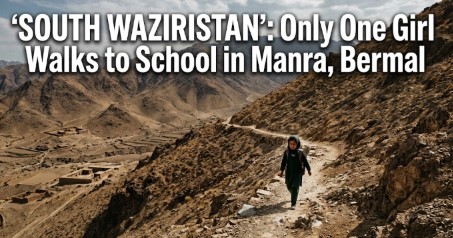
Just 55 children are recorded as attending school out of 2,541 children aged 5–16 in Mara village, South Waziristan district, including only one girl and 54 boys. The WAWA survey also reports 634 madrassa students, 255 unemployed young people, no doctors or engineers, and very few residents with higher educational qualifications.
Hamid Khan Wazir
WANA, SOUTH WAZIRISTAN: A deeply disturbing picture of educational deprivation has emerged from Manra village in Tehsil Bermal, South Waziristan district, Khyber Pakhtunkhwa (KP), where a survey conducted by the Wana Welfare Association (WAWA) has revealed alarmingly low school attendance, particularly among girls.
The findings highlight the severity of the crisis, with only one girl reportedly attending school out of approximately 1,000 girls, alongside limited representation in higher education and professional fields, underscoring the urgent need for measures to improve access to education and expand opportunities for children in the region.
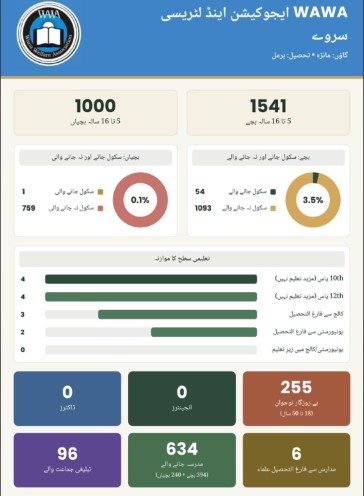
According to the WAWA's education and literacy survey, the village has 2,541 children aged between five and 16, comprising 1,000 girls and 1,541 boys. Of these, only one girl and 54 boys are recorded as attending school, representing reported attendance rates of approximately 0.1 per cent among girls and 3.5 per cent among boys.
The figures point to a profound education challenge for the community, with girls facing particularly stark exclusion. They also raise questions about the availability of formal schooling, access to educational facilities and the effectiveness of efforts to reach children in remote and underserved areas.
The survey does not establish the reasons behind the low attendance, but its findings call for urgent verification and a comprehensive response from the relevant education authorities.
Few Residents Progress Beyond School-Level Education
The survey's educational attainment figures reveal another concerning aspect of the community's educational profile. According to the infographic, four people have passed the 10th grade without pursuing further education, while another four have passed the 12th grade but have not continued their studies. Three people are listed as college graduates, and two as university graduates. No one is recorded in the category of those currently pursuing university or college education.
These figures suggest a limited presence of residents progressing to higher education. They also raise questions about the availability of colleges, financial constraints, access to universities and the opportunities available to students seeking to continue their education.
The figures do not, by themselves, establish why students discontinue their studies or whether all educational institutions and qualifications have been captured. Nevertheless, they highlight the need to examine the transition from school to college, university and employment.
No Doctors or Engineers Recorded
The infographic also records zero doctors and zero engineers in the surveyed community. The absence of such people in these categories raises concerns about the community's access to pathways into specialised higher education and professional careers. Expanding educational opportunities, improving career guidance and helping students overcome financial and geographical barriers could be important steps towards changing this picture.
255 Unemployed Young People Reported
Employment is another major concern highlighted by the survey, which records 255 unemployed young people aged 18-50. The figure points to a substantial employment challenge among the people covered by the survey. Education, vocational training and access to decent work are closely connected. Without opportunities to complete schooling, pursue further education or acquire marketable skills, young people can face additional barriers to securing sustainable livelihoods.
The government and relevant development organisations should assess local employment needs and explore vocational training, technical education, digital skills programmes and other initiatives that can improve access to work.
Madrassas Remain an Important Part of the Educational Landscape
Amid the low reported school attendance, religious educational institutions feature prominently in the WAWA survey. The infographic records 634 madrassa students, comprising 394 boys and 240 girls, alongside six religious scholars listed as having graduated from madrassas. It also records 96 tablighi jamaats in the surveyed community.
These figures highlight the presence of religious education and community-based religious networks in local life. Madrassas provide educational opportunities for many children and deserve recognition for their contribution to learning and community engagement.
There is also considerable scope for constructive collaboration among religious institutions, local communities and public education authorities to expand educational opportunities. Joint efforts to strengthen literacy, numeracy and access to further learning could help equip children with essential skills and open up a wider range of opportunities for their future.
Government Must Turn the Findings into Action
The WAWA survey presents several interconnected challenges, as low reported school attendance, particularly among girls; limited progression to higher education; no doctors or engineers recorded; and 255 unemployed young people.
Addressing these issues requires more than isolated enrolment campaigns. Education authorities should assess existing school facilities, identify children who are not attending school and investigate barriers affecting girls and boys.
A practical response should include functioning schools within reasonable reach, adequate teaching staff, recruitment of female teachers where needed, financial assistance for disadvantaged families, safe access to classrooms and community engagement involving elders, religious scholars and local organisations.
Authorities should also examine why students discontinue education after the 10th and 12th grades, improve access to college and university opportunities, and connect young people with technical training and employment programmes.
The figures from Manra village are a warning that educational access, higher learning and employment opportunities require urgent attention. Every child deserves the opportunity to attend school, every student should have a fair chance to continue their education, and young people need pathways towards productive and dignified livelihoods.
For the government and local stakeholders, the priority must now be to identify the gaps and deliver measurable improvements in educational access and opportunity.
More from Education News


Comments
No comments yet. Be the first to comment!
Leave a Comment