
PIDE Unveils Six-Point Roadmap to Boost Pakistan’s Exports to $100b by 2035
Friday, 16 October 2026
39th PSDE Conference Calls for Lower Trade Costs, Policy Continuity and Diversification into Digital, Maritime and Creative Economies
Hamid Khan Wazir
ISLAMABAD: Pakistan must accelerate structural reforms, reduce trade and logistics costs, ensure policy continuity and diversify its export base to achieve sustainable and export-led economic growth, experts and policymakers said at the conclusion of the 39th International Conference of the Pakistan Society of Development Economists (PSDE), hosted by the Pakistan Institute of Development Economics (PIDE).
The two-day conference outlined a six-point reform roadmap aimed at addressing longstanding barriers to export growth, strengthening investor confidence and unlocking new opportunities in information and communications technology (ICT), artificial intelligence (AI), agriculture, minerals, the blue economy, tourism and creative industries.
Participants stressed that achieving the national ambition of $100 billion in exports by 2035 would require consistent policies, competitive production, efficient trade infrastructure and stronger private-sector investment.
Chief guest Rana Ihsaan Afzal Khan, Coordinator to the Prime Minister on Commerce and Industries, said the National Tariff Policy 2025–30 would rationalise around 7,500 tariff lines and cap customs duties at 15 per cent. He said approximately 500 regulatory requirements were under review, SME financing was set to double from PKR 1 trillion to PKR 2 trillion, and trade procedures were being streamlined through the Trade Facilitation Board and Pakistan Single Window. He identified ICT, artificial intelligence, agriculture, minerals and the blue economy as key drivers of export diversification.
Presenting the conference’s key findings, Dr. Faheem Jehangir, Dean (Policy) at PIDE and Secretary of PSDE, highlighted a stark imbalance: Pakistan’s GDP has doubled over the past 15 years, while exports have barely grown. He attributed this to protection-oriented incentives, policy discontinuity, political uncertainty, weak investor confidence, limited strategic trade agreements, high logistics and border costs, and a narrow export base.
The conference outlined six reform priorities: sustaining URAAN Pakistan beyond political cycles; reforming tariffs and pursuing strategic free trade agreements; streamlining logistics oversight and strengthening the Pakistan Single Window and Corridor Export Coordination Cells; protecting investors through adequate foreign exchange reserves, risk-hedging mechanisms and simpler regulations; upgrading exporters through export-oriented investment and SME clusters; and developing new growth engines in AI-enabled agriculture, ICT, the blue economy, tourism and creative industries. Improved Single Window integration and corridor coordination could reduce trade costs by 10–14 per cent, while around 5,000 new SMEs could generate an additional US$2.5 billion in exports.
The concluding panel, titled “How to Export More: Learning from Newly Industrialised Economies,” was chaired by Prof. Dr. Zafar Nawaz Jaspal, Vice Chancellor of Quaid-i-Azam University, and moderated by Tahir Habib Cheema, Chief (Admin & Finance) at the Federal Board of Revenue (FBR). Panellists Syed Asad Ali Shah, Governance and Economic Reform Specialist; Dr. Babur Wasim, Senior Economist at the Asian Development Bank; Shafiq Shehzad, Director General of Trade Policy at the Ministry of Commerce; and Dr. Madiha Riaz, Professor of Economics at PIDE, stressed that policy continuity, public trust, trade-specific skills, reliable energy and predictable tax and customs regimes were essential for sustained investment. They cautioned that cheap labour and tax incentives alone could not ensure long-term competitiveness.
Technical sessions examined digital trade, port digitalisation, sustainable fisheries, Blue Bonds and overseas labour mobility aligned with verified international demand. Researchers linked tourism growth to strong institutions and the rule of law, while proposing a Music Export Council and a National Music Export Fund to promote creative exports.
Dr. Kabir Ahmed Sidhu, Chairman of the Securities and Exchange Commission of Pakistan (SECP), delivered the Allama Iqbal Memorial Lecture, titled “Beyond the Mandi: Connecting Pakistan’s Farms to Finance, Markets and Exports.” The session was chaired by Dr. Sardar Mohazzam, former Managing Director of the National Energy Efficiency and Conservation Authority (NEECA). Prof. Dr. David Daokui Li of Tsinghua University, Beijing, delivered the Mahbub ul Haq Memorial Lecture, titled “Three Key Lessons and Pragmatic Forms of Assistance from China,” chaired by Dr. Samuel Rizk, UNDP Resident Representative.
The conference received 204 extended abstracts, of which 24 papers, including 10 authored by women, were selected through blind peer review. Of 78 PhD poster submissions, 31 were selected for presentation, with women accounting for 60 per cent of entries. The newly introduced PhD Symposium brought together 31 scholars, including 19 women, who received mentoring from Dr. Eatzaz Ahmed of Iqra University on research design and Tatiana Golea of Springer Nature on international publishing. PSDE also enrolled 541 new members through its new digital membership portal.
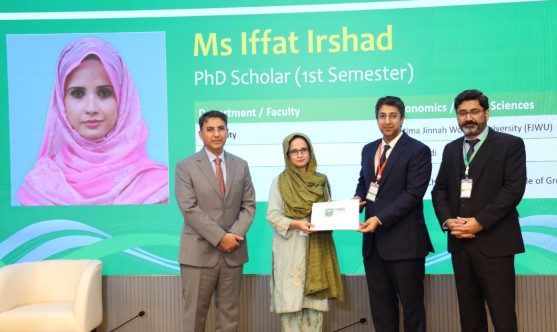
Dr. Jamshed ur Rahman of Government College University, Lahore, won the Best Research Paper award, worth PKR 300,000, followed by Dr. Mohammad Ali of NESPAK, Islamabad, who received PKR 200,000, and Fatima Ejaz of Fatima Jinnah Women University, Rawalpindi, who received PKR 100,000. In the Best Research Poster category, Iffat Irshad, a PhD scholar at Fatima Jinnah Women University, Rawalpindi, won first prize of PKR 150,000, while Muhammad Asif Ali, a PhD scholar at the University of Swabi, received second prize of PKR 100,000.
In his closing address, Dr. Nadeem Javaid (SI), Vice Chancellor of PIDE and President of PSDE, said export-led growth was essential to Pakistan’s economic stability. He called for a shift from managing scarcity to creating wealth through productivity and innovation, urging policymakers to translate the conference’s findings into practical policies and encouraging young scholars to pursue policy-relevant research. He thanked GIZ, the Asian Development Bank, the Higher Education Commission, Quaid-i-Azam University, international experts and the PIDE team for their support despite austerity-related constraints before formally declaring the conference closed.
The conference concluded at a critical time as Pakistan seeks to translate economic stability into sustained, export-led growth. Its recommendations will be shared with policymakers and relevant development stakeholders to help create an enabling environment for achieving the target of US$100 billion in exports by 2035. Strong participation throughout the two-day event, with conference halls remaining packed, reflected considerable interest in shaping Pakistan’s economic future.

More from Business News


Comments
No comments yet. Be the first to comment!
Leave a Comment