

Fuel Prices Stay Unchanged in Pakistan Despite Decline in Global Oil Prices
Friday, 26 June 2026
Staff Report
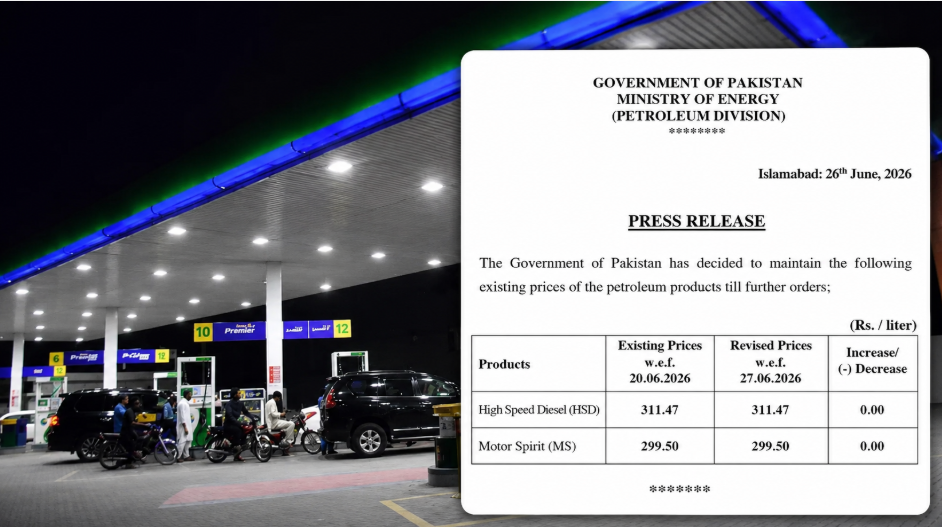
ISLAMABAD: Contrary to expectations of another reduction in fuel prices amid a continued decline in international crude oil markets, the federal government on Friday decided to keep petroleum prices unchanged for the coming week.
According to a notification issued by the Petroleum Division, the price of petrol will remain at Rs 299.50 per litre, while high-speed diesel (HSD) will continue to be sold at Rs 311.47 per litre until further orders.
The decision comes just a week after Prime Minister Shehbaz Sharif announced substantial cuts in fuel prices, reducing petrol by Rs74 per litre and diesel by Rs67 per litre, following a sharp decline in global oil prices.
Market analysts had anticipated further relief for consumers as international crude prices continued their downward trend. On Friday, Brent crude fell nearly 2 per cent to around $73.79 per barrel, while US West Texas Intermediate (WTI) dropped about 2 per cent to $70.48 per barrel, putting both benchmarks on course for significant weekly losses.
It is pertinent to mention here that a day ago, petrol prices in Pakistan could decline further if international crude oil prices continue to fall, Prime Minister’s Adviser Rana Sanaullah said. He said the government has constituted a team to closely monitor global petroleum markets and assess their impact on domestic fuel rates. Sanaullah noted that oil prices had surged during the US-Iran conflict due to supply concerns but have since eased. He reiterated the government's commitment to passing on the benefit of lower international oil prices to consumers.
Global oil markets have remained volatile in recent weeks due to concerns surrounding the conflict between the United States and Iran and disruptions linked to the Strait of Hormuz. However, easing supply fears and the movement of previously stranded oil tankers through the strategic waterway have helped push crude prices lower.
Petrol is predominantly used by private vehicle owners, motorcyclists and public transport operators, meaning any change in its price directly affects middle- and lower-income households. Likewise, diesel prices have a broader economic impact, as the fuel is extensively used in the transport sector, agriculture, heavy machinery, power generation and industrial activities.
The government has been conducting weekly reviews of petroleum prices in response to heightened volatility in international energy markets, particularly following tensions in the Gulf region.



More from Business News






Comments
No comments yet. Be the first to comment!
Leave a Comment