
Pakistan Climbs Four Places in Global Innovation Index, Reclaims ‘Overperformer’ Status
Thursday, 29 October 2026
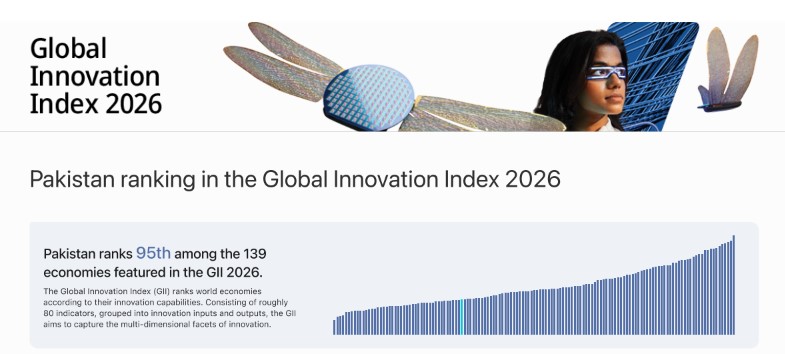
WIPO ranks Pakistan 95th among 139 economies, citing strengths in mobile app development, ICT services exports and digital innovation, despite persistent gaps in research, infrastructure and innovation inputs.
Web Desk
ISLAMABAD: Pakistan has climbed four places to rank 95th among 139 economies in the Global Innovation Index (GII) 2026, reclaiming its status as an innovation “overperformer” for the fourth time, according to a report released by the World Intellectual Property Organisation (WIPO) on Thursday.
The improvement from 99th position in 2025 highlights Pakistan’s ability to generate innovation outcomes beyond what might be expected at its level of economic development. However, the country’s relatively weak performance in innovation inputs underscores the need for sustained investment in research, infrastructure and human capital to translate its emerging strengths into broader economic gains.
According to the GII 2026, Pakistan ranked 121st in innovation inputs but performed considerably better in innovation outputs, securing 72nd position. Both rankings improved compared with the previous year, indicating progress in converting available resources into measurable innovation results.
WIPO defines innovation overperformance as a country’s ability to produce stronger innovation outcomes than expected for its level of development. Pakistan previously held this distinction in 2022 and 2024, making its return to the category a notable achievement.
The report identified Pakistan’s strengths primarily in the digital economy, particularly mobile application development, information and communication technology (ICT) services exports, high-tech imports and software spending. It also highlighted the country’s relatively strong scientific output and university quality as factors supporting the development of its digital economy.
“Innovation overperformance shows that innovation does not follow a straight line from income to results,” the report stated, adding that countries could achieve stronger outcomes by building on focused areas of strength.
Despite the improvement, Pakistan did not feature among the leading innovation clusters in any specific pillar of the index, including human capital and research, infrastructure and other major innovation categories. This points to continuing structural challenges that could limit the country’s ability to sustain and expand its gains.
Among 36 lower-middle-income economies, Pakistan ranked 15th, while it secured eighth place among 11 economies in Central and Southern Asia. Pakistan’s innovation ranking has fluctuated over the past seven years. It stood at 107th in 2020, improved to 99th in 2021 and rose to 87th in 2022. The country subsequently ranked 88th in 2023, 91st in 2024 and 99th in 2025 before moving up to 95th in the latest index.
Globally, Switzerland, Sweden and the United States retained the top three positions, with Switzerland maintaining its lead for the 16th consecutive year. South Korea and Singapore ranked fourth and fifth, respectively, while China remained at 10th place as the only middle-income economy among the top innovation leaders. Japan ranked 12th and Hong Kong, China, 14th.
Europe continued to dominate the top 25, accounting for 14 economies. The Netherlands improved to seventh place, while Austria moved to 18th. WIPO noted that the leading economies had remained largely unchanged from 2025, reflecting continuity at the forefront of global innovation.
The report’s Innovation Tracker also pointed to continued, although slower, progress across the global innovation cycle. Improvements were recorded in scientific output, corporate research and development (R&D), battery costs and technology adoption. However, around three-quarters of the indicators remained below their decade-long averages.
Global research spending remained historically high, with R&D intensity approaching two per cent of gross domestic product (GDP). The report also warned that the global economic environment had become more challenging. Global growth of approximately 3.4 per cent in 2025 was expected to ease to around three per cent in 2026, amid higher energy prices and elevated uncertainty, before recovering modestly in 2027.
Artificial intelligence-related investment remained a major source of potential growth, with leading hyperscale technology companies expected to spend more than $1 trillion on AI infrastructure across 2025 and 2026. However, WIPO cautioned that a downward revision in expected AI returns could tighten financing conditions beyond the technology sector as investment increasingly relies on debt and private credit.
For Pakistan, the latest ranking presents both an encouraging signal and a challenge. Its progress in digital innovation and scientific output offers a foundation for further gains, but sustained improvement will depend on strengthening research capacity, upgrading infrastructure, expanding investment and turning innovation into higher productivity and economic growth.
The report suggests that emerging economies such as Pakistan can improve their overall innovation performance by building on their strongest sectors while addressing the weaknesses that prevent promising innovation activity from translating into broader national development.



More from Technology News



Comments
No comments yet. Be the first to comment!
Leave a Comment