

Pakistan’s Bajaur District Mourns as 35 Youngsters Feared Dead in Deadly Libya Boat Tragedy
Wednesday, 25 November 2026
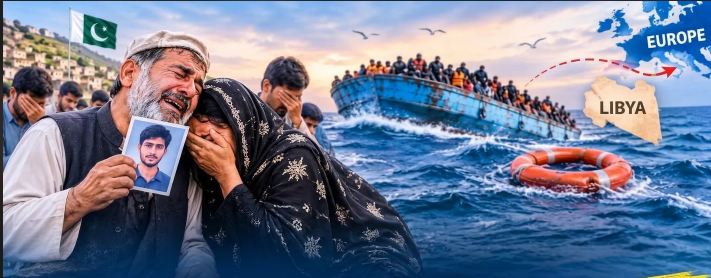
The latest tragedy adds to the 335 Pakistanis killed in seven major boat disasters over four years, while 7,667 migrants died or went missing worldwide in 2025 alone, exposing the international community’s failure to dismantle ruthless human-smuggling networks that continue to trade young lives for profit.
Hamid Khan Wazir
ISLAMABAD: For 35 young men from Bajaur, the journey towards what they hoped would be a better future may have ended beneath the waters off Libya. Their families, who had watched them leave home with dreams of employment, financial security and a brighter future, are now facing the devastating prospect of never seeing them again.
The latest migrant boat tragedy off the Libyan coast has plunged several families in Bajaur into grief and uncertainty, once again exposing the deadly consequences of irregular migration and the operations of human-smuggling networks that continue to exploit the desperation of young Pakistanis. At least 35 youths from the district are feared dead, although the precise number of passengers, the final death toll and the fate of several missing individuals remain unclear.
Among those reportedly killed is Pazirullah, a cousin of Bajaur Member of the National Assembly and Prime Minister’s Adviser Mubarak Zeb Khan. The reported involvement of people from the same communities, including relatives of public representatives, has brought the tragedy closer to home for many families.
The disaster has triggered mourning across Bajaur, particularly in the Salarzai and Mamund tehsils, from where several of the affected youths reportedly belonged. Some families have received information about the deaths of their relatives through agents allegedly involved in arranging their journeys. Funeral prayers in absentia have also been offered in different localities, including Mamund, even as families await reliable information about the missing and the recovery and identification of bodies.
The tragedy is not merely another maritime accident involving migrants. It is a reminder of a recurring national crisis in which young Pakistanis pay enormous sums to smugglers, cross several international borders and board overcrowded, unsafe vessels in the hope of reaching Europe. Many never arrive. Some disappear without a trace, leaving their families with debts, unanswered questions and a lifetime of grief.
As Pakistani authorities coordinate with their diplomatic mission in Libya and other relevant institutions to trace the missing and facilitate the return of bodies, a fundamental question demands attention: How long will criminal networks be allowed to turn the dreams of unemployed young people into a business of death, and why have Pakistan and the international community failed to dismantle the networks operating across borders?
Bajaur mourns as families await answers
The scale of the latest tragedy has also drawn attention to the circumstances in which Pakistani youths are recruited and transported abroad. Many families reportedly learnt about the fate of their relatives through intermediaries and agents rather than through official channels, highlighting the difficulties of obtaining reliable information when migrants disappear on international routes.
Minister of State for Tribal Affairs Mubarak Zeb Khan said he was coordinating with the Pakistani Embassy in Libya and the Ministry of Overseas Pakistanis to respond to the incident. He said search operations were under way to locate missing passengers and recover bodies, with relevant authorities, naval personnel, NATO and rescue organisations involved in the efforts.
He also assured the affected families that arrangements would be made to repatriate the bodies and provide assistance. A special meeting was scheduled for November 26 to review the situation and discuss support for the families and efforts to trace those still missing. He said he had also spoken to survivors from Bajaur.
The Bajaur deputy commissioner expressed grief over the reported deaths and promised a transparent investigation, warning that those involved in human trafficking would face legal action. Political leaders also expressed solidarity with the bereaved families. Khyber Pakhtunkhwa Governor's Adviser on Information, Public Relations, Relief, Rehabilitation and Resettlement Samar Haroon Bilour offered condolences, praying for the deceased and strength for their families.
Awami National Party expressed sorrow over the tragic incident. ANP spokesperson Arslan Khan Nazim described the deaths as a national tragedy, saying that unemployment, economic hardship and the absence of promising prospects were pushing young people towards dangerous migration routes. He called for the identification and repatriation of the deceased, a search for missing passengers and immediate assistance for affected families. The party said it stood with the bereaved families.
The concerns are particularly acute because the reported deaths are not confined to one locality. Families in different villages of Bajaur have been trying to establish whether their relatives were aboard the ill-fated vessel. Until authorities establish the passenger list and confirm the identities of those who died, the number of missing and dead must be treated as provisional.
The immediate priority is to establish the facts, locate survivors, recover and identify bodies and provide families with accurate information. But the larger question is why so many young people continue to depend on criminal intermediaries to reach destinations where they hope to find work.
335 Pakistanis killed in four years: A recurring national catastrophe
The latest incident comes against the backdrop of an alarming series of maritime disasters involving Pakistani nationals over the past four years. According to the Federal Investigation Agency (FIA) data, reported in July 2026, at least 335 Pakistanis died in seven major boat accidents while attempting to reach Europe through irregular migration routes since June 2023.
The figure represents a devastating human toll, particularly considering that the reported deaths occurred in only seven major incidents and do not necessarily account for every Pakistani who has died or disappeared on less widely reported migration journeys.
The deadliest disaster occurred in June 2023, when an overcrowded migrant vessel sank in international waters off Pylos, Greece. According to the FIA figures published by The Nation, 226 Pakistanis were aboard the vessel. Of these, 207 died, while only 19 survived.
Another tragedy occurred in December 2024 when a boat carrying 69 Pakistanis and travelling towards Greece met with an accident. Twenty-five Pakistanis died, while 44 were rescued, according to the FIA figures.
In January 2025, a migrant vessel carrying 70 Pakistanis capsized near Morocco and the FIA figures showed 44 Pakistani deaths. The Libyan coast subsequently emerged as a particularly dangerous departure point for Pakistani migrants.
In February 2025, a boat carrying Pakistani nationals capsized off western Libya. Pakistan's Foreign Office said people from Bajaur and Kurram were among those affected, while Pakistani consular officials confirmed the identities of 16 nationals whose bodies were recovered.
Another major incident occurred in April 2025 near Harawa, eastern Libya. Pakistan's Foreign Office confirmed the recovery of 11 bodies, including four identified Pakistani nationals.
Further tragedies involving boats departing from Libya were reported in October 2025 and April 2026. FIA figures published in July 2026 identified these incidents among seven major disasters since June 2023, with the combined loss of Pakistani lives reaching 335.
Libya: A major transit hub for international smuggling networks
Libya occupies a central position in the irregular migration route connecting Africa and parts of Asia with Europe. Its geographical location across the Mediterranean makes it a departure point for migrants seeking to reach Italy, Malta, Greece and other European destinations.
For Pakistani migrants, the journey generally involves several stages. Prospective migrants may first travel through Iran, Türkiye or other transit countries before reaching North Africa. Some travel by air to countries where they can enter or remain temporarily, while others undertake dangerous overland journeys. From Libya, they are subsequently transferred towards coastal departure points for the Mediterranean crossing.
However, the journey is rarely controlled by a single individual or organisation. Local recruitment agents, transporters, border facilitators, accommodation providers, document arrangers and maritime operators may all be involved. Migrants can be transferred between different intermediaries, with each demanding additional payments or exercising control over their movement. A particularly disturbing picture of the situation in Libya emerges from a United Nations Security Council Panel of Experts report on the country.
The report identified 17 international human-trafficking and migrant-smuggling routes operating in and through Libya since June 2023. These routes involved criminal networks and armed actors operating across several Libyan locations, including Tripoli, Benghazi, Bani Walid, Al-Kufra, Zawiyah and Zuwara.
Pakistan was specifically identified among the countries of origin connected to active international smuggling routes, alongside Bangladesh, Egypt, Nigeria, Syria, Somalia and Sudan.
The report also identified the involvement of Libyan armed actors and criminal networks in controlling parts of these illicit operations and described the use of different land crossings and coastal locations to move migrants towards Europe. This evidence demonstrates that the problem extends far beyond individual Pakistani agents operating in villages and towns. It involves a transnational criminal environment in which migrants can pass through several jurisdictions before reaching the sea.
A global humanitarian crisis: Thousands disappear on migration routes
The deaths of Pakistani migrants are part of a much larger international humanitarian emergency. According to the International Organization for Migration's Missing Migrants Project, 4,114 people died or went missing on migration routes to Europe in 2023, followed by 3,812 in 2024 and 3,403 in 2025.
These figures cover all nationalities and different migration routes, including the Mediterranean and Atlantic crossings. They include both confirmed deaths and people whose fate remains unknown. The Central Mediterranean route, particularly the passage from North Africa towards Italy and Malta, remains one of the most dangerous migration corridors.
A joint IOM-UNHCR overview of the Central Mediterranean route recorded 1,330 deaths and disappearances during 2025. It also estimated that 100,777 crossing attempts from Libya, Tunisia and Algeria towards Italy and Malta were recorded during that year. Pakistanis accounted for five per cent of the main nationalities attempting the crossing.
The Atlantic route from West Africa towards Spain's Canary Islands presents another major danger. Migrants undertaking these journeys can spend days or even weeks at sea in vessels that are poorly equipped to withstand adverse weather and rough waters. The IOM cautions that its figures represent recorded cases and may underestimate the actual number of deaths and disappearances. Some vessels disappear without survivors, while other incidents occur far from coastal monitoring and rescue facilities.
Consequently, the real human toll may be considerably higher than the documented figures. The European Union has also acknowledged the scale and profitability of the criminal business. The European Commission estimated in November 2025 that migrant-smuggling networks generate more than five billion euros annually.
It warned that these networks increasingly use digital platforms and technologies to facilitate their operations and are often connected with other forms of organised crime, including human trafficking, drug smuggling and money laundering.
Why young Pakistanis risk everything for a European dream
Behind the repeated tragedies lies a combination of economic hardship, unemployment, limited opportunities and the belief that migration to Europe offers a way out of financial difficulties.
For many young people in Pakistan, particularly those belonging to economically disadvantaged districts, securing a stable job has become increasingly difficult. Limited industrial development, inadequate vocational training, low wages and restricted employment opportunities contribute to frustration among young people who feel unable to build a financially secure future at home.
Besides, the accounts frequently conceal the risks, hardships and financial sacrifices involved in irregular migration, human smugglers exploit these aspirations by presenting dangerous journeys as reliable routes to European employment and residency. Prospective migrants are sometimes promised that they will be provided with accommodation, employment and safe passage, even when the agents have no legitimate arrangements in place.
Reports have suggested that migrants are charged between Rs2 million and Rs3.5 million for journeys organised through illegal channels. For many households, arranging such amounts requires selling agricultural land, livestock or other assets, borrowing money from relatives or taking loans at considerable financial cost. Families often make these sacrifices believing that their sons will eventually repay the money through overseas earnings. Instead, when a boat disappears, they may lose both their loved ones and the assets they spent years accumulating.
Pakistan's crackdown: Thousands arrested, but the networks remain a challenge
Successive maritime disasters have forced Pakistan to intensify its campaign against human smugglers and improve immigration screening.
FIA has a dedicated Anti-Human Trafficking and Smuggling Wing responsible for investigating organised criminal activities involving human trafficking, migrant smuggling and unlawful migration.
According to the FIA's Annual Administration Report for 2025, the agency arrested 3,345 human smugglers and traffickers during the year, including 17 individuals listed among the most wanted offenders. The report also recorded 19,343 enquiries, 7,039 registered cases and 4,375 interceptions by the Inter-Agency Task Force involving different law-enforcement and security organisations.
These figures reflect the scale of enforcement activity undertaken by the authorities. However, the repeated occurrence of deadly boat accidents indicates that criminal networks continue to find ways to recruit and transport prospective migrants. The FIA has also taken action against officials suspected of facilitating illegal migration.
In June 2026, the National Assembly's Standing Committee on Interior and Narcotics Control was informed that 132 enquiries had been initiated against FIA officials since the 2023 Greece boat tragedy.
FIA Director General Dr Usman Anwar told the committee that the investigations had resulted in 68 major and 36 minor penalties against officials who allegedly failed to follow established passenger-profiling procedures and facilitated irregular migration.
He also informed lawmakers that 22,136 passengers had been offloaded during 2026 following risk-based assessments. According to the briefing, 39,786 passengers were offloaded in 2025, compared with 35,459 in 2024. The figures suggest that authorities have strengthened their screening mechanisms, although the effectiveness of these measures must ultimately be judged by their ability to disrupt smuggling networks and prevent further loss of life.
The government also reported a 64 per cent reduction in attempts at irregular migration during January and February 2026, when 440 cases were recorded compared with 1,224 during the corresponding period in 2025.
While this reduction indicates progress in preventing some dangerous journeys, it does not establish that the international networks arranging them have been dismantled. There is a significant difference between stopping a prospective migrant at an airport and arresting the criminal organisation that has collected millions of rupees from that person's family. The real challenge is to move beyond airport screening and pursue the financial, logistical and international connections behind the business.
Pakistan needs a transparent system for publishing information about major human-smuggling investigations, including the number of suspects arrested, prosecutions completed, convictions secured and assets recovered. Parliamentary oversight should also examine why the same routes and recruitment methods continue to emerge after successive maritime disasters.
The central question is not simply how many people have been arrested, but how many major criminal networks have actually been dismantled and how many of their organisers and financiers have been brought to justice.
Legal reforms and international cooperation
Pakistan already has a legal framework for dealing with human trafficking and migrant smuggling. The Prevention of Smuggling of Migrants Act, 2018 and the Prevention of Trafficking in Persons Act, 2018 provide the principal legislative basis for addressing these offences.
The Prevention of Trafficking in Persons (Amendment) Act, 2025 further amended the existing legislation. The FIA has also reported that a National Action Plan for 2025 on human trafficking and migrant smuggling was developed in collaboration with the United Nations Office on Drugs and Crime.
However, the existence of laws and institutional arrangements is only one part of the response. Their effective implementation requires coordinated investigations, competent prosecution, international information-sharing and protection for victims.
Legal migration: An alternative to dangerous journeys
One important development has been Pakistan's engagement with European countries to expand legal migration opportunities. On February 26, 2026, Pakistan, Italy, Spain and Greece agreed in Rome to pursue a coordinated strategy against illegal migration, human smuggling and narcotics trafficking.
Interior Minister Mohsin Naqvi said the four countries had reached a consensus on promoting legal migration pathways, developing a joint policy framework and strengthening cooperation against criminal networks.
The European participants also agreed to support Pakistan through capacity-building initiatives and cooperation on the repatriation of individuals involved in serious offences. The meeting recognised that regulated migration channels could help reduce the demand for illegal routes and weaken the influence of human smugglers.
However, the success of this approach will depend on whether the agreements translate into practical employment opportunities. Pakistan needs to expand its overseas employment system, improve the quality of technical and vocational training and establish stronger links between local skills programmes and labour-market requirements in destination countries.
Awareness is essential, but economic opportunities matter more
Public awareness campaigns have an important role in preventing irregular migration. Young people need to understand that promises of guaranteed entry into Europe, employment without proper documentation and safe passage through dangerous sea routes are frequently used to deceive prospective migrants.
Schools, colleges, universities, vocational institutions and local administrations can help communicate the risks through targeted awareness programmes. Religious leaders, community representatives and local journalists can also play an important role in discouraging young people from handing over their savings to unlicensed agents.
However, awareness campaigns cannot succeed in isolation. A young person who sees no realistic opportunity to earn a living at home may remain attracted to migration despite knowing the risks. The government must therefore connect anti-smuggling measures with employment generation, industrial development, entrepreneurship and skills training.

More from Pakistan News




Comments
No comments yet. Be the first to comment!
Leave a Comment