

PTI a Political Reality, Must be Part of Democratic Reset: Bilawal
Thursday, 26 November 2026
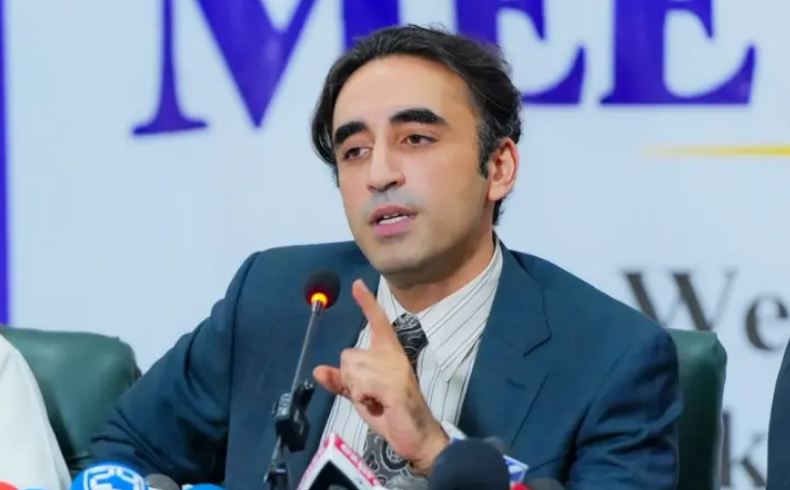
PPP chairman calls for restoring opposition’s trust in state institutions, says returning reserved seats to PTI could serve as a confidence-building measure
Hamid Khan Wazir
MULTAN: Pakistan Peoples Party (PPP) Chairman Bilawal Bhutto Zardari has described the Pakistan Tehreek-e-Insaf (PTI) as an undeniable political reality, saying that no meaningful democratic reset or political reconciliation in the country can succeed without acknowledging the party’s existence, restoring its confidence in the political system and ensuring its effective participation in Parliament.
Addressing a Meet the Press programme at the Multan Press Club on Thursday, Bilawal stressed that political differences must not be allowed to undermine democratic institutions and that the country could not move towards stability by excluding a major opposition party from the political process.
He said that irrespective of political opinions about PTI founder and former prime minister Imran Khan, the party represented a political reality that all stakeholders would have to recognise if they genuinely wanted to restore public confidence in the democratic system.
"Whatever opinion you may hold about Khan sahib, even if you think he is not a political prisoner, there is no denying the fact that PTI is a political reality," Bilawal said, emphasising that the party must be given an opportunity to play its constitutional and parliamentary role.
He maintained that Imran Khan's imprisonment and legal status should not be used as a justification for denying the rights of political workers and prisoners. Referring to the treatment of political opponents during the PTI government's tenure, Bilawal said he did not want the country to continue repeating the mistakes of the past through political revenge.
He argued that restoring PTI's trust in Parliament, the judiciary, the Election Commission of Pakistan and other state institutions was essential for any proposed political reset. "Until PTI's trust is restored in this system and they are able to play their role in Parliament, the reset that is being discussed cannot take place in that manner," he said.
Reserved seats could help bridge political divide
Proposing practical steps to bridge the widening divide between the government and opposition, the PPP chairman identified the allocation of reserved seats as an immediate confidence-building measure that could help restore PTI's trust in the parliamentary system.
He described the disputed reserved seats from the 2024 general elections as a "low-hanging fruit", arguing that addressing the matter could provide an opportunity for political reconciliation and demonstrate the government's willingness to accommodate the opposition.
Bilawal said he personally believed that PTI should have received the reserved seats, questioning the logic of allocating them to other political parties on the grounds that PTI candidates had contested the elections under the platform of the Sunni Ittehad Council (SIC).
He observed that if PTI was being denied the seats because its candidates had not contested under its own electoral identity, the same reasoning could not automatically justify their allocation to the Pakistan Muslim League-Nawaz (PML-N), PPP or Jamiat Ulema-i-Islam (JUI).
He also referred to the Supreme Court Constitutional Bench's 2025 decision, which overturned the July 2024 ruling that had declared PTI eligible for the reserved seats, resulting in their allocation to coalition parties. Bilawal said political parties should negotiate the matter, approach the courts or introduce necessary reforms to resolve the issue, adding that he was personally uncomfortable with another political party being deprived of its electoral symbol.
He stressed that goodwill gestures were necessary to overcome mistrust, adding that political reconciliation could not be achieved through statements alone but required concrete steps by the government and other stakeholders.
Calls for a new Charter of Democracy
Expanding his argument for a broader political settlement, Bilawal called for a fresh Charter of Democracy based on parliamentary supremacy, political reconciliation, constitutional governance and mutual respect among political parties. He said the proposed reset should be a democratic and political exercise involving the government, its coalition partners and all opposition parties rather than an arrangement designed or imposed through non-political channels.
The PPP chairman urged the government to take the initiative in rebuilding confidence with opposition parties, while asking the latter to reconsider their approach towards parliamentary proceedings and recognise their participation as a democratic responsibility.
He pointed out that opposition members should actively participate in parliamentary committees, particularly those dealing with finance, the judiciary and electoral reforms, instead of remaining absent from important legislative and policy discussions. Bilawal said opposition parties should contribute to budget-making and offer proposals to address unemployment, inflation and poverty, as their participation was essential for developing policies that reflected the concerns of ordinary citizens.
He also urged the opposition to become part of the proposed electoral reforms committee, arguing that boycotting parliamentary forums would not help resolve political disputes. "All decisions have to be made in Parliament alone," he said, warning that decisions taken outside the legislature would weaken democratic institutions and leave the country ill-equipped to deal with its mounting challenges.
Electoral reforms essential for political stability
Bilawal maintained that restoring confidence in the electoral process was a prerequisite for political stability, saying that elections could not provide lasting legitimacy to governments unless all political parties and provinces accepted the fairness of the system.
He noted that the credibility of the last general elections had been questioned by opposition parties as well as political forces in government. He warned that without comprehensive electoral reforms enjoying broad political consensus, governments formed through future elections would continue to face questions about their legitimacy and public mandate.
The PPP chairman said the proposed reforms should ensure transparency, fairness and equal opportunities for all political parties, enabling elected governments to function with greater political legitimacy. He also called for restoring confidence in the judiciary, acknowledging that the opposition had serious reservations about the existing judicial system.
Referring to the 1973 Constitution and the 18th Constitutional Amendment, Bilawal said constitutional legislation passed through broad political consensus carried greater democratic legitimacy and strength than measures adopted merely on the basis of numerical superiority.
Clarifying his earlier remarks about the 26th and 27th Constitutional Amendments, he said he was not disowning either measure. He described the passage of the 27th Amendment with a two-thirds majority as a parliamentary success but acknowledged that it had not enjoyed the same level of political consensus as the 1973 Constitution and the 18th Amendment. He said the opposition's lack of confidence in the judiciary could not be ignored and called for dialogue among political parties, judges, lawyers and other stakeholders to identify ways of rebuilding trust.
Political instability worsening economic hardships
Highlighting the economic challenges facing the country, Bilawal said political instability and institutional confrontation were diverting national attention from the problems confronting ordinary people.
He said rising energy costs, inflation, unemployment and regional tensions had further complicated the country's economic situation, placing an enormous burden on low-income households. The PPP chairman observed that people were struggling to meet their basic food requirements, educate their children and arrange medical treatment for elderly family members.
He also expressed concern over the growing frustration among young people, many of whom were unable to find employment, while those earning salaries were finding it increasingly difficult to meet even their commuting expenses.
He said political parties and state institutions should prioritise public welfare rather than remain consumed by political disputes and institutional rivalries. Bilawal argued that strengthening the prime minister and the elected government was necessary to deal with the country's internal and external challenges, provided that democratic institutions and elected representatives remained central to decision-making.
He said national unity, political stability and institutional cooperation were indispensable for addressing economic difficulties and responding to regional and international developments.
Criticises political victimisation, calls for accountability reforms
The PPP chairman also criticised the country's accountability system, saying successive governments had used anti-corruption institutions primarily to target political opponents instead of ensuring impartial prosecution of corruption. He regretted that despite repeated claims by successive administrations about eliminating corruption, the accountability process had failed to deliver the desired results.
Bilawal said accountability should be based on transparency, fairness and the rule of law rather than political considerations, adding that selective accountability further weakened public confidence in state institutions. He maintained that political vendettas must end if Parliament was to regain its effectiveness and democratic institutions were to function independently.
Defends freedom of expression, condemns action against Fazlur Rehman
Speaking about media freedom, Bilawal expressed concern over what he described as the shrinking space for independent journalism, calling for serious dialogue to restore the strength and independence of the press.
He said media organisations and press clubs had an important responsibility to question those in power, highlight public grievances and hold governments accountable. Referring to the Prevention of Electronic Crimes Act (PECA), amended in January 2025 amid protests by journalists' organisations, he said the country had reached a point where press freedom was virtually non-existent.
He added that the media should be allowed to report independently on economic difficulties and issues affecting people at the grassroots level rather than merely repeat the positions of those in power. Bilawal also condemned the reported house arrest and restrictions imposed on JUI-F chief Maulana Fazlur Rehman during his stay in Lahore, describing such actions as incomprehensible.
He said criticism of the government was a legitimate democratic responsibility of opposition leaders and should not be treated as an act of hostility against the state. "If you will take such revengeful actions even against Maulana Fazlur Rehman, then do you expect them to clap for you or praise you?" he remarked.
He urged the government to develop tolerance for criticism, saying that a democratic administration should have the confidence to listen to opposing views and incorporate constructive suggestions into its policies.
Supports South Punjab province, stronger local governments
On the question of creating new provinces, Bilawal reiterated the PPP's support for establishing a separate South Punjab province through a democratic and constitutional process. However, he cautioned against creating new political and ethnic divisions at a time when Pakistan was already facing serious security and governance challenges.
He also reaffirmed his party's commitment to strengthening local government institutions and protecting the rights of farmers and labourers, stressing that grassroots representation was essential for addressing public problems. The PPP chairman's remarks came amid an intensifying national debate over a proposed political and administrative reset. Referring to his earlier statements, he said the country's governance system had not collapsed on its own but had repeatedly been weakened through political and institutional decisions.
He called for a collective assessment of the factors responsible for the prevailing crisis, arguing that any effort to revive the system must begin with identifying its underlying weaknesses. Bilawal said such a process should not be left to a handful of politicians, media personalities or business figures, but should involve all relevant political and democratic stakeholders.
Earlier this month, he had also called for an end to political vendettas, describing Imran Khan as a political prisoner in the context of Pakistan's history of elected prime ministers facing imprisonment. He said the country could no longer afford a politics of revenge and that Parliament must be restored as the principal forum for resolving political differences.
Concluding his address, Bilawal reiterated that recognising PTI as a political reality and restoring its confidence in democratic institutions were indispensable to any meaningful political reset. He maintained that reconciliation, parliamentary supremacy, credible elections and institutional independence offered the most viable path towards ending the prolonged political uncertainty and strengthening democracy in Pakistan.


More from Pakistan News

Comments
No comments yet. Be the first to comment!
Leave a Comment