

New Book Chronicles Nawaz Sharif’s Turbulent Ties With Eight Army chiefs
Saturday, 14 November 2026
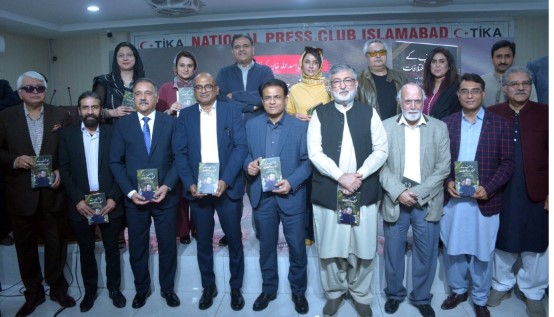
Journalist Asadullah Khan’s publication traces three decades of civil-military tensions, political rivalries and power struggles in Pakistan’s history.
Syed Naveed Hussain
ISLAMABAD: A new book documenting former prime minister Nawaz Sharif’s turbulent relationship with eight army chiefs over more than three decades, and the recurring power struggles that have shaped Pakistan’s civil-military relations, was launched at the National Press Club Islamabad on Saturday.
A book titled “Nawaz Sharif’s Differences with the Military: The Story of His Conflicts with Eight Army Chiefs from 1990 to 2022”, authored by renowned journalist, columnist and 92 News senior anchor Asadullah Khan.
The book examines Nawaz Sharif’s relationship with eight army chiefs between 1990 and 2022, highlighting civil-military relations, political and military differences, and significant events in Pakistan’s political history. Former federal minister Fawad Chaudhry was the chief guest at the ceremony.
Senator Kamran Murtaza, General (Retd) Zahid Mahmood, senior journalists Haroon Rasheed, Amir Mateen, Naseem Siddiqui, Sami Ibrahim, Rana Tahir Mahmood, Anwar Raza, Nair Ali, Abid Abbasi, Fariha Idrees, Yashfeen Jamal, Athar Kazmi, Siddiq Jan and several other political and media personalities attended the event.
Speaking at the book launching ceremony, author Asadullah Khan said the idea of writing the book had emerged around a decade ago, following which he began meeting and interviewing important personalities. He said he had also held detailed discussions with General (Retd) Ziauddin Butt and former president General (Retd) Pervez Musharraf for the book. Interviews, meetings and personal observations gathered during his research had been incorporated into the publication. He thanked the guests, journalists and readers and said suggestions from readers and friends would be considered in the next edition.
Senior journalist Haroon Rasheed said Pakistan needed an educated, aware and critically thinking society. He stressed that strong institutions, merit, an effective civil service, an efficient police force and a sound tax collection system were essential for national progress. He said the military should not interfere in politics and every institution must operate within its constitutional and legal boundaries.
He also emphasised the need to strengthen democratic traditions and political training within political parties. Political opponents should not be pushed against the wall but should be given opportunities to participate in the political process. Instead of spreading pessimism, society should promote hope, positive thinking and meaningful dialogue to address national challenges.
Senior journalist Amir Mateen said Nawaz Sharif was a significant figure in Pakistan’s political history and his long political career required further authentic historical research. He observed that conflicts between Nawaz Sharif and military leadership largely emerged from clashes of interests. He added that the problems in civil-military relations could not be attributed to a single personality or political era, as their roots extended back to the early years of Pakistan’s history.
Former federal minister Fawad Chaudhry said understanding Pakistan’s political developments, changes of governments and power transitions required a careful examination of past events and experiences. Referring to the cipher controversy, he recalled that Imran Khan had convened a meeting attended by Asad Umar, Shah Mahmood Qureshi and Musaddiq, where various aspects of the matter were discussed.
Senator Kamran Murtaza said Nawaz Sharif had worked with eight army chiefs and had continued his political career even after his differences with the eighth army chief. He said Pakistan’s fundamental problem was not individuals but the lack of discipline in the collective system and state institutions.
He stressed that constitutional supremacy and the rule of law were indispensable for Pakistan’s progress, adding that neither state institutions nor politicians consistently adhered to the Constitution. He urged all state institutions and political leaders to respect constitutional boundaries and uphold the rule of law.
More from Pakistan News



Comments
No comments yet. Be the first to comment!
Leave a Comment