

Balochistan Assembly Rejects Resolution Seeking Enforcement of 1976 Anti-Sardari Law
Saturday, 14 November 2026
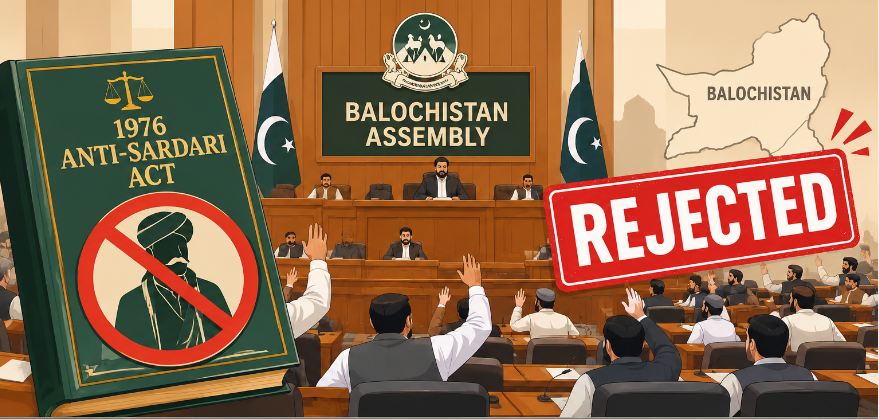
Move by Jamaat-e-Islami MPA Hidayat ur Rehman fails to secure majority; debate exposes divisions over tribal authority, individual freedoms and colonial-era Sardari system
Staff Report
QUETTA: The Balochistan Assembly on Friday rejected a resolution seeking effective and impartial enforcement of the 1976 law abolishing the Sardari system across the province, after the motion failed to secure a majority in a vote.
The resolution, moved by Jamaat-e-Islami MPA Maulana Hidayat ur Rehman Baloch, called on the provincial government to ensure that no individual or tribal authority exercised unlawful control over citizens or deprived them of their fundamental rights in the name of Sardari influence.
Presenting the resolution, Hidayat ur Rehman said legislation enacted in 1976 had abolished the Sardari system and was intended to protect citizens from the domination, coercion and exploitation associated with traditional centres of tribal power. Despite the law, he argued, people in several parts of Balochistan continued to face intimidation, forced decisions, economic and social exploitation and restrictions on their personal freedoms.
He maintained that the legislation should be implemented across the province without discrimination and in accordance with its original objectives.
MPA distinguishes tribal traditions from Sardari system
Clarifying his position, Hidayat ur Rehman said he was not opposed to the tribal system, which he described as an integral part of Balochistan's identity, culture and heritage. His objection, he said, was to the Sardari system introduced during British colonial rule under the Sandeman system.
He questioned the influence of tribal chiefs, asking how, despite the presence of around 140 Sardars in the province, none had been able to protect the father of Asma Jattak. He alleged that the younger generation in Balochistan was increasingly rejecting the Sardari system, which, according to him, continued to survive with the backing of the establishment and the government. The Jamaat-e-Islami legislator also called for a ban on the use of the titles "Sardar" and "Nawab".
Government acknowledges human rights violations
Responding to the resolution, Provincial Minister Mir Zahoor Buledi said he had no objection to individuals holding the titles of Nawab or Sardar. However, he acknowledged that incidents involving violations of people's human rights had occurred and stressed that the government opposed the misuse of authority in any form.
He maintained that the issue should be viewed in the context of individual conduct and the protection of citizens' rights rather than objections to particular personalities or titles.
Opposition leader questions mover's conduct
Opposition Leader Mir Younus Aziz Zehri recalled that a similar resolution had been tabled during the previous assembly session. He criticised the language subsequently used by its mover on social media and during press conferences, describing it as inappropriate.
Zehri said he had contested the 2013 general elections against Nawab Sanaullah Khan Zehri and had also secured his current electoral mandate by defeating candidates belonging to Sardari and Nawabi families. He added that several other members of the provincial assembly had similarly won elections against candidates from influential tribal families, arguing that electoral competition had provided an opportunity for people to challenge traditional political influence.
Following the debate, the resolution was put to a vote but failed to obtain the required majority and was consequently rejected by the House.

More from Pakistan News




Comments
No comments yet. Be the first to comment!
Leave a Comment