

Pakistan, China Join Forces to Advance Next-Generation Semiconductor, Chip Technologies
Sunday, 22 November 2026
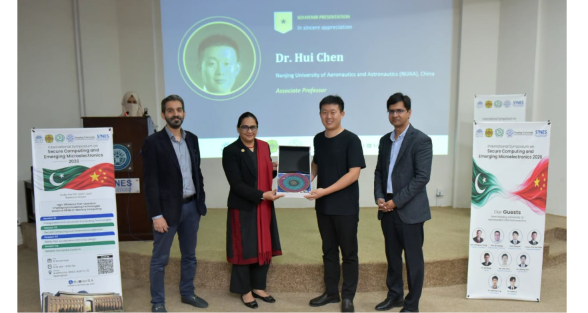
NUST-hosted international symposium brings Pakistani researchers together with a nine-member Chinese delegation to explore RRAM-based computing, energy-efficient chips and secure digital technologies.
Hamid Khan Wazir
ISLAMABAD: Pakistan and China are exploring deeper scientific cooperation in advanced semiconductor technologies, with researchers from both countries joining forces to develop next-generation computer chips, strengthen secure computing capabilities and advance energy-efficient microelectronics.
The collaboration took centre stage at an international symposium hosted by the National University of Sciences and Technology (NUST), highlighting new opportunities for Pakistan to strengthen its semiconductor research and chip-design capabilities through Chinese expertise and joint innovation.
According to an announcement, its BIOMISA Laboratory at the School of Interdisciplinary Engineering and Sciences (SINES) hosted the “International Symposium on Secure Computing and Emerging Microelectronics 2026”, bringing together Pakistani researchers and a nine-member delegation from China's Nanjing University of Aeronautics and Astronautics (NUAA).
Jointly funded by the Pakistan Science Foundation (PSF) and China's National Natural Science Foundation (NSFC), the symposium focused on developing faster, energy-efficient computer chips using advanced Resistive Random Access Memory (RRAM) technology.
RRAM is an emerging memory technology that can retain information without continuous power and offers potential for combining data storage and processing within the same hardware. This approach, known as computing-in-memory, can reduce the movement of data between separate memory and processing units, helping lower energy consumption and improve computing efficiency.
China has been actively advancing research in this field. Researchers from Chinese institutions, including Tsinghua University and the Chinese Academy of Sciences, have published work on RRAM-based computing-in-memory architectures, with applications in artificial intelligence, high-performance computing and cryptographic operations.
Recent research has also explored the use of RRAM architectures to efficiently process mathematical operations required by post-quantum cryptography systems. The technology is particularly relevant as the development of quantum computers raises concerns about the long-term security of conventional encryption systems.
While RRAM can provide efficient hardware for complex computing operations, quantum-resistant algorithms are separately required to protect sensitive digital information against potential future quantum attacks. The NUST announcement said technical presentations enabled both institutions to combine their expertise in security algorithms, digital systems, chip manufacturing and hardware reliability testing.
Participants were also introduced to Pakistan University's Chip Design Centre (NCDC), providing an opportunity to explore the university's facilities and research capabilities in semiconductor design and development. The symposium aimed to strengthen local capabilities in advanced semiconductor technology through research exchange and closer academic cooperation between Pakistan and China.
The engagement reflects opportunities for Pakistan to benefit from China's growing semiconductor research ecosystem through academic partnerships, technical knowledge exchange and collaboration in emerging computing technologies.
NUST
National University of Sciences & Technology (NUST), located in the heart of Islamabad, has gained a premier position among the world's top universities in less than three decades since its establishment. NUST currently stands at 371st position in the World and 68th in Asia as per the QS World University Rankings 2026 and QS Asian University Rankings 2024 respectively. The QS Top 50 Under 50 World University Rankings have placed NUST at the 41st global rank and at 1st rank in Pakistan. NUST produces professionals and researchers of the highest calibre capable of developing indigenous technologies to meet the growing demands of the new era.
NUAA
Nanjing University of Aeronautics and Astronautics (NUAA), a leading public research university based in Nanjing, Jiangsu Province, China, was established in 1952. The university specialises in aerospace, aviation, engineering and advanced technologies and is part of China's prestigious Project 211 and Double First-Class initiatives.


More from Education News






Comments
No comments yet. Be the first to comment!
Leave a Comment