

Pakistan’s First Astronaut to Embark on Historic Space Mission at 5:18am on Wednesday
Tuesday, 24 November 2026
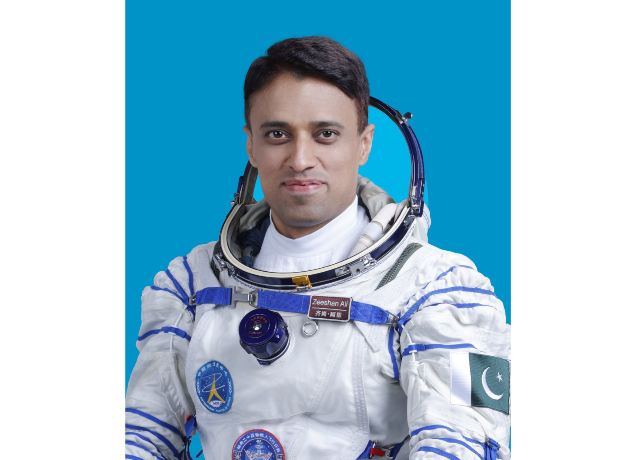
Muhammad Zeeshan Ali to travel to China’s Tiangong Space Station as Payload Specialist; four Pakistani scientific experiments to be conducted in microgravity, with three to remain exposed to space for one year
Syed Naveed Hussain
ISLAMABAD: Pakistan’s first human space mission is set to reach a historic milestone as the country’s first astronaut, Muhammad Zeeshan Ali, is scheduled to embark on his maiden space journey at 5:18am Pakistan Standard Time on Wednesday from China’s Jiuquan Satellite Launch Centre. Ali will travel aboard a spacecraft bound for China’s Tiangong Space Station, where he will conduct a series of scientific experiments developed by Pakistani researchers in collaboration with Chinese institutions.
The mission, led by the China Manned Space Agency (CMSA) in partnership with Pakistan’s Space and Upper Atmosphere Research Commission (SUPARCO), marks Pakistan’s formal entry into human space exploration and represents a significant step forward in the country’s scientific and technological cooperation with China.
Selected as a Payload Specialist, Ali will be responsible for carrying out Pakistan’s scientific research programme aboard the Chinese space station. The experiments will be conducted in a microgravity environment and cover several important fields, including materials science, fluid physics, life sciences, biological sciences and biotechnology.
Developed by Pakistani academia and researchers, the scientific programme is aimed at exploring new possibilities in space research, with potential applications in climate resilience, food security, biotechnology and industrial innovation. Under the mission, the Pakistani astronaut will undertake an experiment titled “Establishment of Green Micro-factories to Support Life Sustainability in Space”. The research will focus on cultivating microalgae, microscopic aquatic organisms, to examine their potential as a source of nutrients and oxygen for astronauts during future long-duration space missions.
Microalgae are considered a promising resource for sustainable life-support systems because of their ability to produce oxygen through photosynthesis and their potential nutritional value. The experiment will assess their suitability for supporting human life in the challenging environment of space.
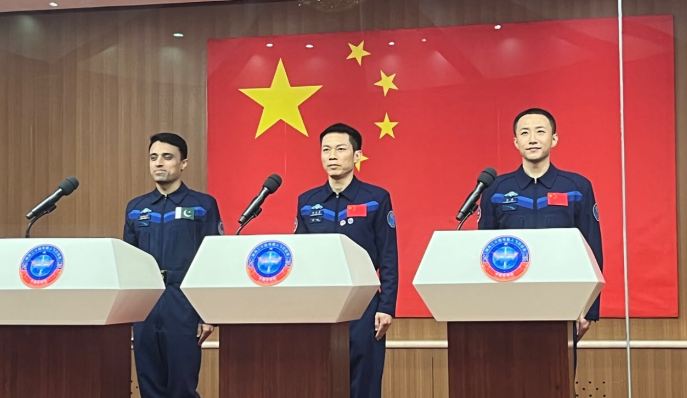
The mission also includes three other scientific experiments that will be installed on the external experiment modules of the Chinese Space Station (CSS), where they will remain exposed to the space environment for one year.
The first of these experiments will investigate the effects of microgravity and cosmic radiation on the longevity and viability of quinoa seeds during spaceflight. The research is expected to contribute to the development of more resilient and radiation-tolerant crop varieties, with possible implications for agricultural research and future food security.
Another experiment will examine the healing efficiency of microcapsule-based self-healing composite materials under space conditions. The technology involves materials designed to repair damage through microcapsules containing healing agents. Researchers will assess how effectively these materials can restore their structural integrity in the space environment.
The findings could have wider applications in developing advanced materials capable of reducing maintenance requirements and repair costs in aircraft, spacecraft and infrastructure. The third external experiment will evaluate the durability of hybrid composite materials through static exposure to the harsh conditions of outer space. Researchers will examine how these materials withstand vacuum conditions, cosmic radiation and extreme temperature variations.
The study is intended to assess their long-term performance and potential for enhancing spacecraft protection, particularly under the demanding environmental conditions encountered beyond Earth's atmosphere. The scientific programme is being conducted in collaboration with several leading Chinese research and academic institutions, including the Centre for Space Utilization, Shanghai Institute of Technical Physics, Dalian Maritime University and Shanghai Jiao Tong University.
The participation of Pakistani researchers in experiments aboard the Chinese space station provides an opportunity to explore advanced scientific technologies, strengthen research cooperation and develop local expertise in emerging areas of space science. The mission is being viewed as a defining milestone in Pakistan's space exploration history and a significant expression of the longstanding scientific partnership between Pakistan and China.
Through the mission, Pakistan joins a select group of countries participating in human spaceflight-related scientific research aboard an operational space station, opening new avenues for Pakistani scientists, universities and research institutions to contribute to international space exploration.

More from Technology News

Comments
No comments yet. Be the first to comment!
Leave a Comment