

Pakistan, Saudi Arabia, Türkiye Pledge Stronger Collective Defence at Islamabad Summit
Friday, 27 November 2026
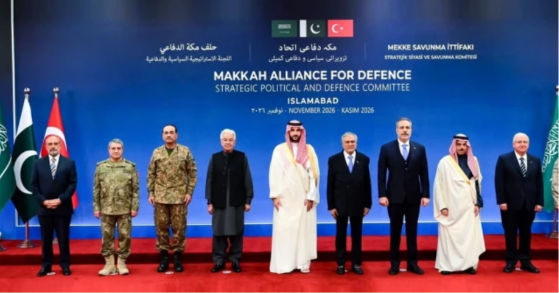
Makkah Defence Alliance condemns ‘persistent and heinous’ Houthi attacks on Saudi civilians and infrastructure; three nations reaffirm solidarity, sovereignty and commitment to regional security
Hamid Khan Wazir
ISLAMABAD: Pakistan, Saudi Arabia and Türkiye have reaffirmed their commitment to collective defence, mutual solidarity and regional stability, strongly condemning persistent Houthi attacks on Saudi Arabia as the three countries' top political, diplomatic and military leadership met in Islamabad to review evolving regional security challenges and advance cooperation under the Makkah Joint Defence Agreement.
The high-level meeting of the Strategic Political and Defence Committee (SPDC), the alliance's principal decision-making forum, lasted approximately two-and-a-half hours on Friday. The participating countries expressed their collective resolve to safeguard Saudi Arabia's security, sovereignty and territorial integrity, while pledging closer coordination to address shared security concerns and prevent further regional escalation.
Addressing the media after the meeting, Deputy Prime Minister and Foreign Minister Ishaq Dar said the three countries had reaffirmed their determination to work collectively towards peace, security and stability. He emphasised that their commitment extended to collective defence, mutual solidarity and respect for the sovereignty and territorial integrity of all member states.
The meeting brought together the foreign ministers, defence ministers and top military leadership of the three countries. Pakistan was represented by Dar, Defence Minister Khawaja Asif and Chief of Defence Forces and Chief of Army Staff Field Marshal Asim Munir. Saudi Arabia's delegation comprised Defence Minister Prince Khalid bin Salman bin Abdulaziz Al Saud, Foreign Minister Prince Faisal bin Farhan and Chief of General Staff of the Saudi Armed Forces General Fayyadh bin Hamed Al-Ruwaili.
Türkiye was represented by Foreign Minister Hakan Fidan, Defence Minister Yasar Guler and Chief of General Staff General Selcuk Bayraktaroglu. Dar thanked the visiting delegations for their participation, saying the meeting reflected the longstanding friendship and solidarity among the three countries and Pakistan's continued diplomatic efforts to promote regional and international peace.
He said the participants reviewed progress on decisions taken at the previous Makkah Alliance meeting and expressed satisfaction with developments towards establishing and operationalising the alliance's permanent secretariat in Saudi Arabia.
The three sides also agreed to maintain consultations to strengthen cooperation and coordination in areas of mutual interest, support efforts to de-escalate regional tensions and encourage peaceful resolution of disputes. A major outcome was the unequivocal condemnation of Houthi attacks targeting civilians and civilian infrastructure in Saudi Arabia. Dar said the three countries had reaffirmed their collective resolve to support the Kingdom's security, sovereignty and territorial integrity in accordance with the collective defence provisions of the agreement.
The participating countries also pledged to expand cooperation in defence industries, joint technological development, training and capacity-building. The initiative aims to enhance the collective capabilities and cohesion of their armed forces while addressing shared security concerns and contributing to regional peace.
The Foreign Office subsequently issued a joint declaration outlining the outcomes of the meeting. It said Dar had reaffirmed Pakistan's commitment to the alliance and underscored the importance of solidarity and close coordination in confronting common security challenges. The Foreign Office also emphasised the agreement's purely defensive character, describing it as an instrument for promoting lasting regional peace, security and prosperity.
Defence Minister Khawaja Asif described the agreement as a historic development, saying Pakistan, Saudi Arabia and Türkiye had formalised and institutionalised their commitment to collective defence, mutual solidarity and respect for sovereignty.
He said the establishment of a permanent secretariat had taken the alliance beyond political declarations and placed it on a practical institutional footing. He also highlighted the potential benefits of trilateral defence cooperation, particularly through Türkiye's technological expertise and Saudi Arabia's resources, which could help strengthen Pakistan's defence capabilities and self-reliance.
Saudi and Turkish delegations meet Prime Minister Shehbaz Sharif
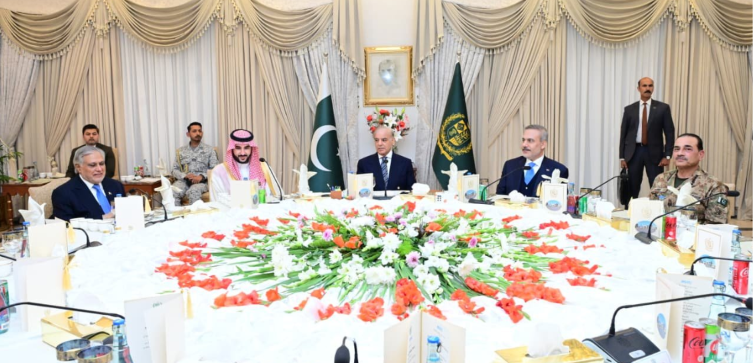
Following the conclusion of the SPDC meeting, the visiting delegations from Saudi Arabia and Türkiye called on Prime Minister Shehbaz Sharif at the Prime Minister's House.
According to a statement issued by the Prime Minister's Office, the premier reiterated Pakistan's unwavering commitment to the Makkah Joint Defence Agreement and welcomed the strong unity and determination demonstrated by the three countries in defending one another's security, sovereignty and territorial integrity under its provisions.
Shehbaz expressed satisfaction with the outcome of the Islamabad meeting and reaffirmed Pakistan's full solidarity with the Kingdom of Saudi Arabia, assuring continued support for its security, sovereignty and territorial integrity. The prime minister also hosted a dinner reception at the Prime Minister's House in honour of the visiting participants.
Dar and Fidan discuss bilateral cooperation
On the sidelines of the trilateral meeting, Dar also held talks with his Turkish counterpart, Hakan Fidan, focusing on strengthening bilateral cooperation in trade, investment, defence and energy.
According to the Foreign Office, both ministers expressed satisfaction with the growing momentum in bilateral relations and reaffirmed their commitment to closer cooperation on matters of mutual interest.
They agreed to translate their strong political ties into tangible economic benefits and maintain close coordination under the Makkah Agreement for Joint Defence, particularly to promote dialogue and regional de-escalation. Fidan thanked Pakistan for its warm hospitality and active diplomatic role.
Alliance moves towards institutional implementation
Pakistan, Saudi Arabia and Türkiye signed the Makkah Joint Defence Agreement on August 7. Under the agreement, an armed attack against any one member is considered an attack against all, obliging the other two countries to extend assistance through available means, including military support.
The SPDC serves as the alliance's principal decision-making body, bringing together the foreign and defence ministers and chiefs of defence staff of the three countries.
A permanent secretariat has been established in Riyadh to coordinate the alliance's activities, with Pakistan's retired Lieutenant General Nauman Mahmood appointed as its first secretary general for a three-year term. A working committee comprising officials from the member countries is also operational.
Türkiye's ratification of the agreement completed the accession process for all three members. However, the alliance's institutional and operational framework remains at an early stage, with its military doctrine, force composition, command arrangements and procedures for collective military responses yet to be publicly defined.
An emergency SPDC meeting held in Riyadh on October 5 had called for practical implementation of the collective defence commitments, including arrangements for the rapid deployment of agreed forces and capabilities, subject to the national laws of member states.
The Islamabad meeting therefore marked another step towards translating the agreement's political commitments into a more structured framework for defence cooperation.
Regional tensions underline importance of coordination
The alliance is taking shape amid wider regional tensions involving Iran, the United States and Israel, making diplomatic coordination and careful management of regional relationships particularly important.
While the three countries share an interest in strengthening regional security and deterrence, their differing strategic priorities underline the need to maintain the agreement's defensive character and prevent it from becoming an instrument of wider military confrontation.
Pakistan, in particular, has sought to balance its expanding defence cooperation with Saudi Arabia and Türkiye with continued diplomatic engagement with neighbouring Iran. The three countries' engagement with Iranian officials in Tehran, facilitated on Pakistan's initiative, has reflected Islamabad's efforts to maintain communication channels and prevent further regional escalation.
Against this backdrop, the Islamabad meeting underscored the growing strategic importance of trilateral cooperation, with Pakistan, Saudi Arabia and Türkiye seeking to strengthen collective security arrangements while keeping diplomacy and peaceful dispute resolution central to their regional approach.
More from World News




Comments
No comments yet. Be the first to comment!
Leave a Comment