

Petrol Price Edges Down by Re1, Diesel Rate Remains Unchanged
Friday, 27 November 2026
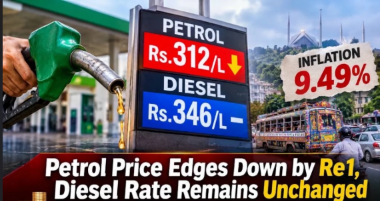
Petrol falls to Rs312 per litre while diesel remains at Rs346; transport fares stay unchanged despite successive fuel price reductions, limiting relief for commuters and keeping freight costs high amid 9.49pc short-term inflation driven by rising wheat flour prices.
Hamid Khan Wazir
ISLAMABAD: The government has reduced the price of petrol by Re1 per litre to Rs312, while keeping high-speed diesel unchanged at Rs346. However, transport fares have remained unchanged despite successive reductions in petroleum prices, denying inflation-hit and poverty-stricken masses the benefits of declining fuel costs.
The revised rates, announced by the Oil and Gas Regulatory Authority (OGRA) in a notification issued on Friday, will take effect from Saturday, and remain applicable until November 30, 2026. The authority said the prices had been determined under the petroleum pricing mechanism approved by the federal government.
However, the latest adjustment has done little to address the wider economic burden on households, particularly as provincial governments have yet to ensure corresponding reductions in passenger and freight transport fares despite substantial declines in fuel prices over recent weeks.
The failure to pass on the benefits of cheaper fuel to commuters and the transportation sector has also kept freight costs elevated, contributing to higher prices of essential commodities, particularly perishable food items. The latest fuel-price revision comes against the backdrop of a decline in short-term inflation, which stood at 9.49 per cent year-on-year in the week ending November 26, according to data released by the Pakistan Bureau of Statistics (PBS).
Although the Sensitive Price Index (SPI) declined by 0.11 per cent week-on-week for the third consecutive week, the relief remains uneven, with wheat flour prices and several other essential commodities continuing to put pressure on household budgets.
Petrol falls, diesel price unchanged
Under the latest revision, petrol has become cheaper by Re1 per litre, declining from Rs313 to Rs312, while the price of high-speed diesel remains unchanged at Rs346 per litre.
The adjustment follows an earlier reduction announced on Thursday, when the government had cut petrol by Re1 to Rs313 per litre and diesel by Rs2 to Rs346 per litre. OGRA has also started publishing daily petroleum prices on its website to improve transparency and enable consumers to track changes in international oil markets more closely.
Transport fares remain high despite fuel relief
Despite successive reductions in petroleum prices, provincial governments have yet to take effective measures to bring down public transport fares and freight charges in line with declining fuel costs.
The situation has raised concerns over the failure to transfer the benefits of cheaper petroleum products to ordinary citizens, who continue to pay high fares for daily commuting. Freight transportation costs also remain a major concern, as elevated charges increase the cost of moving agricultural produce and other essential commodities to markets, adding to the financial burden on consumers. The absence of corresponding fare adjustments has therefore weakened the impact of falling fuel prices on the overall cost of living.
Short-term inflation falls to 9.49pc
According to the PBS, year-on-year short-term inflation eased to 9.49 per cent in the week ending November 26, compared with 10.41 per cent in the preceding week and 11.21 per cent earlier.
The weekly SPI, which tracks prices of 51 essential items collected from 50 markets in 17 cities, recorded a 0.11 per cent decline compared with the previous week. Of the 51 commodities monitored, prices of 20 increased, nine declined and 22 remained unchanged. Wheat flour recorded the highest weekly increase of 5.72 per cent, followed by electricity charges for the first quarter at 5.43 per cent, eggs at 4.36 per cent and chicken at 4.14 per cent.
Other items registering increases included garlic, rice basmati broken, potatoes, pulse gram, matchboxes, plain bread, firewood and washing soap. On the other hand, tomato prices declined by 23.92 per cent, onions by 21.27 per cent and liquefied petroleum gas (LPG) by 7.78 per cent. Petrol prices fell by 2.48 per cent and diesel by 1.99 per cent during the week.
Essential commodities remain expensive
Despite the recent easing in weekly inflation, several essential commodities remain significantly more expensive than a year ago. On an annual basis, LPG recorded the highest increase at 67.49 per cent, followed by wheat flour at 53.53 per cent, chicken at 30.10 per cent, electricity charges for the first quarter at 29.33 per cent, diesel at 22.36 per cent and petrol at 18.34 per cent.
Prices of chilli powder, mutton, plain bread, beef, pulse gram and fresh milk also registered annual increases. In contrast, sugar prices declined by 26.56 per cent, potatoes by 23.04 per cent, tomatoes by 15.91 per cent and eggs by 11.78 per cent.
Global oil market faces renewed pressure
Meanwhile, international oil prices were heading towards ending a three-week losing streak on Friday, supported by four consecutive sessions of gains amid concerns over Middle East supplies. Attacks on oil tankers in the Strait of Hormuz and Saudi energy infrastructure heightened fears of possible disruptions to regional petroleum supplies.
Brent crude futures edged up 3 cents to $96.60 per barrel by 12:39 GMT, after touching their highest level since November 9 earlier in the session, while remaining below the $100 mark.
US West Texas Intermediate (WTI) crude futures rose $1.46, or 1.7 per cent, to $85.14 per barrel compared with Wednesday's close. There was no Thursday settlement due to the US Thanksgiving holiday. With international oil-market volatility continuing and domestic inflation still weighing heavily on consumers, the latest marginal reduction in petrol prices offers limited relief. The failure to bring transport fares and freight charges down in line with falling fuel costs remains a major obstacle to ensuring that petroleum-price reductions translate into meaningful relief for ordinary Pakistanis.


More from Business News






Comments
No comments yet. Be the first to comment!
Leave a Comment