

Imran Khan Appeals to Chief Justices of FCC, SC and IHC for Urgent Medical Care, Warns of Life-Threatening Risks
Monday, 16 November 2026
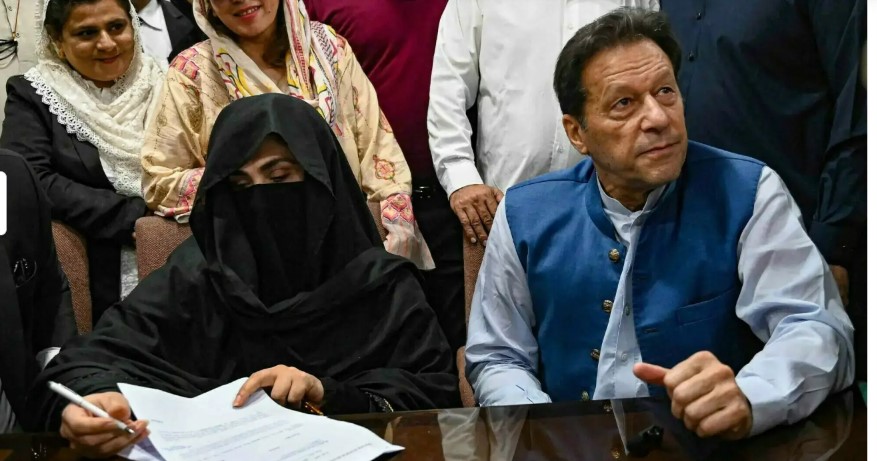
In an open letter, the former prime minister of Pakistan urges the three judicial heads to ensure proper medical attention for himself and Bushra Bibi, highlighting their deteriorating health, prolonged solitary confinement and pending implementation of Supreme Court orders.
Hamid Khan Wazir
ISLAMABAD: Imprisoned Pakistan Tehreek-e-Insaf (PTI) founder and former prime minister Imran Khan has appealed to the chief justices of the Federal Constitutional Court (FCC), Supreme Court (SC) and Islamabad High Court (IHC) for urgent medical treatment for himself and his wife, Bushra Bibi, warning that their deteriorating health conditions could have irreversible consequences if immediate intervention is not ensured.
In an open letter shared on social media on Monday by his lawyer, Barrister Salman Safdar, who had met the ex-premier at Adiala jail on November 2 and November 11, Imran Khan said that he had been denied adequate medical attention, meaningful access to his family and legal counsel, while his wife was also facing serious complications following eye surgery. He urged the three chief justices to ensure implementation of existing Supreme Court orders and provide both with proper medical care, saying he was seeking no special favour but justice on humanitarian grounds.
The letter said that during the November 11 meeting, Imran had directed Safdar to “carry his words to your lordships”. “I have conveyed this letter faithfully and solely on these instructions. The words that follow are his [Imran’s],” the letter said, which also bore Safdar’s signature.


In the letter, Imran detailed his own deteriorating health condition as well as his wife’s, pleading with the courts to grant them access to medical treatment. “I spent my life building hospitals so that those who could not afford treatment would receive it free of cost. Today, I ask only that my wife and I be treated,” he said. Imran said that he was writing from a “solitary cell”, as that was now “the only way my voice can leave these walls”.
“I do not write as a former prime minister, nor as the head of a political party. I have given my life to Pakistan. I served this nation on the cricket field, in social work and philanthropy and as its 22nd prime minister. For seventy years, not a single criminal case stood against my name,” he said.
“Then, after the age of 70, came an unprecedented and ruthless campaign of political victimisation: countless prosecutions, more than a hundred appearances before the courts, pre-arrest bail sought again and again, and an assassination attempt which, by the grace of Allah, I survived. Through all of it, I chose the path of law. I decided that I would fight every one of these politically motivated cases in the courts and I never stopped,” he said.
He said that from “time to time” he was granted relief from the courts that “renewed my faith that justice would prevail”. “After the constitutional amendments, however, that relief became narrow, and then it closed off altogether. It grieves me deeply to say that, when I needed it most, the system I had placed my trust in did not come to my aid. Within the walls of Adiala, my wife and I have faced criminal trials one after the other, and our appeals still await decision. Yet I have never once sought relief on medical grounds, nor used illness as a tactic. I fought on the merits, with confidence, and I still do,” he said.
Imran went on to say that “everything changed” after the judgement in the Toshakhana-2 case. “I was totally isolated, disconnected and held incommunicado from the outside world, in torturous solitary confinement for up to twenty-two hours a day, in disregard of every constitutional right and every entitlement the Prison Rules guarantee a prisoner: no family, no lawyers, no call to my sons, no books and no television,” Imran said in his letter.
He said that after months without access to his lawyer, Safdar was allowed to meet him on Feb 10 after the SC appointed him amicus curiae. “He found that I had lost 85 per cent of the vision in my right eye, and that neither my family nor my counsel had been told. After that visit, the disconnect returned, and the jail administration, acting vindictively, isolated me once again,” he said.
Imran said that he had only been allowed to meet his lawyer four times during the year, while Bushra Bibi had only been allowed to meet her counsel once. He asserted that this was a violation of the rules and the basic rights of every prisoner, adding that it had left them “unable to defend ourselves in the very cases we are fighting”.
“Prolonged solitary confinement and the absence of any meaningful human interaction have taken a heavy toll on my mental health. This is not my claim alone: the jail’s own medical board has recorded my anxiety and advised more frequent contact with my wife and family, reading material and television. That advice has not been followed,” he said.
Imran alleged that his weekly meeting with his wife was skipped by jail authorities “without reason or explanation”. He said that he had also learnt that his sisters were in custody, adding that he was not allowed to meet them. He said his sons, Kasim and Sulaiman, were also not allowed to call in contradiction of court orders.
“No one in the jail is permitted to respond to me or speak to me, not when I offer them salaam and not when I recite a verse of the Holy Quran. The purpose, I can only conclude, is to make me ill and to break my will,” he said. Imran said that despite this, he was more concerned about Bushra Bibi’s conditions. He said that in April, she suffered a retinal detachment and underwent a “complicated eye surgery in secrecy” and was sent back to solitary confinement. “When I saw her this month, she could neither bear the light nor open her eyes, and without another surgery she may lose her sight permanently. Her records are withheld, her doctors denied, her suspension of sentence unheard, despite the law’s compassion for women prisoners,” he said.
Imran said that on August 18, the SC directed that he be shifted to Shifa International Hospital within two days, a medical board be constituted to examine him and that he be allowed interactions with his family. “That order has not been implemented. My case now rests on the docket of the FCC, awaiting a hearing,” he said. He said that his appeal in the Al-Qadir trust case was being taken up ahead of older ones concerning the health of the couple and unimplemented court orders.
“It is my wife’s failing sight, and that unimplemented order of the honourable SC, that compel me to write. In solitary confinement, my blood pressure has become uncontrolled: 130, then 150, then 170, and last week 192 and 193 on Nov 10. The doctors now tell me that I am highly vulnerable to a brain haemorrhage and cardiac arrest and that my heart has already suffered damage. At 74, this unrelenting state is taking me to a place from which I may not return alive,” he said.
“I have fought impossible legal battles in countless cases, and I have not stopped. But the system has stopped giving me justice,” he lamented. “I do not ask your Lordships for any favour. All I request as justice is the implementation of the orders of the honourable SC and proper treatment for our medical conditions. I will only remain able to prove my innocence if I stay alive. I appeal to your Lordships, on the most basic grounds of human compassion: give me justice before it is too late,” he concluded.



More from Pakistan News



Comments
No comments yet. Be the first to comment!
Leave a Comment