

Govt Cuts Petrol, Diesel Prices by Rs 2 Per Litre as Pump Owners Demand Monthly Revisions
Monday, 16 November 2026
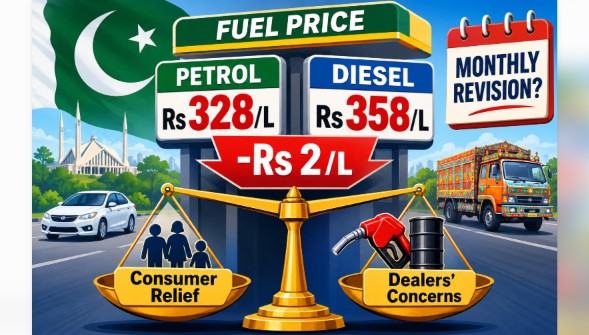
Petrol drops to Rs328 and high-speed diesel to Rs358, offering limited relief to motorists and transporters; dealers cite inventory losses from frequent price changes but face questions over potential gains when fuel prices rise.
Hamid Khan Wazir
ISLAMABAD: The federal government on Monday reduced the prices of petrol and high-speed diesel (HSD) by Rs 2 per litre, bringing petrol down to Rs328 and diesel to Rs358, offering modest relief to motorists, transporters, farmers and businesses amid persistent high fuel and operating costs.
The reduction came as the All Pakistan Petrol Pump Owners Association called for replacing the existing frequent petroleum price revision mechanism with monthly adjustments, arguing that repeated price changes were creating serious financial and operational difficulties for fuel dealers across the country.
According to a press release issued by the Oil and Gas Regulatory Authority (OGRA), the revised prices took effect on November 17 under the government's petroleum pricing mechanism. Under the new rates, petrol will be available at Rs328 per litre against its previous price of Rs330, while high-speed diesel will cost Rs358 per litre compared with Rs360 previously.
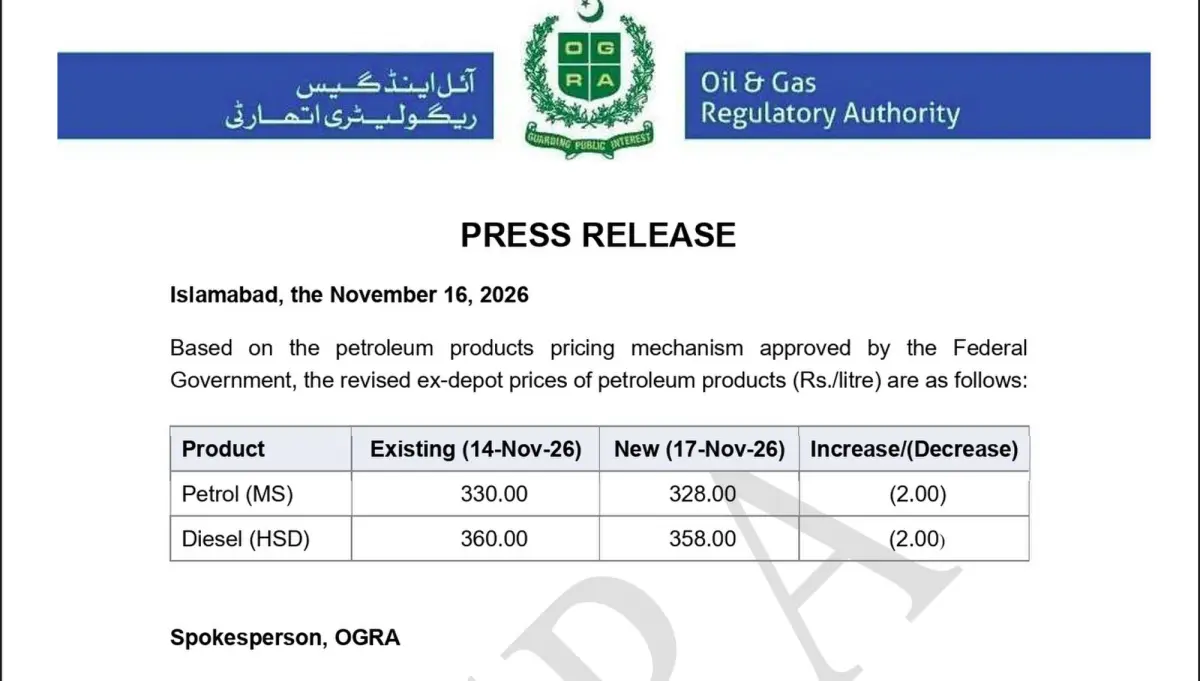
The reduction is expected to provide some relief to daily commuters, public transport operators, farmers and businesses that rely heavily on petroleum products. However, the impact on consumers is likely to remain limited, as any meaningful reduction in transportation fares and commodity prices will depend on whether transport operators and businesses pass on the benefit of lower fuel costs to the public.
Petrol Pump Owners Seek Monthly Price Revisions
Separately, All Pakistan Petrol Pump Owners Association Vice Chairman Nouman Ali Butt has written to Prime Minister Shehbaz Sharif, requesting that petroleum product prices be revised monthly instead of being changed frequently.
In his communication, Butt described the existing pricing mechanism as a serious business difficulty affecting petrol pump operators across the country, particularly small and medium-sized dealers who must manage fuel inventories, working capital and daily operating expenses. He argued that when dealers purchase fuel at higher prices and rates subsequently decline, they are forced to sell their existing stocks at lower prices, potentially suffering inventory losses that they cannot recover.
According to him, frequent price changes also make it difficult for dealers to plan purchases, manage cash flows and maintain smooth business operations, while creating confusion among customers. The association maintained that a monthly revision mechanism would provide greater stability and predictability, protect dealers against avoidable inventory losses and still allow petroleum prices to reflect movements in international markets.
Question of Fairness: What Happens When Fuel Prices Rise?
However, the dealers' argument also raises an important question about how the proposed monthly pricing mechanism would address situations in which international petroleum prices increase.
If petrol pump owners purchase fuel at lower rates and retail prices subsequently rise, they could potentially benefit from selling their existing lower-cost inventory at the newly revised higher prices, depending on the applicable pricing and inventory arrangements.
While dealers have highlighted losses when prices decline after purchasing expensive stocks, their demand does not adequately explain how potential gains from lower-cost inventory would be treated when prices move in the opposite direction.
A fair and transparent pricing mechanism would therefore need to address both situations: protecting petrol pump operators from genuine inventory losses while ensuring that consumers receive the benefit of falling international oil prices and are not subjected to unjustified increases. The association also pointed out that its members operate small and medium-sized businesses, provide an essential service and employ a significant number of people.
It warned that continued uncertainty could make it increasingly difficult for some operators to sustain their businesses. The association believes that monthly revisions would provide much-needed stability, improve business planning and protect dealers from frequent price fluctuations.
Despite the successive reductions, petroleum products continue to carry substantial government taxes and duties. The government is collecting Rs114 per litre in taxes and duties on petrol and Rs100 per litre on high-speed diesel, reflecting the significant tax burden embedded in retail fuel prices.
Fuel Relief Scheme Continues for Small Vehicle Owners
Meanwhile, the government had launched the Prime Minister's Fuel Relief Scheme nationwide on September 17 to ease the financial burden on lower-income segments following rising petroleum prices amid the evolving Middle East situation. The subsidy programme covers owners of motorcycles, rickshaws and vehicles with engine capacities of up to 800cc, targeting segments considered particularly vulnerable to increases in transportation and fuel expenses.
The initiative is aimed at providing targeted assistance to individuals who depend heavily on motorcycles and small vehicles for daily commuting and livelihoods. For Pakistani consumers, the latest consecutive reduction offers some respite, although the substantial tax component in domestic fuel prices and uncertainty surrounding international oil markets remain key factors shaping future petroleum price adjustments.
Government Introduces Daily Fuel Price Review
In a significant change to the petroleum pricing system, the government has shifted towards daily fuel price reviews in response to unpredictable movements in international oil prices.
OGRA has also started publishing daily petroleum price information on its official website to improve transparency and enable consumers to track changes in fuel costs. Previously, petroleum prices were generally revised on a fortnightly basis. Following the outbreak of the US-Iran conflict on February 28, the government initially moved to weekly adjustments before introducing the latest daily review mechanism amid continuing uncertainty in global energy markets. The revised approach is intended to ensure that changes in international oil prices are reflected more promptly in domestic petroleum rates.
Government Maintains Heavy Petroleum Taxes
Despite the latest reduction, petroleum products continue to carry substantial taxes and duties, adding to the financial burden on consumers. The government is currently collecting approximately Rs114 per litre in taxes and duties on petrol and Rs100 per litre on high-speed diesel.
Meanwhile, under an arrangement announced on November 2 for a period of 30 days, oil refineries will contribute towards the petroleum levy by absorbing a cumulative financial impact of Rs15 billion. According to the government, this arrangement has enabled a reduction of Rs14.71 per litre in the consumer price of petrol through adjustments involving refinery pricing and petroleum levy calculations.
Revised Pricing Formula to Pass on International Oil Changes
The federal cabinet approved changes to the petroleum pricing mechanism on October 30 to address volatility in international markets following the US-Iran conflict.
Under the revised formula, the import price of petrol is determined using the actual import cost of the relevant Pakistan State Oil (PSO) cargo. Where the actual cost of a cargo is unavailable for daily price calculations, the premium, incidental expenses and customs duty applicable to the last available cargo are used instead.
For domestic refineries, the government has temporarily maintained the premium, incidental expenses and customs duty used in calculating ex-refinery petrol prices at their March 7, 2026, pre-war levels for 30 days. The difference between the import price and the resulting ex-refinery price is to be surrendered by refineries under the petroleum levy account, with the financial benefit passed on to consumers through corresponding reductions in petrol prices.
The government has also introduced a temporary adjustment mechanism to smooth fluctuations in petrol prices by incorporating the benefit arising from the premium differential at a rate of $2.950 per barrel per day.
Fuel Prices Fall From April's Record Highs
The latest reduction comes after petrol and diesel prices witnessed unprecedented increases following the outbreak of hostilities involving the United States, Israel and Iran on February 28. High-speed diesel had surged to a record Rs520.35 per litre on April 3 after rising from approximately Rs281 per litre before the conflict.
Petrol prices also reached an all-time high of Rs458.41 per litre on April 3, having climbed from around Rs266 during the first week of March. Although subsequent reductions have brought prices down considerably from their April peaks, fuel remains an expensive commodity for households and businesses.
Middle East Tensions Keep Global Oil Markets Under Pressure
International oil markets remain sensitive to developments in the Middle East, particularly uncertainty surrounding Iran, Washington and the security of regional energy supplies.
The conflict that began on February 28 disrupted energy shipments after Tehran moved to close the Strait of Hormuz, a critical global shipping route that previously handled approximately one-fifth of the world's energy supplies. Tensions have intensified following the collapse of a fragile ceasefire between Tehran and Washington in June, raising concerns about renewed military confrontation and further disruptions to international oil shipments.
Fuel Costs Remain Critical for Households and Businesses
Petrol and high-speed diesel are among Pakistan's most important petroleum products, and their prices have a direct impact on transportation costs, inflation and the overall cost of living. Petrol is predominantly consumed by private vehicles, motorcycles, small cars and rickshaws, making price changes particularly significant for middle- and lower-middle-income households.
Diesel, meanwhile, plays a central role in the country's transport and logistics networks, agricultural machinery, power generation and large industrial generators. Any substantial change in its price can affect freight charges, food transportation and the cost of essential commodities. Petrol and high-speed diesel are also the country's major petroleum revenue-generating products, with monthly sales estimated at 700,000 to 800,000 tonnes each, compared with approximately 10,000 tonnes of monthly kerosene demand.
Fuel Relief Scheme for Motorcyclists and Small Vehicles
Separately, the government launched the Prime Minister's Fuel Relief Scheme nationwide on September 17 to reduce the impact of rising petroleum costs on financially vulnerable segments of society. The scheme covers owners of motorcycles, rickshaws and vehicles with engine capacities of up to 800cc.
The latest petroleum price reduction, alongside the revised pricing mechanism and targeted relief measures, forms part of the government's efforts to manage the economic consequences of international energy market volatility.


More from Business News



Comments
No comments yet. Be the first to comment!
Leave a Comment