

Governor Balochistan stresses political dialogue, youth engagement for lasting national stability
Monday, 02 November 2026
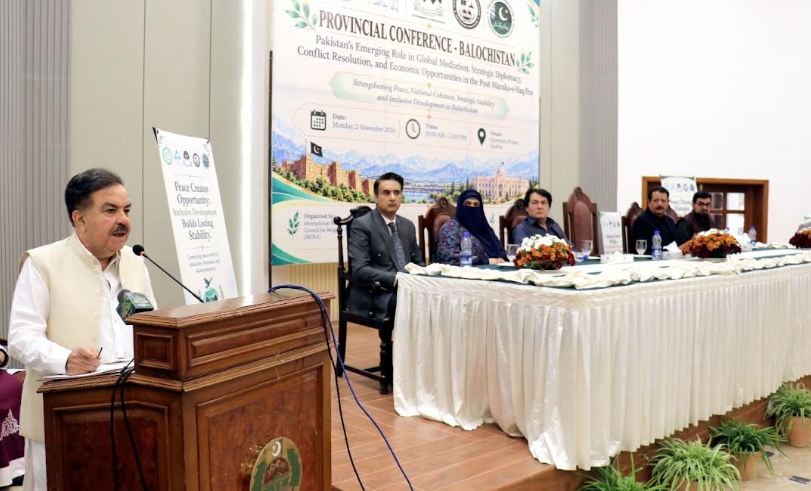
Calls for public trust, political consensus and inclusive development, says constructive youth participation is vital to strengthening social cohesion and countering internal challenges
Staff Report
QUETTA: Governor Jaffar Khan Mandokhail has called for inclusive political dialogue, stronger public trust and greater youth engagement in constructive activities, saying political harmony, national unity and public participation are essential to ensuring lasting internal stability and national cohesion.
Addressing a national conference at the Governor House here on Monday, the governor said Pakistan’s achievements in defence and diplomacy had enhanced its international standing, and similar efforts were now needed to strengthen domestic stability through inclusive political processes and public participation.
The conference, titled “Pakistan’s Emerging Role in Global Mediation, Strategic Diplomacy, Conflict Resolution and Economic Opportunities in the Post-Marka-e-Haq Era,” was organised by the International Research Council for Religious Affairs with financial support from the Pakistan Poverty Alleviation Fund (PPAF) and in collaboration with the Centre of Excellence on Countering Violent Extremism (CoE-CVE) Balochistan.
Jaffar Mandokhail said Pakistan had successfully overcome major challenges posed by terrorism and sectarian violence and expressed confidence that the country would similarly address current challenges through political harmony, national unity and collective efforts. He cautioned that adversaries could exploit internal weaknesses at any time, underscoring the importance of maintaining social cohesion and political consensus.
The governor lauded PPAF for organising the conference and highlighted the significance of dialogue, mutual understanding and peaceful engagement in conflict resolution and social harmony. He emphasised the central role of youth in Balochistan’s socio-economic development, saying expanded educational, professional and economic opportunities at national and international levels were essential to empowering the younger generation.
Reaffirming the provincial government’s commitment to community development and youth empowerment, he said efforts would continue to ensure young people had access to resources and opportunities.
Jaffar Mandokhail also paid tribute to the armed forces for their services during Marka-e-Haq and reiterated Pakistan’s growing role in diplomacy, peacebuilding and economic cooperation. Participants at the conference included government representatives, policymakers, academics, religious scholars and leaders from the development sector, who discussed Pakistan’s evolving role in global diplomacy, peacebuilding, conflict resolution and regional economic cooperation.
PPAF Chief Executive Officer Nadir Gul Barech emphasised the importance of inclusive development, strategic partnerships and people-to-people engagement in promoting sustainable peace and socio-economic stability.
He said reducing poverty, creating livelihood opportunities and investing in marginalised communities were essential for long-term stability and inclusive growth. He also called for stronger collaboration among government institutions, development partners and civil society organisations.
Additional Chief Secretary for Home and Tribal Affairs Hamza Shafqaat briefed participants on government initiatives and legislation aimed at promoting peace and social harmony. He underscored the importance of effective laws, institutional coordination and public participation in creating a peaceful and inclusive environment across the province.
President of the International Research Council for Religious Affairs Muhammad Israr Madani highlighted the role of interfaith engagement, dialogue and intellectual discourse in promoting tolerance, mutual understanding and peaceful coexistence. He said constructive engagement would further strengthen Pakistan’s contribution to conflict resolution and global peace efforts.
Among other speakers, Associate Professor of Political Science at the University of Peshawar Dr Aamir Raza discussed Pakistan’s evolving geopolitical and diplomatic role and the importance of regional cooperation. Chief Coordination Officer of CoE-CVE Dost Muhammad Barech stressed the need for public engagement and interfaith harmony to counter violent extremism.
Chief Executive Officer of the Balochistan Rural Support Programme Dr Tahir Rashid highlighted grassroots development and community mobilisation as foundations for socio-economic stability, while CPD Chief Executive Officer Dr Nasrullah Barech spoke about community participation and sustainable development.
Religious leaders and representatives of different faiths, including Sikh leader Sardar Jasbir Singh and Father Bashir Simon of Quetta’s Methodist Church, also addressed the gathering. They emphasised interfaith harmony, tolerance, mutual respect and peaceful coexistence as essential components of a stable and progressive society.
The conference concluded with a consensus that dialogue, institutional partnerships, interfaith harmony and inclusive development remain the key pillars for achieving sustainable peace, social cohesion and economic progress in Balochistan and across Pakistan.

More from Pakistan News

Comments
No comments yet. Be the first to comment!
Leave a Comment