

Petrol Price Slashed By Rs 5.45, Diesel By Rs 3.68 Per Litre
Tuesday, 03 November 2026
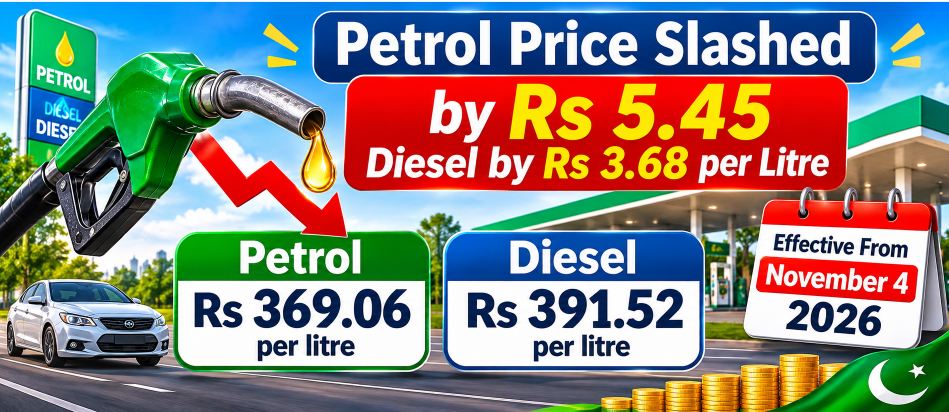
New rates of Rs 369.06 for petrol and Rs 391.52 for high-speed diesel to take effect from November 4 amid fluctuations in international oil markets
Hamid Khan Wazir
ISLAMABAD: The federal government on Tuesday announced a reduction of Rs 5.45 per litre in the price of petrol and Rs3.68 per litre in high-speed diesel (HSD), providing some relief to inflation-ridden and poverty-stricken masses amid persistent fluctuations in international oil prices.
Under the revised petroleum prices, petrol will now be available at Rs369.06 per litre, down from Rs374.51, while the price of high-speed diesel has been reduced to Rs391.52 per litre from Rs395.20. The new prices will come into effect from November 4, 2026.
According to a press release issued by the Oil and Gas Regulatory Authority (OGRA), the revised ex-depot prices were determined under the petroleum pricing mechanism adopted by the federal government.
The latest reduction comes after another downward adjustment in petroleum prices announced on Monday, when the government had reduced the price of high-speed diesel by Rs7.76 per litre to Rs395.20 and petrol by Rs3.40 per litre to Rs374.51.
The successive reductions reflect adjustments in domestic petroleum prices in response to developments in the international oil market and the government's periodic review of petroleum product rates.
Petrol is one of the most widely used fuels in the country, particularly for motorcycles, cars and other private transport vehicles. Its price directly affects household transportation expenses and contributes to the overall cost of living.
The reduction is expected to provide some relief to motorists and commuters, particularly those who rely on private vehicles for daily travel. However, its broader impact on inflation and transportation costs will depend on whether the lower fuel prices translate into reduced fares and transportation charges.
High-speed diesel, meanwhile, is a key fuel for the country's transport, agriculture and industrial sectors. It is extensively used by heavy transport vehicles, buses, trucks, agricultural machinery and generators.
Consequently, changes in diesel prices have a wider impact on the cost of transporting goods and agricultural produce. A reduction in its price could help ease operational expenses for transporters, farmers and businesses, although the extent of any relief will depend on market conditions and the response of service providers.
International oil market
The latest revision in domestic petroleum prices comes as international oil markets remain volatile amid geopolitical developments and concerns over possible disruptions to global energy supplies.
Global oil prices fell by around two per cent on Tuesday, touching a three-week low, as investors assessed diplomatic efforts to end the wars in Ukraine and Iran against concerns about further supply disruptions following recent attacks linked to both conflicts.
Market participants remained cautious as developments on the diplomatic front continued to influence expectations about future oil supplies and demand. The possibility of progress in efforts to end the conflicts raised hopes of easing geopolitical risks and improving the outlook for global energy supplies. However, concerns over attacks on energy-related infrastructure and potential disruptions to supply routes continued to weigh on market sentiment.
The international market's movements are particularly important for oil-importing countries such as Pakistan, where changes in global petroleum prices can influence the cost of imported fuel and domestic pricing decisions.
Pakistan's petroleum prices are periodically reviewed under the government-approved mechanism, with OGRA assessing relevant market factors and recommending adjustments for government consideration.
The latest reduction is expected to offer consumers some breathing space, although petroleum prices remain a major component of household expenditure and the country's overall inflationary pressures.
US midterm elections add to market uncertainty
Meanwhile, global financial and commodity markets were also closely monitoring the US midterm elections, with voters set to deliver their verdict on the first two years of President Donald Trump's second term.
Opinion polls and nonpartisan analysts indicated that Democrats were favoured to regain control of the House of Representatives from Republicans, while the contest for control of the Senate remained uncertain.
The election outcome was being closely watched by investors for its potential implications for US domestic policies, international relations and the broader economic outlook. Developments in the United States, alongside geopolitical tensions in Europe and the Middle East, have contributed to uncertainty across international financial and energy markets.
For Pakistan, sustained stability or a further decline in global oil prices could help reduce the country's petroleum import bill and ease pressure on foreign exchange reserves. Conversely, renewed geopolitical tensions or disruptions to supplies could push international prices higher, potentially reversing the relief offered through the latest domestic price reduction.



More from Business News





Comments
No comments yet. Be the first to comment!
Leave a Comment