

Global Youth Unemployment Rises as 67m Remain Jobless, ILO Warns of Growing Barriers to Decent Work
Tuesday, 10 November 2026
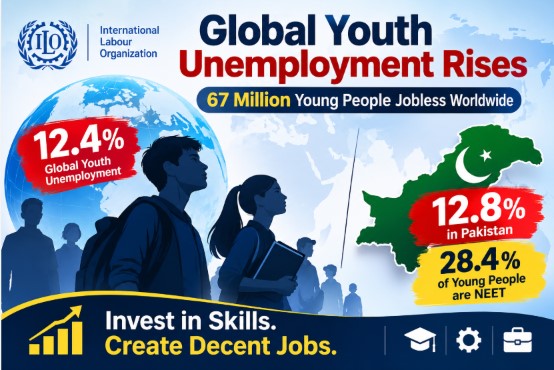
ILO report puts global youth unemployment at 12.4pc, while Pakistan’s national labour survey records a 12.8pc rate and 28.4pc of young people outside employment, education or training
Hamid Khan Wazir
GENEVA/ISLAMABAD: The global youth employment crisis is deepening as economic uncertainty, sluggish job creation and rapid technological change make it increasingly difficult for young people to secure decent and stable work, with Pakistan facing a particularly pressing challenge as millions remain unemployed or disconnected from education and the labour market.
According to the International Labour Organization’s (ILO) Global Employment Trends for Youth 2026: Back to the Future report, released on August 11, global youth unemployment reached 12.4 per cent in 2025, representing approximately 67 million unemployed people aged 15 to 24. Meanwhile, around 20 per cent of young people---more than 257 million worldwide---were not in employment, education or training (NEET).
ILO Highlights Growing Global Youth Employment Crisis
The report warns that slowing economic growth, weak job creation, geopolitical tensions and technological disruption are worsening employment prospects for young people.
Unlike in previous editions of the GET for Youth, where the trends on the main labour market indicators varied widely across subregions, the worsening results on job entry for young people have been almost universal over the past couple of years. The youth unemployment rate rose between 2023 and 2025 in 8 of the 11 subregions, as well as in high-income, lower-middle-income and low-income countries.
The largest increases were in Northern Africa, Northern America and Northern, Southern and Western Europe. In Central and Western Asia and Eastern Europe, and in upper-middle-income countries, the “good news” of declining youth unemployment rate was muted by the rise in youth in NEET status.
And while Latin America and the Caribbean stood out as the only region to show a decline in both the youth unemployment rate and youth NEET rate, further analysis showed that results were driven in part by declining youth population sizes and that most countries in the subregion showed worsening trends in youth labour market engagement.
Pakistan's youth employment challenge
While the ILO's global report highlights the worldwide employment crisis, Pakistan's own labour market figures underline the scale of the challenge facing the country's young population.
According to the Pakistan Labour Force Survey 2024-25, the country has an estimated 46.3 million people aged between 15 and 24. Of these, approximately 20.6 million participate in the labour force, while 2.6 million are unemployed.
Pakistan's youth unemployment rate stands at 12.8 per cent, nearly twice the overall national unemployment rate of 7.1 per cent. More concerningly, 28.4 per cent of young people remain outside employment, education or training, meaning more than one in four are disconnected from the opportunities needed to develop skills, secure jobs and contribute to the economy.
Although the Not in Education, Employment, or Training (NEET) proportion has declined from 32.5 per cent in 2020-21, the current figure demonstrates that substantial barriers continue to prevent young Pakistanis from entering education, training and productive employment.
The challenge extends beyond unemployment alone. Limited access to quality education, skills mismatches, insufficient decent job opportunities and the prevalence of informal employment leave many young people struggling to find secure livelihoods and long-term career prospects.
Skills development emerges as a priority in Pakistan
Against this backdrop, the International Labour Organization (ILO), the Punjab Skills Development Fund (PSDF) and the British Council convened a high-level roundtable titled "Skills for a Shared Future" in July 2026, bringing together stakeholders to discuss how Pakistan's skills development system can better prepare young people for emerging employment opportunities.
Held in connection with World Youth Skills Day, the discussion emphasized the need to strengthen the relationship between skills development and actual labour market demand, particularly as digitalization, artificial intelligence (AI), climate change and demographic shifts reshape the future of work.
Participants stressed that Pakistan must move beyond conventional training approaches and equip young people with practical, market-relevant skills that respond to the changing needs of employers and emerging industries.
The discussion also highlighted the importance of creating stronger pathways between education, vocational training and employment so that young people can translate their qualifications into meaningful economic opportunities.
Artificial intelligence creates new opportunities and risks
The growing influence of artificial intelligence (AI) and technological transformation is another major concern highlighted by the report.
According to the ILO, approximately 6.1 per cent of jobs held by young people aged 15 to 29 are in occupations highly exposed to AI-related changes.
Many of these positions overlap with middle-skilled occupations already experiencing declining employment opportunities, particularly administrative and clerical roles.
However, the report also identifies expanding demand for skilled professionals in science, healthcare, engineering and other knowledge-based technical fields.
It stresses that governments must invest in education, vocational training and lifelong learning to ensure young people can adapt to changing workplace requirements.
The ILO cautions against underestimating the risks associated with AI and calls for a human-centred approach to technological development so that innovation creates employment opportunities rather than deepening existing inequalities.
A growing need for urgent policy action
The ILO has called on governments to invest in quality education, lifelong learning, apprenticeships and stronger employment services while expanding social protection and safeguarding workers' rights.
It has also stressed the need for human-centred AI governance to ensure technological innovation creates employment opportunities rather than deepening existing inequalities.
ILO Director-General Gilbert F. Houngbo warned that young people who cannot access decent employment are being deprived of the opportunity to build secure futures, while countries risk losing valuable talent, productivity and social cohesion.
For Pakistan, the findings reinforce the urgency of addressing the gap between its large young population and the employment opportunities available to them. With 46.3 million people aged 15 to 24, the country has significant demographic potential, but turning that potential into economic strength will require coordinated investment in education, technical training, private-sector job creation and labour market reforms.
The July roundtable's emphasis on aligning skills with market demand reflects an important part of this response. However, the scale of the challenge requires sustained implementation and broader efforts to ensure that training leads to actual employment.
Ultimately, the challenge for Pakistan is not simply to reduce unemployment figures but to ensure that young people can access decent, secure and productive work in an economy increasingly shaped by technological and structural change.



More from World News



Comments
No comments yet. Be the first to comment!
Leave a Comment