

Trump Fumbled the Name, Michigan Delivered the Verdict
Sunday, 08 November 2026
Asem Mustafa Awan
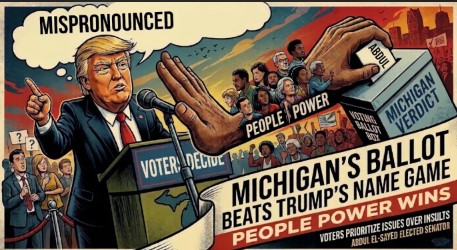
Donald Trump went into the US midterm campaign with familiar promises about making America great again. In Michigan, however, he appeared preoccupied with a more pressing matter: what to call Abdul El-Sayed, the Democratic Senate candidate.
Trump repeatedly called him “Mohammed” instead of Abdul, labelled him a “radical jihadist” and defended the performance with a remarkable declaration. “I’m the president. I can call him whatever the hell I want.”
Apparently, the presidency now comes with authority over other people's names. Unfortunately for Trump, it does not include the power to choose their elected representatives.
El-Sayed replied that Trump knew his name perfectly well. “He knows my name is Abdul. He says it every day.” Vice President JD Vance joined the attacks, describing the candidate as “a very, very evil” person. The campaign increasingly focused on his Muslim identity rather than the problems troubling Michigan households.
Voters had more practical concerns. Grocery bills, fuel prices, healthcare costs and the war with Iran were difficult to ignore, even when political rallies offered a convenient distraction.
On November 3, Michigan elected El-Sayed, making him the first Muslim to enter the US Senate. His response was sharper than any campaign advertisement. Addressing Vance, he said, “JD, habibi,” before joking that the vice-president would have to swear him in. He then turned to Trump. “I know you struggled with my name. So after JD swears me in in January, you can just go on and call me Senator.”
That was a rather expensive lesson in pronunciation.
The Republican setback extended beyond Michigan. Vance offered an unusually blunt explanation, writing, “The reason we lost is the war.” He acknowledged that voters wanted the Iran conflict ended and expected the administration to address inflation and the cost of living. Trump conceded that the war was “a piece” of the defeat, although he insisted he would make the same decision again.
The contradiction was revealing. One leader recognised the political cost; the other remained determined to defend it.
The lesson is simple. A president can mispronounce a name, question someone's faith and attack a political opponent. But he cannot make rising prices disappear through insults. Michigan voters answered the name game with a ballot. Trump wanted to decide what Abdul El-Sayed should be called. The voters decided what he would become.



More from Opinion News


Comments
No comments yet. Be the first to comment!
Leave a Comment